How to Care for Dracaena fragrans in Winter? A Detailed Guide to Growing and Care Methods
Growing and care methods for Dracaena fragrans in winter. Dracaena fragrans, also known as the Brazilian iron tree or fragrant dracaena, is an evergreen indoor foliage plant. Common varieties include the golden-edged Dracaena fragrans and the golden-hearted Dracaena fragrans.
There are roughly two situations for overwintering Dracaena fragrans indoors. One is when the temperature is suitable and the light is sufficient, and the Dracaena fragrans is in a normal growth state. At this time, because of vigorous growth and high water consumption, water shortage is likely to occur, so attention should be paid to timely watering, generally once every 2 to 3 days. The second is when the temperature is low and the light is weak, and the Dracaena fragrans is in a slow-growth state. At this time, water consumption is low, and waterlogging is likely to occur, so watering should be appropriately reduced. On the one hand, this can improve the cold resistance of the Dracaena fragrans, and on the other hand, it can also enhance soil permeability and ensure normal root respiration.
Improper care in winter often leads to the following problems:
Leaves wilting and drooping, dull and listless leaf surfaces, and no improvement after watering. These problems are mostly caused by root rot due to too much or too little watering, and at this time the rotten roots should be removed. If the bottom wooden stump is rotten, it can be sawed off, soaked in 2‰ potassium permanganate water for 10 to 30 minutes, and buried in a substrate soil mixed with sand or ash residue that drains well. If the center of the leaf bud turns black and gradually rots outward, this is due to too low a temperature and is mostly caused by frost damage. If the bark of the wooden stump is not rotten, it can still be moved to a high-temperature place to force new buds and remove the old buds for renewal. Leaf edge scorch or dry tips are sometimes caused by dry air, which can be improved by frequently spraying water on the leaves; sometimes they are caused by a low temperature that puts the plant in a slow dormant state. The most suitable temperature should be 20 to 25°C (growth slows below 13°C, and frost damage occurs below 5°C). The yellow stripes on the leaves becoming lighter and fading is caused by indoor light being too dim, and it can recover with a little proper sunlight. The above is an introduction to growing and care methods for Dracaena fragrans in winter.
Growing and Care Methods for Dracaena fragrans
Dracaena fragrans itself comes from Africa, and it is now relatively common in southern China and Southeast Asian countries. Dracaena fragrans has strong vitality and is suitable as a large potted plant placed in a hall or study, adding to the layout style of the entire room. Below let us learn about growing and care methods for Dracaena fragrans.
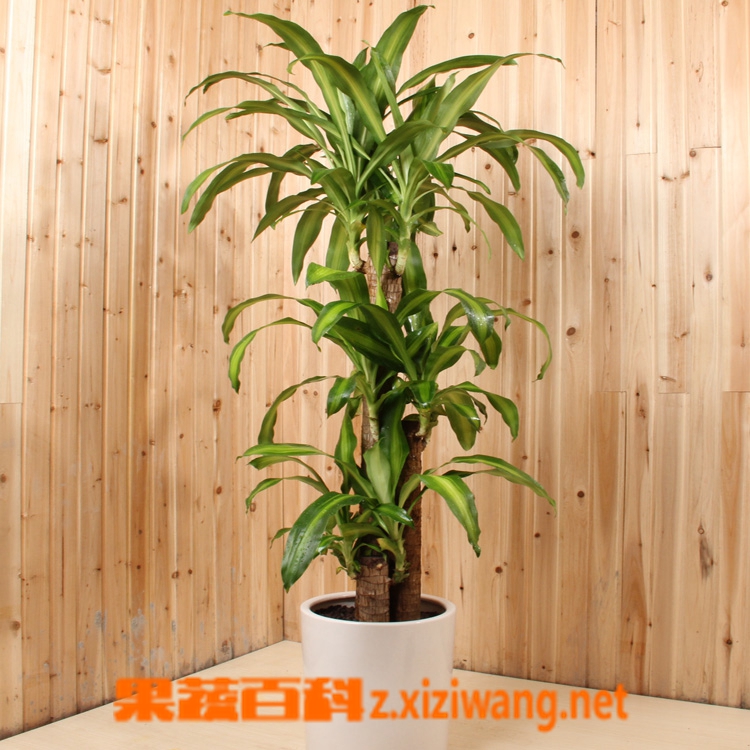
1. Soil: Dracaena fragrans is suitable for loose, well-drained, fertile river sand loam rich in humus, and alkaline soil should be avoided. For potting soil, it is best to use leaf mold or peat soil, adding about 1/4 river sand or perlite and a small amount of decomposed organic fertilizer. Loose soil, good drainage, and rich organic matter are beneficial to its growth.
2. Sunlight: Dracaena fragrans has a wide range of adaptability to light, but it is not tolerant of strong light. Especially from May to October, strong light will cause leaves to turn yellow or leaf tips to scorch, so attention should be paid to shading, and relatively bright scattered light is sufficient. Although it is shade-tolerant, too much shade will also make the leaf color dull. This is especially true for variegated varieties, where the patterns on the leaf surface easily disappear, reducing ornamental value.
3. Temperature: The suitable growth temperature for Dracaena fragrans is 20°C to 28°C, the dormancy temperature is 13°C, and the overwintering temperature is 5°C. If the temperature is too low, yellow-brown spots will appear on leaf tips and leaf edges, and in severe cases the tender branches or the whole plant will be damaged by frost. Therefore, in the north in winter it should be moved into a greenhouse for care. For indoor placement, it should be placed in a spot with light, and the room temperature should preferably be kept above 6°C to 8°C.
4. Watering: During the growing season in spring, summer, and autumn in the north, water Dracaena fragrans once every 2 to 3 days on sunny days, and spray water on the leaves 1 to 2 times a day. After late autumn, the amount of watering should be controlled, and it is enough to keep the potting soil slightly moist. In winter, watering should be controlled, and the potting soil should be kept half dry and half moist. Too much water will cause root rot and scorched leaves.
5. Fertilizing: During the growth process, Dracaena fragrans consumes some of its own nutrients. If fertilizer is not applied in time at this time, it will cause insufficient stamina and gradually degenerate. During the growing season, first bury organic fertilizer at the base or edges, then apply liquid fertilizer once every 15 to 20 days, or compound fertilizer 1 to 2 times, to ensure vigorous growth of branches and leaves. Fertilizer should be applied thinly, and concentrated fertilizer must be avoided. The fertilization period is from May to October each year. Stop fertilizing in winter and move it indoors to overwinter. For variegated varieties, when fertilizing, attention should be paid to reducing the proportion of nitrogen fertilizer, so as to avoid excessive leaf growth and cause the patterns to become dull or even disappear.
6. Pests and diseases: Common diseases of Dracaena fragrans include leaf spot and anthracnose, which can be sprayed with a 1000-fold solution of 70% thiophanate-methyl wettable powder. Common pests include scale insects and aphids, which can be killed by spraying with a 1000-fold solution of 40% omethoate emulsifiable concentrate. The third point of growing methods for Dracaena fragrans is that attention should be paid to soil and fertilizer. Dracaena fragrans is suitable for growing in loose, fertile river sand loam. In addition, Dracaena fragrans also needs to be repotted and have its soil changed once a year to keep nutrients in the soil sufficient. Fertilizing is generally done during the growing season by first applying organic fertilizer at the base or edges, then applying liquid fertilizer once every 15 to 20 days, to ensure vigorous growth of branches and leaves.
How to Grow Dracaena fragrans: An Introduction to Growing Methods for Dracaena fragrans
How to Grow Dracaena fragrans Correctly?
Growing methods for Dracaena fragrans 1. Soil: Dracaena fragrans is suitable for loose, well-drained, fertile river sand loam rich in humus, and alkaline soil should be avoided. For potting soil, it is best to use leaf mold or peat soil, adding about 1/4 river sand or perlite and a small amount of decomposed organic fertilizer. Loose soil, good drainage, and rich organic matter are beneficial to its growth.
Growing methods for Dracaena fragrans 2. Sunlight: Dracaena fragrans has a wide range of adaptability to light, but it is not tolerant of strong light. Especially from May to October, strong light will cause leaves to turn yellow or leaf tips to scorch, so attention should be paid to shading, and relatively bright scattered light is sufficient. Although it is shade-tolerant, too much shade will also make the leaf color dull. This is especially true for variegated varieties, where the patterns on the leaf surface easily disappear, reducing ornamental value.
Growing methods for Dracaena fragrans 3. Temperature: The suitable growth temperature for Dracaena fragrans is 20°C to 28°C, the dormancy temperature is 13°C, and the overwintering temperature is 5°C. If the temperature is too low, yellow-brown spots will appear on leaf tips and leaf edges, and in severe cases the tender branches or the whole plant will be damaged by frost. Therefore, in the north in winter it should be moved into a greenhouse for care. For indoor placement, it should be placed in a spot with light, and the room temperature should preferably be kept above 6°C to 8°C.
Growing methods for Dracaena fragrans 4. Watering: During the growing season in spring, summer, and autumn in the north, water Dracaena fragrans once every 2 to 3 days on sunny days, and spray water on the leaves 1 to 2 times a day. After late autumn, the amount of watering should be controlled, and it is enough to keep the potting soil slightly moist. In winter, watering should be controlled, and the potting soil should be kept half dry and half moist. Too much water will cause root rot and scorched leaves.
Growing methods for Dracaena fragrans 5. Fertilizing: During the growth process, Dracaena fragrans consumes some of its own nutrients. If fertilizer is not applied in time at this time, it will cause insufficient stamina and gradually degenerate. During the growing season, first bury organic fertilizer at the base or edges, then apply liquid fertilizer once every 15 to 20 days, or compound fertilizer 1 to 2 times, to ensure vigorous growth of branches and leaves. Fertilizer should be applied thinly, and concentrated fertilizer must be avoided. The fertilization period is from May to October each year. Stop fertilizing in winter and move it indoors to overwinter. For variegated varieties, when fertilizing, attention should be paid to reducing the proportion of nitrogen fertilizer, so as to avoid excessive leaf growth and cause the patterns to become dull or even disappear.
Growing methods for Dracaena fragrans 6. Pest and disease control: Common diseases of Dracaena fragrans include leaf spot and anthracnose, which can be sprayed with a 1000-fold solution of 70% thiophanate-methyl wettable powder. Common pests include scale insects and aphids, which can be killed by spraying with a 1000-fold solution of 40% omethoate emulsifiable concentrate.