How to Grow Paphiopedilum (Slipper Orchids)? A Detailed Guide to Everyday Care
How to grow Paphiopedilum: Paphiopedilum is native to the tropical regions of Asia, with unusual flower shapes and long-lasting blooms. It is usually divided into two types according to growth form: one type originates in cool, high-mountain regions, with completely green leaves, large and brightly colored flowers, a preference for cool low temperatures, summer dormancy, and difficulty being grown on flat lowland; the other type has patterned leaves, prefers warm, shady and humid conditions, blooms in summer and autumn, and can be grown on flat lowland. Therefore, when cultivating Paphiopedilum, the first step is to choose a suitable species or variety according to your specific conditions.
Although Paphiopedilum is a terrestrial orchid, its roots are covered with hairy fibers and differ in structure from other terrestrial orchids. The growing medium should be an organic mixture, such as sphagnum moss, fine tree-fern fiber, wood shavings, leaf mold, humus soil, peat soil, etc. A mix of fine tree-fern fiber : peat soil : humus soil : crushed stone or brick in a 6:2:1:1 ratio is better. When potting, first place 1/5 crushed stone or brick at the bottom of the pot; after planting, press the medium down slightly so the roots and medium are fully in close contact. When the weather turns cool in autumn or after the flowers fade is the suitable time for repotting.
The suitable growing temperature for green-leaf varieties of Paphiopedilum is 12-18°C; for mottled-leaf varieties it is 15-25°C, but they can still survive above 30°C, with growth nearly at a standstill. The only exception is that from March to June each year the temperature must not exceed 22°C, otherwise flowering will be affected. Paphiopedilum's light requirements are 60%-70% shading in summer and 40%-50% shading in spring and autumn; it must never be exposed directly to harsh sunlight.
As for humidity requirements, it differs from other orchids: air humidity of only 40%-60% is enough, but the medium in the pot should instead be kept slightly moist, and water should be added promptly when it dries out. When the winter temperature is below 10°C, watering should be stopped to prevent cold damage. For fertilizer, a small amount of slow-release fertilizer can be placed in the medium in the pot, or decomposed bean-cake fertilizer, bone meal, etc. can be used, applied at least once a month. Normally, use a 1,500-2,000 times diluted water-soluble quick-acting fertilizer and spray-water once every 20-30 days. Orchid plants that have not yet flowered should use a fertilizer with a balanced three elements of nitrogen, phosphorus and potassium, while individuals nearing flowering should be given more phosphorus and potassium fertilizer to promote more and brighter flowers. The above is an introduction to how to grow Paphiopedilum.
How to Grow Paphiopedilum: Cultivation Methods for Paphiopedilum
Nowadays, many people love Paphiopedilum, but currently its cultivation is not widespread, mainly because many orchid enthusiasts have not grasped its growth habits, leading to repeated setbacks in cultivation. Paphiopedilum is divided by form into two major categories: green-leaf species and mottled-leaf species. Green-leaf species have completely green leaves, large flowers and bright colors, originate in cool, high-mountain regions, and are not easy to grow on flat lowland, while mottled-leaf species prefer sunlight and warmth and can be grown on flat lowland to flower normally. Below is a specific introduction to how to grow Paphiopedilum.
I. Introduction to Paphiopedilum
Paphiopedilum, also known as slipper orchid, is one of the earliest cultivated and most popular orchids in the world. Most species of Paphiopedilum are terrestrial orchids, with small plants and large, unusual flowers, making them most suitable for pot cultivation. Paphiopedilum is a perennial herbaceous plant growing under tropical and subtropical forests, living on humus soil, with a few species being epiphytic. The genus contains about 65 species, mainly distributed across southwestern China, the Himalayas to western Asia, and the Indonesian archipelago over a vast area. China has about a dozen or more wild species, most of which have already been used as breeding parents and introduced to Europe and America.
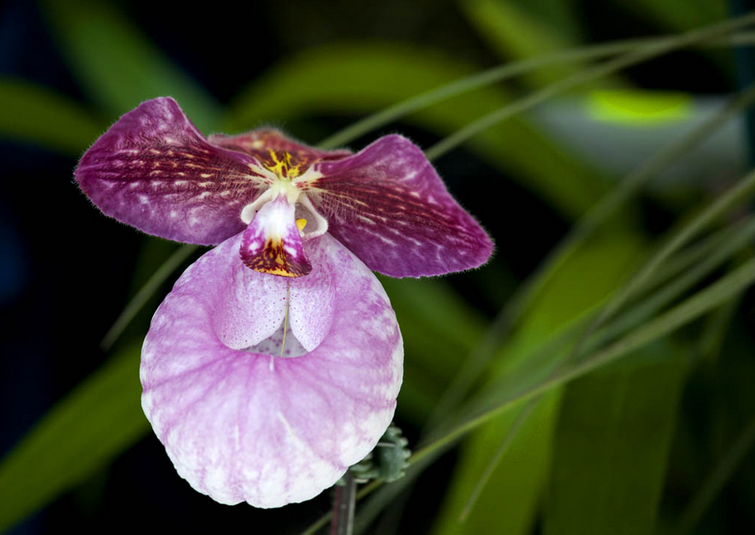
Paphiopedilum flowers are relatively elegant, with rather dignified colors, including white, light green, yellow, pink, purple-red, brown, and those with irregular spots or stripes. The petals are relatively thick, and the flowering period is relatively long. Paphiopedilum's lip is shaped like a slipper (pouch), hence its name.
Paphiopedilum generally has a smaller plant form; green-leaf types stay evergreen through the four seasons, mottled-leaf types are unusually attractive, and they do not demand much light. Those with round, broad leaf shapes resemble the dwarf types among Chinese orchids, so they are very suitable for indoor pot cultivation, or placed on a desk, a bedroom windowsill, or in a bathroom. Larger varieties can be placed in the living room or at the entrance. Paphiopedilum has a relatively long flowering period; each flower stays open for as short as 3-4 weeks or as long as 5-8 weeks, and varieties with multiple flowers on one stem bloom even longer.
Paphiopedilum blooms at different times depending on the variety; most species bloom in winter and spring, and there are also varieties that bloom in summer and autumn. If cultivated properly, there can be flowers to enjoy all year round. For growing in an orchid shed, lightweight pots are best, such as black plastic bag pots; if the plant is short, it can be grown in tall Chinese-orchid pots, so multiple pots can be placed on one shelf. For some more high-end varieties, nested pots can be used; the inner transparent pot allows you to observe root growth and also maintains better humidity.
II. Cultivation Methods for Paphiopedilum
1. Soil: Paphiopedilum's roots need air circulation, so soil cultivation is preferable. The substrate is best a well-draining, airy leaf mold soil plus some expanded vermiculite; it can also be made by mixing leaf mold soil and decomposed coarse sawdust (peat) in a 2:1 ratio. Note that overly sticky soil must not be used. When planting, place 1/3-1/4 charcoal or crushed stone (crushed brick) at the bottom of the pot to help root aeration, water absorption and drainage.
2. Temperature: Paphiopedilum likes a warm environment, with specific temperatures varying by variety. Green-leaf varieties should be kept at 12-18°C, and mottled-leaf varieties should be grown at 15-25°C. The winter temperature is best at 10-15°C, and the summer temperature must not be higher than 30°C. When the temperature is around 25°C, Paphiopedilum should be given more sunlight and the plant moved from time to time to help bud formation. When the temperature drops below 10°C in late autumn, it should be moved indoors promptly.
3. Watering: Paphiopedilum likes moisture and cannot tolerate dryness, so the potting soil must be kept moist for a long time. Water as soon as it looks slightly dry, watering thoroughly until water flows out of the bottom of the pot, letting old water and air escape together. Rainwater is best; tap water must be left to stand for 3-5 days. To increase air humidity, spray water around the Paphiopedilum, including on the leaf surfaces. During the plum rain season and in winter, water according to the situation.
4. Fertilizer: During the new shoot growth period of Paphiopedilum, apply a 1,000 times diluted 6.5:6:19 nitrogen, phosphorus, potassium weak liquid fertilizer once a week. If using granular fertilizer, apply once in March-April. The leaf surface needs a top dressing every 10 days, spraying a 0.2% potassium dihydrogen phosphate solution. Pots with leaf mold soil can be given nutrient solution during the leaf growth period, and old sphagnum moss or planting material should also be given more fertilizer. During the flower-stem emergence period, apply a 1,000 times diluted potassium dihydrogen phosphate fertilizer once every two weeks, and after flowering apply fertilizer once every 3-4 weeks.
5. Pests and diseases: Paphiopedilum is prone to soft rot and leaf spot. Soft rot is most likely in hot, humid weather; at such times ventilation must be strengthened, and the plant can be placed in a breeze. Before the plum rain season arrives, spray Benlate wettable powder 1,000 times diluted or Daconil wettable powder 800 times diluted twice a month. Common insect pests of Paphiopedilum include scale insects, aphids, etc., which can be controlled by spraying the appropriate preparations.
Finally, after reading this, I believe many people now know and recognize Paphiopedilum flowers, and also know how to grow them! Aren't its cultivation methods quite simple? In fact, as long as we are patient, we will surely produce the most beautiful Paphiopedilum flowers.
Paphiopedilum: Paphiopedilum Illustrated Guide: How to Grow Paphiopedilum / How to Propagate Paphiopedilum
Paphiopedilum ProfilePaphiopedilum
Cultivation Methods and Precautions for Paphiopedilum: An Introduction to Paphiopedilum
Paphiopedilum, also known as slipper orchid. Orchidaceae perennial herb. Most are terrestrial species, with many hybrid varieties. It is one of the most widely cultivated tropical orchids. It is mainly distributed under tropical and subtropical forests in Asia. It likes warm, humid and semi-shady environments. The stem is very short; the leaves are strap-shaped or oblong-lanceolate, green or with reddish-brown markings. The flower is very unusual, with the lip shaped like a pouch; the dorsal sepal is extremely developed, with various gorgeous patterns; the two lateral sepals are fused together; the petals are relatively thick and the flower has a long lifespan, some staying open for more than 6 weeks, and there are species that bloom in all four seasons.
[Alias] Wrinkled Paphiopedilum
[Source] Orchidaceae Paphiopedilum Cypripedium corrugatum Franch., roots used as medicine.
[Habitat and Distribution] Yunnan.
[Nature and Flavor] Sweet, astringent, slightly sour, neutral.
[Functions and Indications] Regulates menstruation and invigorates blood, reduces inflammation and relieves pain. Mainly treats irregular menstruation, dysmenorrhea, amenorrhea, adnexitis, cystitis, hernia, etc.
[Usage and Dosage] Used in formulas, 2-3 qian.
Morphological Characteristics of Paphiopedilum
The flower stem emerges from the leaf cluster, the flower shape is unusual, and the lip is pouch-shaped.
The dorsal sepal is extremely developed, with various gorgeous patterns.
The two lateral sepals are fused together. The shape of the column differs from that of ordinary orchids, with the two anthers borne separately on either side of the column. The petals are relatively thick and the flower has a long lifespan.
Ecological Habits of Paphiopedilum
It likes warm, humid and semi-shady environments, and fears strong direct sunlight.
The suitable growing temperature for green-leaf varieties is 12-18°C, and for mottled-leaf varieties it is 15-25°C. The highest temperature it can endure is about 30°C, and the overwintering temperature should preferably be around 10-15°C.
Generally speaking, warm-type mottled-leaf varieties mostly bloom in summer and autumn, while cool-type green-leaf varieties bloom in winter and spring. The stem is extremely short, the leaves are leathery, nearly basal, strap-shaped or oblong-lanceolate, green or with reddish-brown markings.
Cultivation Techniques for Paphiopedilum: Flowering Period Management
Temperature control and shading: Paphiopedilum originates in low-latitude, high-altitude regions, so it cannot grow normally at too low or too high temperatures. In winter, special attention must be paid to keeping it warm; the nighttime room temperature should be above 10°C, and the daytime temperature should be 5°C to 10°C higher than at night. Paphiopedilum also rather likes sunlight, but direct sunlight must be avoided; in autumn, more than 70% of sunlight should be blocked, and in winter more than 50% should be blocked, so that it can flower well. Maintaining humidity: Paphiopedilum likes a humid environment and has very poor drought resistance, and its flowering period coincides with the dry autumn and winter seasons, so the potting soil must be kept moist and water sprinkled around the flower pot frequently to maintain relatively high air humidity. If humidity is insufficient, the leaves easily turn yellow and shrivel, directly affecting flowering.
Moderate fertilization: During the growing period, Paphiopedilum should be given phosphorus and potassium fertilizer and an appropriate amount of nitrogen fertilizer. If there is too much nitrogen fertilizer, the plant grows luxuriantly with dark green leaves but does not bloom; if phosphorus and potassium fertilizer are lacking, it will likewise bloom very little. It is best to apply decomposed dilute bean-cake water. If conditions permit, it is best to spray 1‰ potassium dihydrogen phosphate on the leaf surface every 10 to 15 days to let the leaves absorb it; the effect is very good.
Ventilation and pest prevention: When overwintering indoors, Paphiopedilum should be placed in a ventilated spot, otherwise scale insect damage will occur. Once pests are found, they can be gently brushed off by hand with a soft brush, then rinsed clean with water, and then controlled with pesticides such as dimethoate, trichlorfon, and Supracide.
Cultivation Management
It is a shade-loving plant, so matching shading facilities are needed during cultivation. During growth, its light requirements are not entirely the same. Therefore, management is relatively complicated. In early spring, semi-shade is best; in midsummer, give light in the morning and evening and shade around noon; in winter, there must be sufficient sunlight, and on rainy and snowy days artificial lighting must be added. In short, strong direct light must be avoided.
For pot cultivation, use a growing medium made of 2 parts leaf mold soil and 1 part peat or decomposed coarse sawdust. When potting, first place a layer of charcoal or crushed brick and tile particles at the bottom of the pot, with the layer thickness kept at about 1/3 of the pot depth. This maintains good air permeability and also good water absorption and drainage capacity, meeting the requirements for the plant's root growth.
After the potted plants are brought out of the room in April, place them under a shade frame. The shading rate in spring and autumn is 50%, and in summer it must reach 60%-70%, and exposure to harsh sunlight must be prevented.
It has poor adaptability to changes in moisture and temperature, and requires a sufficient water supply and relatively high environmental humidity. During the growing period, keep the potting soil moist at all times; when the potting soil is 70% dry, water thoroughly. In dry and hot summer weather, spray water frequently on the plant and around it to cool it and increase humidity. During the plum rain and autumn rain seasons, control water appropriately and pay attention to ventilation to regulate temperature and humidity. Note that water must not accumulate on the leaves for too long, otherwise it will cause leaf rot. At the same time, relatively high air humidity easily causes fungal diseases. Therefore, special attention should be paid to regulating the air in the growing environment. If the air is dry, the leaves easily turn yellow, shrivel, wither and fall off, directly affecting flowering. Paphiopedilum has no pseudobulbs and has relatively poor drought resistance.
During the growing periods from March to June and from September to November, fertilize regularly, usually once every half month, preferably with decomposed bean cake and sauce residue liquid, with the concentration controlled at about 10%. After fertilizing, if the leaves appear tender green, you can continue fertilizing. If the leaves turn yellow, it indicates poor root growth, and fertilization should be stopped, otherwise root rot will occur. After fertilizing, promptly rinse the leaf surfaces with clean water.
In late October, move it indoors to a sunny spot, reduce watering, and do not let the soil become too wet. When the midday sun is relatively strong, it is still best to provide a little shade.
During the plum rain season, because of high air humidity and poor ventilation, Paphiopedilum is prone to leaf spot and soft rot damage, which can be controlled by spraying 70% thiophanate-methyl wettable powder 800 times diluted. When growing indoors or in a greenhouse in winter, pay attention to air circulation. If ventilation conditions are poor, scale insects will harm Paphiopedilum leaves and affect the ornamental effect; once found, wash them off promptly and spray with 40% omethoate 1,000 times diluted to kill them. Regularly spray fungicides such as carbendazim or thiophanate-methyl to prevent stem rot and leaf spot.
Spring Management
(1) Growing location: Because slipper orchids originate in dimly lit environments, direct sunlight must be strictly avoided, and 50%-60% shading is required. If grown in a greenhouse, use a layer of shade netting to reduce sunlight exposure. At the same time, there should be an appropriate distance between pots to facilitate ventilation. If placed indoors, also use windows to block part of the light. When moving from indoors to outdoors, do not expose it to sunlight immediately, to avoid scorching the orchid leaves. When growing outdoors, choose a spot that does not receive rainwater and has good ventilation.
(2) Watering: The native home of slipper orchids is humid areas, so they like water all year round. When the surface of the sphagnum moss and planting material looks slightly dry, water promptly to keep the pot moist at all times. When watering, water until water flows out of the bottom of the pot, so that old water and air in the pot are expelled. When watering, in addition to watering the roots thoroughly, also spray water on the leaf surfaces, which can further promote the growth of new shoots. During the plum rain season, water according to the dryness of the planting material surface as appropriate.
(3) Fertilizer: When new shoots begin to grow, apply a 1,000 times diluted liquid fertilizer N-P-K (composition ratio 6.5-6-19) once a week. Before use, read the brand's instructions carefully and mix according to the indicated concentration; it must not be too dilute or too concentrated. If using a solid fertilizer made of a mixture of oil cake and bone meal, apply once between March and April; for a 4-5 inch pot, place one granule. If the planting material is new sphagnum moss, or the orchid plant is repotted once every 2 years, sometimes no fertilizer is needed and it can still bloom. But if old sphagnum moss or planting material is used, more fertilizer should be applied.
(4) Pest and disease control: During the plum rain season, because of high temperature and humidity, slipper orchids often suffer from soft rot during this period. Therefore, pay special attention to ventilation; it is advisable to hang the orchid plants in a place with a gentle breeze for cultivation. In the early stage of soft rot, a water-soaked brown rot appears at the base of the orchid plant. The preventive method is to spray Daconil wettable powder 800 times diluted or Benlate wettable powder 1,000 times diluted twice a month before the plum rain season begins.
(5) Repotting: Usually repot after flowering and before new roots grow; the most suitable time is when the nighttime temperature is above 12-13°C. Repotting does not need to be done every year; about once every two years is enough. If you only want to grow it into a large plant, simply move it into a larger pot; if you want to propagate, then divide the plant. Because slipper orchids have few roots, be very careful and never damage the roots. When repotting, use a bamboo chopstick to carefully remove the old planting material and remove rotten roots. If the planting material used is sphagnum moss, fill the bottom of an unglazed clay pot with Styrofoam pieces to aid drainage. If lightweight stone is used as the planting material, since unglazed clay pots dry out easily, you may switch to ceramic pots for growing. When using sphagnum moss as the planting material, in addition to pressing it firm and tight, adding oyster shell or limestone fragments works even better. Within half a month after repotting, place it in a dark spot, reduce the amount of watering, and frequently spray water on the leaf surfaces to promote the growth of new roots. If too much water is given during this period, it will instead delay root development; pay special attention to this point.
[Note]:
Division: Division usually means dividing 2-3 shoots into one plant; the principles are as follows:
1. A thick, large new shoot is divided into a plant by itself.
2. A small new shoot and an old shoot are divided into one plant.
3. An old shoot that has already flowered is planted separately as one plant. When dividing, first pull up the orchid plant, observe carefully, and after deciding the number of divisions, carefully remove the old sphagnum moss. Because there are very few roots, when dividing, hold the leaf base of each division with your fingers, then gently separate them, replant, water, and place in a dark spot.
Summer Management
(1) Growing location: Summer sunlight is very strong, especially after the plum rain season, when the temperature rises a great deal, so the shading rate should be increased to 60%-70%. Whether growing in a greenhouse or indoors, an additional layer of shade netting is needed to avoid sunscald on the leaves. When using shade netting, keep it as far from the orchid plants as possible; if it is too close, it not only hinders ventilation but actually traps heat, weakening the orchid plants. Non-mottled-leaf slipper orchids need brighter light for growth than mottled-leaf ones, therefore non-mottled types need brighter light. Thus, if non-mottled slipper orchids are shaded too much, the orchid leaves will grow too long and droop, and flowering will also be poor.
(2) Watering: In summer, slipper orchids grow quickly; if not watered every day, they will dry out, so water thoroughly both morning and evening. If the daytime temperature exceeds 30°C and the nighttime temperature exceeds 25°C, in addition to watering the pots thoroughly, also water around the shade frame and on the ground to keep things cool. When growing indoors, if air conditioning is on, there is no particular effect. But if the night is too stuffy and hot, it is best to move them outdoors for cultivation.
(3) Fertilizer: Summer is the peak growing season for slipper orchids, so fertilizer is indispensable. Apply 1,000 times diluted liquid fertilizer once a week until mid-September. In addition to applying liquid fertilizer directly into the pot, you can also spray it on the leaf surfaces with a sprayer. For the solid fertilizer made of a mixture of oil cake and bone meal, apply twice between May and July, and stop using it in August. Applying strong fertilizer during extreme heat easily causes root rot and harms the orchid roots.
(4) Pest and disease control: Soft rot is most likely to appear in summer. Slipper orchids are mostly grown indoors; if ventilation is poor and the temperature rises, the new tender shoots easily turn black and drop off, causing the whole plant to wither. In addition to spraying fungicides, the control method is to keep the growing location well ventilated, and once the disease occurs, stop watering for 5-6 days to keep the orchid plant dry.
Autumn Management
(1) Growing location: Compared with summer, autumn not only has shorter daylight hours but also weaker sunlight. If two layers of shade netting are still used, it will cause insufficient sunlight, so remove one layer and maintain 50%-60% shading. Afternoon western sun easily causes leaf scorch, so western exposure should still be avoided. Good ventilation should still be maintained; in late autumn, if the nighttime temperature is relatively low, close the windows around the greenhouse.
(2) Watering: Watering is generally done when the surface of the planting material dries. Since it has entered the growth-stopping period, its water absorption is far less than in summer. Therefore, generally water about once every 2-3 days. Because the air is dry this season, the surface of the planting material dries easily. There is often a phenomenon where, when the surface of the planting material looks dry, the inner layer is still very moist, so watering should not be too wet. In addition, note that water easily accumulates in the crown of the orchid and causes flower buds to rot. Therefore, for orchid plants with flower buds, watering requires special attention.
(3) Fertilizer: As in summer, apply liquid fertilizer 2-3 times a month, but for flowering plants, suspend fertilization.
(4) Removal of old leaves: When this year's growth ends, the leaves grown in the previous two years turn tea-brown and are about to wither. This is not a diseased state, just an aging phenomenon; simply carefully remove or cut them off from the base.
(5) Weeding: When growing in urban areas, this problem is relatively absent. But when growing in the suburbs or in fields and gardens, weed seeds often fly everywhere and sprout all over, causing great trouble. Therefore, in early to late autumn, pull weeds out by the roots; once they are allowed to grow, removing them becomes quite difficult.
Winter Management
(1) Growing location: Because sunlight is weaker on overcast days and daylight hours are short, the shade netting originally used can all be removed. However, for newly built aluminum-frame greenhouses, because of their strong radiation capacity, for safety's sake you may still use one layer of shade netting, maintaining 30% shading. Because indoor daylight hours are extremely short, when placed by an indoor window, no curtain shading is needed either. Winter nighttime temperatures are relatively low; if below 13-15°C, it is best to move the orchid plants indoors or into a greenhouse. Each slipper orchid's tolerance of the minimum temperature differs. Non-mottled-leaf types are the most cold-tolerant, about 5-7°C, while the rest need above 10°C. The optimal temperature for non-mottled-leaf types is 10-13°C, and for the rest 15°C. The daytime temperature should preferably not exceed 25°C, and air circulation should be maintained.
On overcast days when the air is dry, you may place the pots in an indoor air trough or a polystyrene box, which both keeps them warm and prevents drying out.
(2) Watering: Because the flower buds are gradually growing larger and the flower stems also need to grow, water absorption increases greatly. If water is insufficient at this time, it is quite unfavorable for the growth of the flower stems, and growth will stop within a short time, so special care must be taken not to let them dry out too much.
In winter, watering is best done before noon, when the surface of the planting material looks dry.
(3) Humidity: Slipper orchids like a high-humidity environment all year round, and humidity should usually be kept at around 60%-80%; if humidity is insufficient, it has an adverse effect on the growth of slipper orchids and causes the plant to weaken. When humidity is insufficient, water the ground to increase humidity. Or spray water on the leaf surfaces, but the amount of water should be at a level where water does not accumulate in the crown of the orchid. If it is large-scale cultivation, you will have to rely on a humidifier.
(4) Orchid plants that have already grown flower buds and are flowering do not need fertilization.
(5) Staking: During the flower bud growth period, if the air is too stuffy and hot or too much fertilizer is applied, the flower stem will be unable to extend upright, and may fall over or bloom downward. To avoid this, stake it before the flower stem has set its shape, then tie it with string to secure it. To make a stake, cut a 25-40 cm length of wire, and as shown in the figure, bend the part 3-4 cm from one end into a right angle, then bend half of it back to form a U shape.
Propagation Methods for Paphiopedilum
Paphiopedilum is commonly propagated by seed sowing and division.
Seed Propagation
Because Paphiopedilum seeds are extremely small and the embryo is not fully developed, sowing by conventional methods makes germination relatively difficult. Embryo culture can only be carried out in test tubes with a culture medium under sterile conditions; after germination, the seedlings undergo 2-3 rounds of seedling separation and transplanting in the test tubes, and when the seedlings grow to 3 cm tall, they can be removed from the test tubes and planted in pots. From sowing to flowering takes 4-5 years. The Paphiopedilum culture medium consists of Hyponex No. 1 3 g, sucrose 35 g, peptone 2 g, agar 15 g, and distilled water 1,000 ml.
Division Propagation
Any Paphiopedilum with 5-6 or more leaf clusters can be divided; potted plants can be divided once every 2-3 years. Division is carried out during the brief dormant period after flowering. In the Yangtze River basin region, April-May is best, and it can be combined with repotting. Tip the mother plant out of the pot, gently remove the growing medium attached to the roots, being careful not to damage tender roots and new shoots, then pull the divided plants apart with both hands, or cut the connection point with a knife. Each division should not have fewer than 3 shoots; then plant them separately, choosing 2-3 seedlings per pot. Use fertile leaf mold soil as the potting soil, with a pH of 6-6.5. After potting, place in a shady, humid spot to help the roots recover.
Aseptic Seed Propagation
Because Paphiopedilum seeds are small and the embryo is not fully developed, embryo culture can only be carried out under sterile conditions, and when the seedlings grow to 3 cm they are removed for pot cultivation. Generally, from sowing to flowering takes 4-5 years.
Distribution Range of Paphiopedilum
Paphiopedilum is native to the forest floor in tropical and subtropical regions. Most are terrestrial species, a few are epiphytic species, and there are many hybrid varieties.
It is mainly distributed in the tropical regions of southern Asia, including India, Myanmar, Indonesia and as far as New Guinea, as well as in southwestern China. The genus Paphiopedilum has about 66 species worldwide. China is rich in Paphiopedilum plant resources, with 18 known species, mainly distributed in the southwestern and southern China regions.
Variety Classification of Paphiopedilum
Paphiopedilum appletonianum, Paphiopedilum armeniacum, Paphiopedilum concolor, Paphiopedilum godefroyae, Paphiopedilum micranthum, Paphiopedilum insigne, Paphiopedilum hirsutissimum, Paphiopedilum parishii, Paphiopedilum malipoense, Paphiopedilum niveum, and the hybrid Paphiopedilum Jack Tonkin.
Uses of Paphiopedilum: Ornamental Value
Paphiopedilum is a perennial evergreen herbaceous plant and one of the most primitive groups in the orchid family. It is one of the earliest cultivated and most popular tropical orchids in the world. Its plant form is elegant, its flower shape unusual, its flower colors rich, and its flowers large and brightly colored, making it very suitable for pot cultivation and appreciation. It is an excellent high-end indoor potted flowering plant. Its flowering period is long; each flower stays open for as short as 3-4 weeks or as long as 5-8 weeks, and varieties with multiple flowers on one stem bloom even longer. Paphiopedilum blooms in different seasons depending on the variety; most species bloom in winter and spring, and there are also varieties that bloom in summer and autumn, so if cultivated properly, there are flowers to enjoy all year round.
Cultural Background of Paphiopedilum: Folklore
It is said that God had seven very beautiful daughters. When they learned that a certain wealthy man in the human world had a garden full of rare flowers and exotic plants, every afternoon after bathing, while their parents were not paying attention, they would put on long nightgowns and beautiful slippers and secretly slip into the rich man's garden to play, only hurrying back to heaven when the Heavenly Emperor was about to close the heavenly gate.
At first, the hundred flowers blooming in the garden and the green grass all spread smiles to welcome these beautiful fairies, and the seven fairies also fully enjoyed the beautiful scenery and played, getting along happily with one another. Gradually, they revealed their mischievous nature, playing hide-and-seek in the garden and jumping about, and the flowers and grass were trampled so much that they hung their heads in dismay, very angry.
One day, while the youngest fairy was not paying attention, the flowers and grass deliberately tripped her, and hid her slippers in the embrace of an orchid, disguising them as petals. The fairies searched everywhere without finding them and had to hurry back before the heavenly gate closed. After returning to heaven, under their mother's questioning, they finally told the truth, and for this they were forbidden to descend to the human world. From then on, the flowers and grass in the garden regained their vitality. As for the youngest fairy's slippers, they remained forever on the orchid's petals and gradually turned into the interesting slipper orchid.
The Flower Language of Paphiopedilum
The flower language and symbolic meaning of Paphiopedilum: beauty, diligence and thrift.
Paphiopedilum is also known as slipper orchid and lady's slipper. In the genus name Paphiopedilum, "paphio" represents "beauty," and the ending "pedilon" means "shoe." It has a large slipper-shaped lip standing above two petals, and a dorsal sepal, with colors ranging from yellow, green and brown to purple, and often with veins or stripes. Slipper orchids are distinctive among orchids; the most obvious difference is that, unlike most epiphytic orchids, they are terrestrial orchids and have no pseudobulbs. Slipper orchids are the most eye-catching flowers at Dutch flower shows, with flowers standing above two petals and a slipper-shaped large lip. Many kinds of slipper orchids can bloom all year round and are one of the best varieties for indoor cultivation.
Paphiopedilum Pictures