How to grow orchids? Flower lovers who don't know how to water must read this
How to grow orchids: orchids have certain xerophytic characteristics. They have thick fleshy roots that can store a relatively large amount of water, and in addition the leaf surface has a fairly thick cuticle that prevents excessive and overly rapid water loss from the plant. They can withstand about 3 days of absolute drought without wilting. Of course, if too dry, metabolism is affected, and in effect growth stops. Prolonged excessive dryness leads to root death; but too much water or waterlogging reduces the air content of the soil, which suppresses root respiration and can even suffocate the roots, causing the leaves to turn yellow and, in severe cases, root rot and death. Orchids require the soil to be kept at 40%-50% moisture and the relative air humidity to be kept at around 80%. Maintaining suitable humidity is the key to growing orchids well.
(1) Orchids should be given fertile, loose soil with good drainage. If the planting material used is granular pond-mud chunks, weathered rock, and the like, the frequency of watering can be increased; if sphagnum moss, which has strong water-retaining ability, is used, watering once every several days is enough. The drainage layer at the bottom of the pot should be at least 2/5 or more of the pot's soil volume, filled firmly with broken tiles, broken bricks, charcoal fragments, small stones, etc., to ensure waterlogging prevention and ventilation. What orchids need is moist soil full of air.
(2) As for the amount of water, generally speaking, water generously from spring to summer and control it from autumn to winter. But this should also be handled according to the specific conditions of the variety and growth stage. For example, Cymbidium ensifolium (Fujian cymbidium) buds and blooms in autumn and needs more water; Cymbidium goeringii (spring orchid) budding in winter needs the soil kept moist.
(3) Do not water too much. Water reasonably according to various specific conditions, at the right time, in the right place, and in the right amount. Keeping the pot soil seven parts dry can allow the orchid plant to accumulate sugars and concentrate its nutrients, which favors flower bud differentiation. If too wet, leaves tend to grow excessively, pathogens spread, and the roots may even rot and die.
(4) Watering should generally be determined by the season. In early spring the temperature is low and evaporation is slow, so the pot soil should be kept slightly dry. From April to May, when new shoots emerge from the soil, the pot soil should still be kept slightly dry, and watering once every 2-3 days is sufficient. In June, when new roots and leaf buds grow, the pot soil can be kept relatively moist. After September, the amount of water should gradually be reduced, but it should not be too dry, otherwise the sprouting of leaves and blooming the following year will be affected. In winter, after the plant is moved indoors, the pot soil should be kept slightly dry, generally watering once about every 20 days; if the pot soil is not dry, watering can be skipped.
(5) At night the temperature drops and water evaporates less, so not watering does not affect normal growth; on the contrary, proper water control actually stimulates root growth and the sprouting of new shoots. Watering in the morning, when the water temperature, air temperature and soil temperature are close, is beneficial to root growth.
(6) During the plum rain season, when it rains for a long time without clearing, do not let the pot soil become waterlogged. You can lay the pot on its side or move it to a sheltered, ventilated place to prevent excessive humidity.
How to grow orchids: for orchids, air humidity is even more important than the moisture at the roots in the soil. However, due to differences in place of origin, variety and growth habits, the requirements for relative air humidity also differ.
(1) Generally, a spray bottle with a fairly even and fine nozzle should be used to spray water on the leaves, ground, walls, pot stands, etc., to increase humidity, lower the temperature, reduce water evaporation, wash dust off the leaf surface, help leaf respiration, enhance photosynthesis, prevent the leaves from aging and turning yellow, and keep them green and beautiful.
(2) Air humidity has a great influence on orchid flowering. Too low humidity shortens the flowering period and makes the flower color and fragrance fade, but too high humidity causes the petals to rot and mildew and pests and diseases to spread. Before flowering, spraying must not wet the flower buds, lest the buds rot and fewer flowers appear. During the flowering period, only the leaves should be sprayed with water; never spray into the flower buds, so as not to shorten the life of the flowers.
(3) In the cold winter, be careful not to spray with cold water, and be careful not to let the leaf sheaths become too wet.
(4) When growing orchids in a greenhouse, if the air humidity is too high, open the windows for ventilation to lower the humidity. If the humidity is too low, sprinkle an appropriate amount of water on the greenhouse floor to raise the humidity. That concludes the introduction on how to grow orchids.
How to grow orchids: how to water, transplant and repot
When it comes to orchids, many people like them; they are quite attractive, but no matter how you grow them yourself, they never thrive and always seem about to die. So how do you grow orchids?
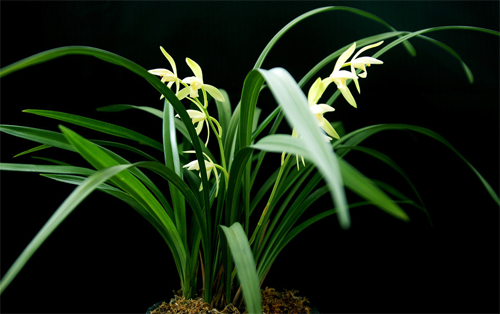
1. How to water orchids
Improper watering of orchids is the main cause of death. Some people usually spend a lot of time caring for them, are very afraid of the plant drying out, and water frequently; the plant's roots have already rotted without them even knowing.
How much to water depends on your growing environment, the conditions of humidity, light and ventilation, and the state of the root system. This is also the key reason why orchids are difficult to grow well.
These issues apply to most orchids, including Phalaenopsis and Cattleya. The simplest approach is to water based on how dry or wet the potting medium is. Each watering should be well summed up; whether you give water every few days or once a week depends on your home growing environment!
2. The medium for growing orchids
Checking whether the orchid medium is dry or wet is an important indicator for watering. You can put your finger into the medium and pull it out to judge how dry or wet the medium is and whether it lacks water.
Sphagnum moss and bark are common media for growing plants, and they also make it very easy to judge whether the orchid medium is dry or wet.
Orchids grown in sphagnum moss and bark sometimes have no drainage holes; this prevents too much water from draining away during watering, which would amount to not watering at all. Sphagnum moss has a water-retaining effect! For growing orchids, it is also fairly advisable to use orchid pots.
3. The role of sphagnum moss
Sphagnum moss is like a sponge; it can keep the medium slightly moist for a long time. Therefore, for Phalaenopsis and Cattleya, which do not like overly damp environments but do like slight moisture, the medium needs to dry out thoroughly before watering, and after watering you need to wait longer before watering again, rather than watering too frequently.
Bark is also excellent for growing orchids and lowers the risk of root rot. The rule for watering orchids should be mastered: it is best to water the day before the medium dries out completely.
4. Differences among varieties
For example, slipper orchids (Paphiopedilum) and Lycaste enjoy damp environments; they grow well in moist conditions, and their pot soil must not be allowed to dry out completely!
Choosing high-quality sphagnum moss and bark is more conducive to caring for orchids, and watering is also easier to control.
5. Transplanting and repotting
The bark or good sphagnum moss used for growing orchids generally needs to be replaced once a year; poor-quality sphagnum moss needs replacing after just one month! Bark gradually degrades through repeated watering and drying, so generally as soon as it degrades a little, it is time to repot and transplant!
The withered bark can be used for compost, and the withered roots of orchids can also be used for compost.
6. Fertilizing orchids
For orchids, water-soluble liquid fertilizer is best. First choose the dosage yourself and fertilize during the growth period. As for the dosage, follow the dosage on the liquid fertilizer instructions, add more water, and dilute the concentration to 1/4 of the recommended dosage before fertilizing. This is what is meant by light fertilization applied frequently.
That concludes the introduction to orchid growing methods. Hurry and follow these methods to make your orchids even more beautiful.
How best to grow orchids: how to fertilize and how to water orchids
Since ancient times, orchids have been a symbol of nobility and elegance for us, and together with plum, bamboo and chrysanthemum they are called the Four Gentlemen. Chinese orchids and tropical orchids are very different: they have neither striking gaudy looks nor huge flowers and leaves, but they have a simple, quiet, elegant and noble temperament, which fits the Oriental aesthetic standard very well. So how best to grow orchids, and how to fertilize and how to water orchids?
How best to grow orchids, and how to fertilize and how to water orchids:
Orchid growth habits:
Orchids like a cool, shady environment and are afraid of direct sunlight. By nature they like moisture and dread dryness, and they also like fertile loam soil rich in a large amount of humus. They are best suited to growing in an environment with air circulation.
How to fertilize and how to water orchids:
Fertilizing: a newly potted orchid cannot survive if the pot soil is too rich in fertilizer; even if it does survive, its flowering rate will be very low. If there is too much fertilizer, it will grow too vigorously in autumn, which will also lead to poor flowering the following spring; too little will also affect the formation of flower buds. In fact, the safest approach is that when you see its leaves turning yellow, it is lacking fertilizer, and you should give it a topdressing; when its leaf tips scorch, it has been over-fertilized, and at that point you need to stop fertilizing it. The fertilizer used for it must be rotted and decomposed; undecomposed fertilizer must not be used, and using human excrement and urine, etc., is even more taboo.
Watering: practice has shown that orchids need eight parts dry and two parts wet. During its flowering period and the period when it sprouts leaf buds, it should be watered somewhat less. During the plum rain season, it should be moved indoors or a rain shelter should be built for it to keep off the rain. In summer, it should be watered in the early morning and in the evening. It must not be watered too much. In autumn, watering can be appropriately increased. In dry seasons, it needs to be misted every evening to make the ground damp and increase air humidity. In winter, watering can be appropriately reduced, but it must not be omitted; be careful not to let the pot soil dry out completely. In short, water when dry and stop watering when moist, following the principle of keeping it appropriately on the dry side.
Light: light is an important factor in flower bud formation for many plants. Although orchids like cool conditions, if they are kept in a hidden place all year round, they will also bloom very little. Friends who love orchids have long noticed that orchid leaves in shady places are long and the flowers sparse, while orchid leaves in sunny places are short and the flowers numerous. Therefore, when cultivating orchids, attention must be paid to the light issue. In spring and summer, we had best use reed curtains to shade them, or place them at an indoor window facing east or south with ventilation. Orchids under the curtain should be turned once every half month so that the orchid receives light on all sides, which favors balanced growth of the plant. When the weather turns cool in autumn, the potted orchid should be moved out from the shady place and allowed to get half a day of morning sun, but also be careful that autumn does not dry it out.
How best to grow orchids, and how to fertilize and how to water orchids, is what we share with you here. We hope this article is helpful to everyone, and we wish you good luck.