How to grow a potted rubber plant? Care methods and precautions
How to grow a potted rubber plant. The rubber plant has broad, thick leaves with a glossy, leathery texture and stays green all year round, making it an excellent potted foliage plant.
(1) Light regulation. The rubber plant loves light and needs medium to high light intensity, but in summer avoid direct strong sunlight to prevent leaf scorch; in winter it should be placed near a south-facing window indoors with ample light. If kept in shade for a long time, the leaves easily turn yellow or drop. The rubber plant has a rather stubborn original orientation, so do not move the pot casually, but if it grows too vigorously in one direction, it should be turned appropriately to balance its growth.
(2) Temperature regulation. The rubber plant prefers a high-temperature environment, with an optimal growth temperature of 25-30°C, but when it exceeds 35°C, it should be moved to a cool, ventilated place. In winter, room temperature should be kept above 10°C, otherwise the leaves will turn black and drop. Prolonged low temperatures and soggy potting soil can also easily cause root rot.
(3) Watering. The rubber plant loves water, and during the growing period a sufficient water supply must be ensured to keep the potting soil moist. In the hot summer season, water once each morning and evening, and spray water on the leaves several times. In autumn, gradually reduce watering, and in winter control watering. The leathery leaves have low requirements for air humidity and adapt to relatively dry environments, but the leaf surface needs to be frequently sprayed and rinsed to keep the leaves fresh.
(4) Fertilizing. The rubber plant loves fertilizer. In seasons when the temperature is around 25°C, apply a nitrogen-based compound fertilizer or decomposed dilute cake fertilizer water once a month. For young trees, when repotting each year, increase the humus content in the potting soil and apply sufficient base fertilizer. For 4-8 year old mature plants grown in wooden tubs, applying topdressing 3-4 times a year can make the branches lush and the leaves abundant.
(5) Preparation of growing medium. Potted rubber plants require soil that is fertile, moist, rich in humus, and slightly acidic. It is commonly prepared by mixing peat soil, leaf mold, and river sand at 1/3 each with a small amount of base fertilizer added. The above is an introduction to how to grow a potted rubber plant.
How to grow a potted rubber plant?
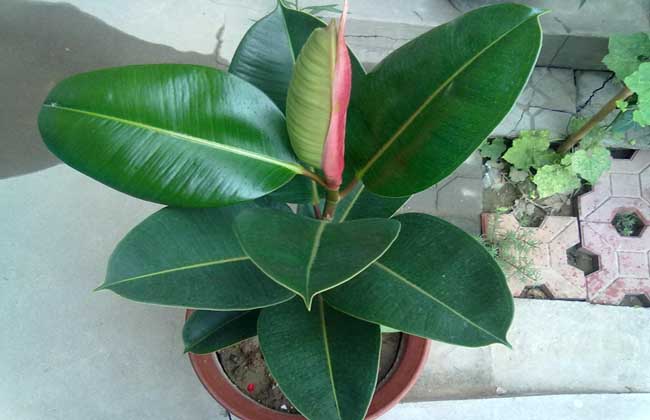
The rubber plant is a large tree species in the Moraceae family, genus Ficus, also known as rubber tree, Brazilian rubber, etc. It has high ornamental value and is a famous potted foliage plant, extremely suitable for indoor beautification arrangements. Small and medium-sized plants are often used to beautify living rooms and studies, while medium and large plants are suitable for placement on both sides of the entrance halls of large buildings and in the center of lobbies. Let us take a look below at how to grow a potted rubber plant!
Growth habits of the rubber plant
The rubber plant is native to Brazil and is now widely cultivated in tropical regions of Asia. In China it is cultivated in Taiwan, China, southern Fujian, Guangdong, Guangxi, Hainan, and southern Yunnan, with more planting in Hainan and Yunnan. It prefers a hot, humid environment with ample sunlight, with an optimal growth temperature of 20-25°C, and avoids direct sunlight. It can also tolerate shade but not cold, with a safe overwintering temperature of 5°C. It tolerates dry air. It avoids clayey soil and cannot tolerate barrenness or drought; it prefers loose, fertile, well-drained, slightly acidic soil.
Propagation methods of the rubber plant
1. Cuttings: The cutting time is in late spring and early summer, and can be done together with pruning. The cuttings mostly use current-year semi-lignified middle branches, inserted into a cutting bed with plain sand or vermiculite as the substrate. After insertion, keep the cutting bed at relatively high humidity, but do not let it become waterlogged. The suitable temperature is 18-25°C. Frequently sprinkle water on the ground to increase air humidity, and do a good job of shading and ventilation. Roots can form in about 2-3 weeks.
2. Layering: Select appropriately sized, well-developed, firm 2-year-old branches. At the predetermined location for wrapping soil, make a light ring-bark cut about 1 cm wide, and apply 30-50 ppm naphthalene acetic acid solution. Then use wet soil or a moss mixture or water-saturated vermiculite to wrap the ring-cut area, bind the outside with plastic film, tie the lower end tightly, and leave an opening at the upper end for ventilation and watering. Layer in June, roots form in July-August, and after rooting it can be cut off and potted.
How to grow a potted rubber plant?
1. Soil: The rubber plant prefers loose, fertile, well-drained, slightly acidic soil and cannot tolerate barrenness. The growing medium can use a mixture of leaf mold, garden soil, and river sand at 1/3 each, with a small amount of cake fertilizer added as base fertilizer. It usually needs repotting once every 2 years.
2. Temperature: The rubber plant likes a high-temperature environment, so it grows fastest in summer and autumn. The ambient temperature should be kept between 20-30°C. When the ambient temperature is below 10°C, the rubber plant is basically in a state of stalled growth. The overwintering temperature should not be lower than 5°C.
3. Light: The rubber plant likes strong direct sunlight and also tolerates shaded environments. However, during cultivation it should receive no less than 4 hours of direct sunlight per day. If conditions permit, it is best to ensure the plant can receive full sun.
4. Fertilizing: The rubber plant loves fertilizer, but avoid nitrogen fertilizer. When there is too much nitrogen fertilizer, the stem nodes grow excessively, the leaf spacing widens, and the plant shape becomes unattractive. During the growing season, young plants should be given decomposed 10x diluted liquid fertilizer mixed with an equal amount of 500x potassium dihydrogen phosphate solution once every 20 days, or 1000x "Huaduoduo" general-purpose fertilizer twice. For mature plants, to control height, apply mixed liquid fertilizer once every 2 months during the growing season.
5. Watering: The rubber plant likes moisture but avoids waterlogging and cannot tolerate drought. In spring and autumn, keep the potting soil moist and frequently sprinkle water on its leaves and surroundings to increase air humidity. In summer, the rubber plant needs a large amount of water and should be watered every day to keep the potting soil moist, while increasing the frequency of sprinkling. When winter temperatures are low, watering should be done so that the potting soil is on the dry side of moist.
6. Pruning: In spring, prune together with moving the plant out of the shed. Remove forked branches, inward-growing branches, dead branches, and thin weak branches inside the canopy, and shorten the rampant branches extending beyond the canopy so that the interior of the plant has good ventilation and light and the tree shape remains round and neat. If the canopy is too large, the outer branches can be shortened as a whole. During the growing period, remove overly dense branches at any time and shorten long branches.
Precautions for the rubber plant
1. The optimal growth temperature for the rubber plant is 25-30°C. In winter, if it is below 3°C, the leaves will turn yellow and drop, so in winter it should be placed in a sunny spot indoors and room temperature kept above 10°C. When it exceeds 35°C in summer, the plant should be moved to a cool, ventilated place for care, and water should be sprayed in a timely manner to cool it down.
2. The rubber plant is a Moraceae plant, and the whole plant contains milky sap. Therefore, after each pruning, immediately plug the cut with clay or apply charcoal powder, to avoid excessive sap flow causing dehydration and death.
3. The reason rubber plant seedlings need to have the pot direction changed regularly is to avoid the plant growing toward one side, which would make the plant shape not upright and affect its appearance.
4. After the rubber plant becomes a mature plant, because the roots grow larger and larger, the soil becomes compacted, hindering soil aeration, causing the rubber plant to turn yellow, and in severe cases it may die. It is best to repot once each spring before new buds grow, and loosen the soil once every 15-20 days until it returns to normal growth.
How to grow the rubber plant, cultivation methods for potted rubber plants
The rubber plant is also called large-leaf green, red Burmese tree, red-mouth rubber plant, protective film tree, Burmese fig, Burmese tree, fig milk tree, elastic protective film tree, evergreen, rubber tree, Indian rubber fig, Indian fig, Indian rubber plant, etc. It is an ornamental plant in the Moraceae family, genus Ficus, native to India. Its management is not complicated, and even people lacking cultivation experience can grow it well.Growth habits of the rubber plant:The rubber plant prefers a warm, humid environment with ample sunlight, and can also tolerate slight shade, but not cold. It requires fertile, loose soil and grows well in neutral or slightly acidic soil. When potted, it is best to use leaf mold and grass ash soil with about 1/4 river sand and a small amount of base fertilizer to make the growing medium. Usually keep the soil moist and apply dilute liquid fertilizer once every 15-20 days. In the hot summer season, the rubber plant grows relatively fast and should be given plenty of fertilizer and water, but avoid water accumulation in the pot. After autumn begins, gradually reduce fertilizing and watering to promote solid plant growth and help it overwinter. Because the rubber plant likes sunlight, from spring to autumn it should be placed outdoors in a sunny spot for care; if left in a shaded place for a long time, the leaves easily turn yellow and drop. It likes sunlight, but also tolerates shade relatively well. When watering, often use overnight tea, and the whole plant should be sprayed with water frequently; use a wet cloth to wipe the leaves clean, which benefits photosynthesis.
Because the rubber plant cannot tolerate cold, in winter it must be moved indoors to a sunny spot for care, keeping room temperature above 10°C, and the lowest temperature should not be below 5°C; if the temperature is too low and the potting soil is wet, it will cause the leaves to turn black and drop and the roots to rot, and even the whole plant to die. From late April to early May of the following year, move it to a courtyard or balcony for care. In the north, note that when moving from indoors to outdoors with the change of seasons, it cannot immediately receive strong sunlight; that is, the changes in light and temperature should not be too great. When winter room temperature is low, water sparingly and keep the potting soil slightly moist.
The rubber plant has glossy leaves, green and pleasant, and its plant is tall and imposing, suitable for placement on a balcony to green the environment.
Placement:
Potted rubber plants can be placed on east-facing, south-facing, or west-facing balconies for care, among which cultivation results are best on a south-facing balcony. Its plant is relatively tall and suitable for planting on a very spacious balcony. During its vigorous growth stage, place the plant where it receives no less than 2 hours of direct sunlight per day. In summer, keep the environment ventilated. Slightly low winter temperatures do no harm.
Potted management:
It is best to choose sandy loam rich in humus as the growing substrate. If conditions permit, the potting soil used can be prepared from leaf mold, fine sand, and garden soil at a volume ratio of 1:1:2. The rubber plant is relatively tall and grows quickly, so a large flower pot is usually chosen for planting. The rubber plant prefers a slightly moist, on the dry side soil environment. Summer is the stage when it needs the most water, so it can be watered more; winter is the period when it needs the least water, so water less. In addition to applying about 50 grams of horse hoof pieces etc. at the bottom of the flower pot as base fertilizer when planting, during the vigorous growth stage a dilute liquid fertilizer should also be applied once every 10 days. The rubber plant likes direct sunlight and also tolerates shaded environments. If conditions permit, it is best to let the plant receive full sun. Keeping the environment properly ventilated is sufficient. The rubber plant likes a high-temperature environment and grows well within a temperature range of 16°C-30°C, and the overwintering temperature should not be lower than 5°C. Each spring before new buds sprout, shorten the old branches of the plant by 2/3 or 1/2 to promote new branches, and at the same time prune the inner branches and thin weak branches. In balcony cultivation, the rubber plant usually rarely suffers from diseases, but it is susceptible to attack by white grubs. Each spring in March, plants older than three years should be repotted once. During the operation, some old roots can be cut off, some new soil added, and the plant's branches moderately pruned to promote branching. In this way the plant will have stronger growth vigor, thereby greatly improving its ornamental value.
Propagation methods:
Cuttings are the main propagation method, mostly carried out in spring from March to April. Fine sand can be used as the propagation substrate. The size of the pot used can be determined according to specific needs. Combined with pruning, cut the just-lignified branches of the rubber plant into single-node sections, each section with 1 leaf. White milky sap will flow from the cut end of the stem section; it can be washed off with warm water, and then a small amount of charcoal powder can be dipped onto the cut surface for later use. Fill a small flower pot with fine sand, then insert 1 bamboo stick about 20 cm long vertically, bury the trimmed rubber plant cutting stem section in the soil while maintaining polarity, wrap the middle of the leaf around the bamboo stick, and tie it firmly with fine string. Then place the flower pot with the cutting into a plastic tent, spray water frequently to keep it moist, and under conditions of 25°C-30°C, the rubber plant cutting can root after about 4 weeks. When the young seedling grows 2-3 new leaves, it can be knocked out of the pot and planted. Layering can also be used for propagation.
Rubber plant leaf cutting method (with pictures and text)
Although the petiole of a rubber plant leaf cutting can grow adventitious roots, it cannot produce adventitious buds, so it cannot grow into a new individual. Therefore, it is necessary to use a leaf with a bud at the base or a terminal bud for cutting in order to form a new plant. The depth should be such that only the bud tip is exposed. After insertion, cover with a glass cover to prevent water evaporation. If the leaves are opposite, they can be split into two halves, each half with one bud used as a cutting.Rubber plant leaf cuttings can use one leaf and one bud, or one leaf, half a leaf, or even smaller propagation material. In an intelligently controlled rapid propagation seedling bed, they can root quickly. A whole leaf can be quickly dipped with 2000 PPM Rapid Propagation Treasure, and half a leaf treated with 400 PPM for 1 hour gives the best rooting effect, with a rooting rate reaching 100%.
The picture below shows rubber plants propagated on February 21. On March 21, their well-developed root system is visible. At this point, after treatment with cytokinin, they will soon differentiate buds and become a complete plant.
00 Favorite Share