How to Grow Saxifraga stolonifera? A Detailed Guide to Planting Methods
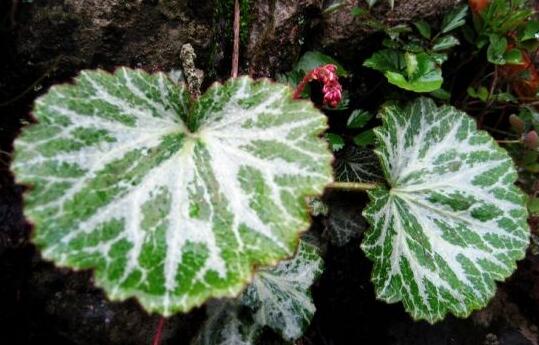
How to grow Saxifraga stolonifera. Saxifraga stolonifera belongs to the family Saxifragaceae. It is a perennial herbaceous plant of the genus Saxifraga, native to the region south of the Qinling Mountains in China. The leaf surface is green with white netted veins, the underside is purplish-red, and both sides are covered with white fine hairs. Its shape resembles a tiger's ear, hence the name Saxifraga stolonifera. The leaf stalks are long, mostly purplish-red. Flowers appear in summer as panicles of irregular small white flowers, with two petals notably long, and the flowers are sparse. Among cultivated varieties there is also a tricolor Saxifraga stolonifera, whose leaves have broad white or creamy-white margins inlaid with red, yellow and white patches; the leaf stalks are relatively short, delicate and elegant, suitable for growing in small pots.
The Saxifraga stolonifera plant is compact with unusual leaf shapes and prefers a shaded, humid environment, so it is often used as an accent in water-absorbing stone bonsai and as planting material for rock gardens, and can also be grown in shaded spots beside ponds, wells and streams. At home it is mostly grown in pots, hung upside down and suspended under eaves or indoors for viewing, giving a fresh, elegant and lively feeling.
When each leaf of Saxifraga stolonifera grows to a certain point, it sends out a slender stem from the leaf axil, initially semi-transparent and quite tender. As the leaf grows, this stem becomes longer and longer, then sprouts nodes and buds along the stem, hanging out little Saxifraga stolonifera plants one after another. Suspending it indoors gives a distinctive look.
Saxifraga stolonifera is shade-tolerant, so when cultivating or hanging it, choose a shaded and humid spot. For potting, use humus soil or peat soil with fine sandy soil, requiring a loose texture and good drainage. Repot and change the soil every spring or after flowering. Growth requires relatively high air humidity, but the potting soil must not become waterlogged. After flowering there is a dormant period during which water must be appropriately controlled, as excessive moisture easily causes root rot. In spring and autumn, apply a dilute liquid fertilizer once every 2 weeks, and stop fertilizing during the dormant period and in winter. Saxifraga stolonifera is relatively cold-tolerant and generally will not suffer frost damage. In northern regions, potted plants must overwinter indoors at no less than 15°C, but the tricolor Saxifraga stolonifera has poor cold tolerance and its overwintering temperature must not be below 15°C. The above is an introduction to how to grow Saxifraga stolonifera.
Planting Methods for Saxifraga stolonifera
Flower and Bonsai Network Plant Care section: Planting Methods for Saxifraga stolonifera will introduce you to the cultivation methods for Saxifraga stolonifera and how to grow it well
(1) Overview of Saxifraga stolonifera
Also known as Jinsi Diao Furong, Teng'er Cao and Dwarf Saxifraga stolonifera, it is a perennial herbaceous plant of the family Saxifragaceae. It is 14-45 cm tall, and from the base of the plant grow slender creeping stems of varying lengths, 80-100 mm long, with one to several small plantlets at the tips of the slender stems. When potted, the small plantlets and creeping stems hang around the pot, which is very interesting and attractive. There are several leaves, basal, nearly kidney-shaped, green on top with wide white netted veins, densely covered with purplish-red dots on the underside, and with long hairs on both sides. The panicle is sparse, with irregular small white flowers, and 2 petals are particularly long. There is a cultivated variety, the "tricolor" Saxifraga stolonifera, whose leaves have broad white or creamy-white margins inlaid with red, yellow and white patches, and relatively short leaf stalks, suitable for potting.
(2) Key Cultivation Points for Saxifraga stolonifera
Temperature: It prefers a cool environment, with a minimum overwintering temperature of 5-7°C; the overwintering temperature for "tricolor" Saxifraga stolonifera should be around 16°C. In summer it needs to be placed in a cool, ventilated spot, and it goes dormant at high temperatures.
Light: It prefers bright light; avoid direct strong sunlight, and provide about 50% shade in summer.
Water: Water when the surface of the potting soil dries 1-2 cm, but it must not be too wet; avoid water accumulation in the potting soil. When the winter temperature is too low or the summer humidity is too high, reduce watering.
Air humidity: You can frequently spray water on the leaves and around the plant.
Repotting: Repot every spring.
Propagation: Potting the small plantlets on the creeping stems makes them very easy to establish.
How to Propagate Saxifraga stolonifera, Propagation Methods for Saxifraga stolonifera / With Division and Sowing Essentials
The leaves of Saxifraga stolonifera are attractive and the flowers are colorful, so many people want to grow a few more pots, but they do not know how to propagate it. At present, the two propagation methods of Saxifraga stolonifera commonly used by botanists are division and sowing, each with its own advantages and disadvantages, so you need to choose according to your own situation.
How to Propagate Saxifraga stolonifera
The most commonly used methods in plant propagation are cuttings, sowing and division, so which is best for propagating Saxifraga stolonifera? Both division and sowing can be used. Since the two methods have different characteristics, below is a comparison of their advantages and disadvantages.
Division propagation: advantages are a high success rate, short time to results, and simple operation; the disadvantage is that the propagation time is restricted.
Sowing propagation: the advantage is that it is easy to maintain; the disadvantages are that the seeds are not easy to collect and seed selection requires care.
Propagation Methods for Saxifraga stolonifera
1. Division Propagation of Saxifraga stolonifera
1. Propagation Time
If conditions are suitable, it can be propagated all year round, but most people cannot provide a suitable environment at any time, so for ordinary people, division propagation should be carried out in spring or autumn, when the temperature is not high.
2. Operation Steps
a. Select the stems
In April or October, select robust small plantlets on the creeping stems of Saxifraga stolonifera and cut them off.
b. Plant the stems
Plant the stems in a cultivation pot, then cover with glass or plastic film, and observe the humidity inside every day; be sure to maintain relatively high humidity.
c. Transplanting
About two weeks after division propagation, the plant can resume growth, and at this point it can be transplanted elsewhere, such as into pots or under the eaves.
2. Sowing Propagation of Saxifraga stolonifera
If you have the opportunity to obtain seeds of Saxifraga stolonifera, then this propagation method is the most worthwhile choice. However, when sowing, there are three points to note:
1. Choose the soil carefully
Saxifraga stolonifera's requirements for soil are fertility, moisture and good drainage. It can be planted under dense, moist forest, or on shady, damp hillsides, as long as it is not exposed to direct sunlight.
2. Timing is very important
When using sowing propagation, the best time is March to April, when the humidity and temperature are relatively suitable, and after emergence the growth is faster. From sowing to emergence generally takes about 15-20 days.
3. Later care
The new seedlings that grow after sowing are relatively fragile, so you must understand the correct cultivation methods and precautions for Saxifraga stolonifera. Just after transplanting, the new seedlings do not need to be watered many times, but the potting soil must be kept moist. In summer, shade should be provided, with a shading level of 50-60%.
Summary: The propagation methods for Saxifraga stolonifera mainly include division and sowing. Since the seeds are not easy to collect, most people use division propagation. No matter which propagation method is used, one point that must be emphasized is that the environment must be suitable, and the environment includes temperature, humidity and light, with a humid and shady environment being preferable. Later care is equally important.