How to grow Pilea cadierei? Detailed guide to cultivation methods and precautions
How to grow Pilea cadierei, also known as snow-white grass and mosaic nettle, is a perennial herb of the genus Pilea in the nettle family. Its underground rhizomes grow horizontally, the plant height is 30-50 cm, the above-ground stems are fleshy and semi-transparent, with swollen nodes and many branches. The leaves are opposite, ovate, with abruptly pointed tips, and three main veins are very obvious, with silvery-white longitudinal stripes between the veins, sunken veins, and slightly wrinkled leaf blades, and the underside of the leaves is pale green.
Pilea cadierei has strong adaptability and likes warm, humid conditions and bright light. It is not cold-tolerant and is relatively shade-tolerant. The suitable growth temperature is 15-25°C, and the winter temperature should not be lower than 5°C. It is quite sensitive to light. When exposed to strong light, the leaves become smaller and the leaf color is not vivid; if the light is too weak, the internodes become longer and the stems become soft, making the plant loose and untidy. In a place with sufficient scattered light, the leaf color is clearly green and white, the internodes are short and compact, and the leaf surface is translucent and glossy.
Pilea cadierei is generally propagated by cuttings. In spring and autumn, cut the tips of the branches. The cuttings should be 8-10 cm long, and the leaves at the base should be removed. After cutting, they can take root in about 10 days, with an extremely high survival rate. After being potted, Pilea cadierei grows relatively quickly, so fertilizer and water must be supplied abundantly. In summer, in addition to watering every day, the leaves should also be sprayed with water frequently. Apply a 0.3% potassium dihydrogen phosphate solution once every half month.
In winter, it needs sufficient sunlight and appropriately less watering. During the growth period, it should be pinched back frequently. When the seedlings are 15 cm tall, start pinching back to encourage side branches and maintain a low, full plant shape. In summer and autumn, when the plant grows too tall, cut back the top to keep the plant lush and compact. In the spring of the second year, shorten the old plant again, leaving only two nodes at the base of the stems. After half a month, new branches and leaves will sprout again from the base of the stems. The above is an introduction to how to grow Pilea cadierei.
How to grow Pilea cadierei, cultivation methods and precautions for Pilea cadierei / fertilizer and water should be sufficient
Pilea cadierei is a highly ornamental plant, and it can be seen in many regions of China. There are also many people in China who grow it. However, if you want to grow it well, there are many points to pay attention to. So how do you grow Pilea cadierei? What are the cultivation methods and precautions for Pilea cadierei? Below, the editor will take everyone to learn about it.
1. How to grow Pilea cadierei: understand its habits
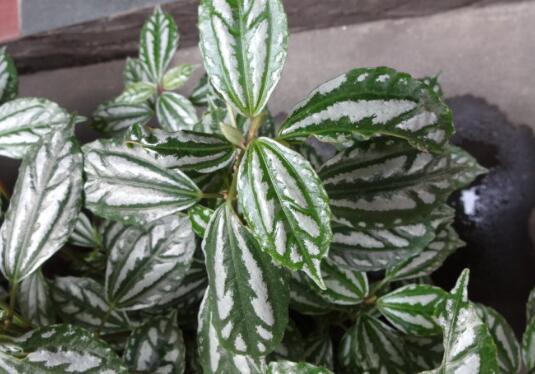
If you want to know how to grow Pilea cadierei, first we need to understand its growth habits. It is a light-loving plant, so when growing it, you should maintain sufficient light. In addition, watering, fertilizing, and other aspects also need attention. The specific details are introduced in the cultivation methods and precautions for Pilea cadierei below. Let's take a look.
2. Cultivation methods and precautions for Pilea cadierei
1. Soil selection: good drainage is required
When growing Pilea cadierei, we first need to choose soil, which is the step of laying a good foundation. Generally, it is best to choose relatively loose humus soil. This kind of soil has good drainage and aeration, allowing Pilea cadierei to grow more vigorously, and when using this kind of soil, it is also less likely to become waterlogged.
2. Fertilization requirements: once every 2 weeks during the growth period
During the growth process of Pilea cadierei, fertilizer is one of its main nutrients. Especially after entering the growth period, its demand for fertilizer is very high. Basically, it needs to be fertilized once every two weeks so that it can grow more robustly. However, when fertilizing, there is one point to note: the fertilizer needs to be diluted with water before application so that it can be absorbed better.
3. Watering management: control the amount of watering
When watering Pilea cadierei, it is best to keep the potting soil dry without cracking and moist without being wet. In summer, we can often spray water on its leaves to maintain leaf moisture and also clean the leaves. When watering, pay attention to controlling the amount of water. It is best not to water too much, otherwise waterlogging can easily lead to root rot.
4. Light requirements: grow it in scattered light
Among the cultivation methods and precautions for Pilea cadierei, light is also a point that needs relatively more attention. Although Pilea cadierei likes light, it is not tolerant of strong light, so it is best to grow it in a place with scattered sunlight, because if the light is too strong, it can easily scorch the plant and cause its leaves to turn yellow, while if the light is too dark, the leaves will also gradually lose their green color.
5. Temperature control: 15°C-25°C
When growing Pilea cadierei, it is also very important to let it grow at a comfortable temperature. The suitable environmental temperature for its growth is between 15°C and 25°C. When growing it, we can do a good job of temperature control. Especially after entering winter, temperature control is even more important. Pilea cadierei is relatively not cold-tolerant, so in winter the environmental temperature should preferably not be lower than 5°C.
6. Pruning management: pinch back once after potting
Pilea cadierei is relatively tolerant of pruning. After the cuttings are potted, we can pinch them back once. When the new side branches grow to 4 leaves, keep 2 leaves and pinch back again. By repeating this operation, a multi-branched, full, hemispherical plant shape can be formed. When the old branches of Pilea cadierei grow too tall, we also need to prune them to maintain its plant shape.
7. Pest and disease management: handle promptly and do not delay
When growing Pilea cadierei, if it is not grown properly, problems such as pests and diseases can easily appear. Such problems are extremely harmful to the plant and must be handled promptly, because the longer it is delayed, the harder it is to cure. The specific control methods are introduced in detail by the editor in the article on pest and disease control for Pilea cadierei. You can take a look.
How to grow Pilea cadierei: cultivation methods and precautions for Pilea cadierei
Pilea cadierei is an evergreen foliage plant with beautiful leaf colors and attractive patterns, and it is very easy to grow, with strong adaptability to the environment. Although Pilea cadierei is a foliage plant, it can also produce particularly beautiful and eye-catching flowers. So how should Pilea cadierei be grown? Let's learn about it together with the editor below!
How to grow Pilea cadierei
1. Soil: The potting soil for Pilea cadierei is best to use loam rich in humus, loose, and fertile. Keep the potting soil moist, but not overly wet, otherwise the roots are prone to rot. It has relatively high requirements for air humidity. Use mainly decomposed organic fertilizer and do not apply too much urea. If there is too much nitrogen fertilizer, it is prone to excessive growth, which is not conducive to a beautiful plant shape. When phosphorus and potassium fertilizers are insufficient, the markings on the leaves tend to fade.
2. Light: Pilea cadierei is an indoor flower with very beautiful leaf color. It is very shade-tolerant, but it prefers sufficient light and should avoid direct strong light. In summer, place the flowerpot on a north-facing window, and in winter, place it on a south-facing window. If the light is too dark, the leaf color will fade. If the sunlight is too strong, the leaves will be scorched. The suitable growth temperature is 18-22°C, and the overwintering temperature should not be lower than 7°C.
3. Fertilizer and water: It is best to keep the potting soil of Pilea cadierei dry without cracking and moist without being wet. In summer, frequently spraying water on the leaf surface can keep the leaves clean and glossy. In winter, spray less water on the leaf surface, otherwise black spots may appear on the leaves, or even blackening and rotting. During the growth period, apply a 20-80 or 30-70 nitrogen liquid fertilizer about once every two weeks to promote robust plant growth. After autumn, increase phosphorus and potassium fertilizers to strengthen the stems and prevent lodging.
4. Pruning: Pilea cadierei is tolerant of pruning. After the cuttings are potted, pinch back once. When the new side branches grow to 4 leaves, keep 2 leaves and pinch back again. Repeat this to form a multi-branched, full, hemispherical plant shape. When the old plant grows too tall, you can repot it in spring and leave 2-3 nodes at the base, then heavily prune and shorten it. After new branches emerge, pinch back 2-3 times, and a short and compact plant shape can again be formed.
5. Pests and diseases: Pilea cadierei commonly suffers from leaf spot disease, which can be prevented by spraying 200-times Bordeaux mixture. If the potting soil is too wet, root rot is likely to occur, and it can be irrigated with 1000-times Topsin solution. If root-knot nematodes are found, 3% carbofuran can be applied for control. If there are scale insects, spray with 1000-times 40% omethoate solution to kill them. If scarab beetles eat the leaves, they can be caught manually or sprayed with 1000-times trichlorfon solution.
Cultivation methods and precautions for Pilea cadierei
1. Pilea cadierei should be repotted at least once a year in spring. During the growth period, fertilize about once a week, applying nutrient solution once.
2. When Pilea cadierei has been cultivated for too long and its growth slows down, it should be pruned in time, otherwise the ornamental effect will be reduced.
3. Pilea cadierei likes relatively strong scattered light. In summer, block more than 70% of the sunlight. If the sunlight is too strong, the leaves will be scorched. In winter, no shading or only slight shading is needed.
4. When overwintering, the temperature for Pilea cadierei should be kept above 13°C. Long-term temperatures below 10°C will cause damage, but a short period at around 5°C will not cause damage.
5. Pilea cadierei likes a humid environment. Keep the potting soil moist and the air humidity relatively high. In dry seasons, you can frequently spray water on the surrounding environment or the leaf surface.
When does Pilea cadierei bloom?
Pilea cadierei does bloom, but its flowers are actually not very showy. It is dioecious. The inflorescences grow out from the leaf axils, bearing cyme-like flowers, small yellow-white blooms, very elegant. After Pilea cadierei blooms, it also produces fruit. Overall, both the flowers and fruits of Pilea cadierei have a certain ornamental value.
In fact, Pilea cadierei blooms in summer. Its flowering period is from June to September, and its fruiting period is from September to November.
Growth habits of Pilea cadierei
Pilea cadierei is native to valleys, streamside areas, or shady and humid places under forests, at an altitude of 300-1500 m. It is produced in Guangdong, Guangxi, Hunan, Hubei, Guizhou, Sichuan, southern Gansu, southern Shaanxi, southern Henan, southern Anhui, Jiangxi, Zhejiang, Fujian, and Taiwan, China, and is also distributed in Japan and Vietnam.
Pilea cadierei likes a warm and humid climate and prefers loose and fertile sandy soil. The suitable growth temperature is 15°C to 25°C, and in winter it must not be low.
Pilea cadierei is a small foliage plant and takes up relatively little space. It is generally used to decorate interiors. Many people like to grow it in rooms or offices. It is not only beautiful but can also purify the air!