What are the cultivation methods for the parlor palm?
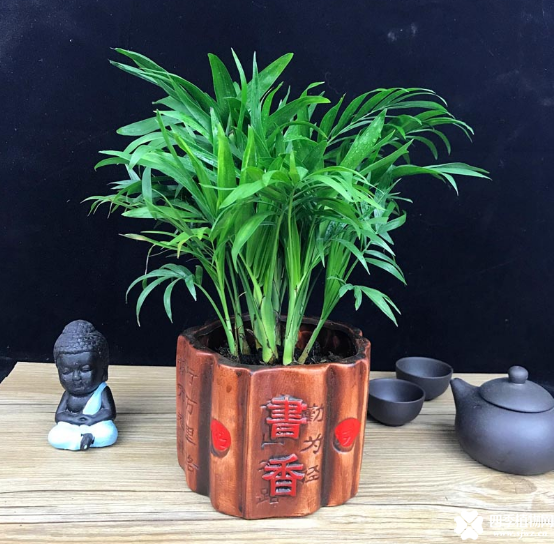
Cultivation methods for the parlor palm. The parlor palm belongs to the palm family (Arecaceae) and is an evergreen small tree. Its pinnate leaves grow from the top of an upright stem; the leaves are thin, leathery and glossy. Its compact form resembles a beautiful coconut palm, which is how it got the name parlor palm.
When cultivating it, the parlor palm should be kept year-round in a spot without direct strong light; it is best not to place it near a south-facing window, as too much light will cause the leaf edges to scorch. Indoors it is generally grown as a small to medium potted plant, placed on a desk or windowsill for viewing. It has small yellow flowers, and when it blooms, the sight of its lush foliage and branches is the best viewing period.
The parlor palm's suitable growing temperature is 20-30°C; it tolerates high temperatures fairly well, but in winter it must not go below 10°C. Besides keeping the potting soil moist, you should also spray water on the leaves and the ground frequently. In summer, placing it on a balcony to grow and letting it occasionally get a light shower of rain is very good for its growth. The potting soil must not be acidic soil, and a small amount of clay should be added. Because it has many roots, it should be planted in a tall pot. Repotting should be done in spring, and repotting once every 3 years is more suitable.
Caring for the parlor palm is not difficult, but home propagation is relatively hard; cuttings do not easily take root, so it is only suitable for propagation by seed. The above is an introduction to the cultivation methods for the parlor palm.
Cultivation methods for the parlor palm
1. Potting soil:
For potted parlor palms, loam soil that drains well and is loose and fertile is best.
2. Light:
The parlor palm likes semi-shade; under strong sunlight the leaf color will turn withered and yellow. If it is placed in a spot with insufficient light for a long time, the plant will become leggy. So indoors it is best placed in a bright spot by a window.
3. Temperature:
The parlor palm likes warmth; its suitable growing temperature is 18-25°C, and it enters dormancy at 13°C. In winter it is best not to let it go below 10°C.
4. Watering:
The parlor palm likes water; during the growing period keep the soil moist, and during dormancy wait until two-thirds of the potting soil is dry before watering again. In addition, the parlor palm likes high air humidity; if it is too dry, the leaf tips will turn brown. So during dry periods, such as in autumn, take measures such as frequently spraying water on the leaf surfaces to raise the air humidity around the plant.
5. Fertilizing:
During the growing period, the parlor palm can be given a compound fertilizer once a month.
6. Pests and diseases:
Under high temperature and high humidity, the parlor palm is prone to brown spot disease. If brown spot disease is found, promptly treat it with 800-1000 times diluted thiophanate or baijunling. When the air is dry and ventilation is poor, it is also prone to scale insects. If scale insects are found, besides removing them manually by scraping, you can also spray with 800-1000 times diluted omethoate for control.
Cultivation methods for the parlor palm
Light: The parlor palm likes semi-shade; under strong sunlight the leaf color will turn withered and yellow. If it is placed in a spot with insufficient light for a long time, the plant will become leggy. So indoors it is best placed in a bright spot by a window.
Temperature: The parlor palm likes warmth; its suitable growing temperature is 18—24°C, and it enters dormancy at 13°C. In winter it is best not to let it go below 10°C.
Watering: The parlor palm likes water; during the growing period keep the soil moist, and during dormancy wait until two-thirds of the potting soil is dry before watering again. In addition, the parlor palm likes high air humidity; if it is too dry, the leaf tips will turn brown. So during dry periods, such as in autumn, take measures such as frequently spraying water on the leaf surfaces to raise the air humidity around the plant.
Fertilizing: During the growing period, give the plant a compound fertilizer once a month.
Potting soil: Loam soil that drains well and is loose and fertile is best for planting.
Propagation: The parlor palm is generally propagated by seed.
When cultivating the parlor palm, pay attention to the following points:
1. Guard against scorched leaf edges caused by too much light. Since the parlor palm prefers a more shaded environment, indoors it should be placed near a north or east window or in another spot with bright indirect light; the parlor palm fears direct strong light most of all, and even brief exposure to the sun can cause the leaves to scorch and the leaf color to turn yellow. Conversely, if it is kept in a too dry and dark place for a long time, the leaf color will also fade and lose its luster.
2. Suitable growing temperature. The most suitable growing temperature is generally 20-30°C; in winter the indoor temperature should be between 12-14°C, and the lowest temperature must not go below 10°C.
3. Maintain the surrounding air humidity. It needs frequent spraying of water on the leaf surfaces to increase air humidity.
4. The potting soil must not be acidic soil, and a small amount of clay should also be added.
5. It needs repotting once every 3 years.
6. During the seedling stage, apply diluted liquid fertilizer 3-4 times in spring and autumn.