How to control Golden Pothos Pseudocercospora leaf spot?
Symptoms: It mainly affects the leaves. Chlorotic yellow spots first appear on the leaves, with unclear margins; later, elliptical or oval yellowish-brown lesions appear on some of the yellow spots, with dark brown margins and clear boundaries. There is a broad yellow halo around them, and later a thin mold layer appears on the surface of the spots.
Control:
1. Strengthen management, appropriately thin out branches and leaves, improve air circulation, and collect diseased residues and burn them.
2. Spray fungicides to prevent and control the disease. The fungicides can be 30% copper oxychloride suspension concentrate + 70% mancozeb wettable powder (1:1) at 800 times dilution, or 75% chlorothalonil + 70% thiophanate at 1000-1500 times dilution, or 10% copper polyfungicide emulsion powder at 400 times dilution, or 40% triadimefon carbendazim wettable powder at 1000-1500 times dilution, or 50% duomeiling wettable powder at 800-1000 times dilution, or 40% duofengnong wettable powder at 500-600 times dilution. Apply once every 10-15 days, alternating the fungicides, spraying evenly and thoroughly.
What is chrysanthemum Pseudocercospora leaf spot, and how to control chrysanthemum Pseudocercospora leaf spot
Chrysanthemums are chosen to bloom in autumn; they are unique in this way, and their noble qualities make them highly favored by people. So what is chrysanthemum Pseudocercospora leaf spot? Below is an introduction to the control methods for chrysanthemum Pseudocercospora leaf spot.
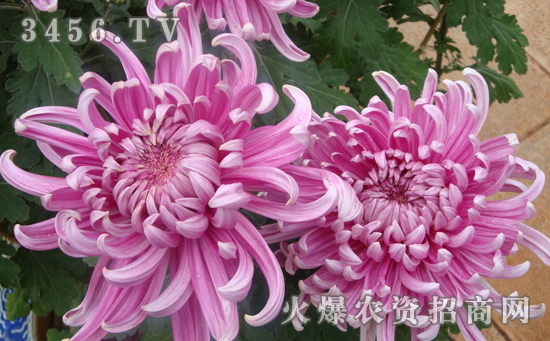
Symptoms of chrysanthemum Pseudocercospora leaf spot
The lesions occur on both sides of the leaves, are nearly circular, and initially have indistinct margins; later, a thin dark brown line sometimes forms, often along the leaf edge. On the leaf surface, the lesions are initially light yellow and later brown to dark brown, while on the underside they are grayish-brown.
Characteristics of chrysanthemum Pseudocercospora leaf spot
This disease is caused by a fungus, and the pathogen is Pseudocercospora chrysanthemicola. The pathogen overwinters on diseased residues and causes primary and secondary infections through conidia, spreading via airflow and rain splash. The disease is usually prone to occur in rainy weather or when there is heavy fog and dew.
Physical control methods for chrysanthemum Pseudocercospora leaf spot
When picking leaves, collect diseased residues and carry them out of the field to burn; clear ditches and drain waterlogging, avoid excessive application of nitrogen fertilizer, so that the plants grow robustly and their resistance is enhanced.
Chemical control methods for chrysanthemum Pseudocercospora leaf spot
At the early stage of the disease, spray 50% iprodione wettable powder at 1000-1500 times dilution; use 50% carbendazim wettable powder at 500 times dilution per mu, 100 ml per plant as a root drench, once every 7-10 days, for two or three consecutive applications; use 75% chlorothalonil wettable powder 147-267 g per mu, diluted in 75 L of water, and spray evenly.
Controlling chrysanthemum Pseudocercospora leaf spot
Chrysanthemum (Latin scientific name: Dendranthema morifolium (Ramat.) Tzvel.): In plant taxonomy, it is a perennial herbaceous plant with persistent roots in the Asteraceae family and the Chrysanthemum genus. According to cultivation forms, it is divided into cultivation types such as spray chrysanthemum, single-stem chrysanthemum, large standard chrysanthemum, cliff chrysanthemum, artistic chrysanthemum, and potted desk chrysanthemum; according to the appearance and form of the petals, it is divided into cultivation types such as inward-curved, recurved, reflexed, irregular, open-centered, and flying-spider types. Chrysanthemums in different types are also given a variety of cultivar names. Controlling chrysanthemum Pseudocercospora leaf spot1. Symptoms
The lesions occur on both sides of the leaves, are nearly circular, and initially have indistinct margins; later, a thin dark brown line sometimes forms, often along the leaf edge. On the leaf surface, the lesions are initially light yellow and later brown to dark brown, while on the underside they are grayish-brown.
2. Disease characteristics
This disease is caused by a fungus, and the pathogen is Pseudocercospora chrysanthemicola. The pathogen overwinters on diseased residues and causes primary and secondary infections through conidia, spreading via airflow and rain splash. The disease is usually prone to occur in rainy weather or when there is heavy fog and dew.
3. Control methods
(1) Horticultural control: When picking leaves, collect diseased residues and carry them out of the field to burn; clear ditches and drain waterlogging, avoid excessive application of nitrogen fertilizer, so that the plants grow robustly and their resistance is enhanced.
(2) Chemical control: At the early stage of the disease, spray 50% iprodione wettable powder at 1000-1500 times dilution; use 50% carbendazim wettable powder at 500 times dilution per mu, 100 ml per plant as a root drench, once every 7-10 days, for two or three consecutive applications; use 75% chlorothalonil wettable powder 147-267 g per mu, diluted in 75 L of water, and spray evenly.