How to dwarf fruit tree bonsai? A detailed guide to practical methods
Methods for dwarfing fruit tree bonsai. Because potted fruit trees are limited by cultivation conditions, some measures are often needed for dwarf cultivation. The main methods for dwarfing potted fruit trees are as follows:
(1) Trunk ring-barking with a dwarfing rootstock bark patch. On a fruit tree trunk grown in a pot for 1 year, make a ring bark cut 5 cm near the base, peel off a piece of dwarfing rootstock bark of the same size and stick it on, then wrap and bind it. If no dwarfing rootstock is available, a dwarf variety can be used instead.
(2) Ring-barking with inverted bark patch. After the fruit tree is in full bloom, make a ring bark cut 4-5 cm on the trunk, stick the removed bark back on upside down, then wrap and bind it.
(3) Multiple ring-barking in one year. After the fruit tree is in full bloom, starting from the base of the trunk, peel off a strip of bark 0.2 cm wide, then wrap and bind it. After the wound heals, continue the above ring-barking 1 cm above it, until early July.
(4) Wire-girdling method. After full bloom, starting from the base of the trunk, tie 1 loop of iron wire every 3 cm, for a total of 3-4 loops. The wire must be tightened with pliers so that it cuts into the bark layer, but must not damage the xylem. Remove the wire in mid-August.
(5) Bark-peeling method. In May, peel off 1/3 of the bark layer from the trunk from top to bottom, leaving 2/3 as the transport channel for nutrients and water. If necessary, peel off 1/4 of the layer on each of two opposite sides of the trunk, or use a spiral peeling method, and wrap with plastic after peeling.
(6) Twisting method. In mid-May, hold the base of the trunk fixed with one hand, grab the upper end of the trunk with the other hand and twist it 360 degrees, then release.
(7) Multiple scoring method. Use a sharp knife to make several vertical cuts in the bark layer of the fruit tree trunk at intervals of 0.3 cm, or use a diagonal scoring method.
(8) Root-raising method. When potting a fruit tree, cut off the main root, keep 4-5 lateral roots, and make the root collar of the fruit tree 10 cm above the rim of the pot, then bury all the roots with soil, make a small watering ditch at the edge of the pot for watering, or use an infusion set for drip irrigation. After one year of growing, dig out all the soil above the pot rim, exposing part of the fruit tree's root system to the air, inhibiting root thickening and controlling the growth of aboveground branches, thereby achieving dwarfing. This shape is also unique, and after fruiting its ornamental value is extremely high. The above is an introduction to the methods for dwarfing fruit tree bonsai.
What is a dwarf fruit tree bonsai, and notes on daily care
Fruit tree bonsai, I believe everyone is very familiar with it. It is a plant decoration that people love very much in today's home decor. But everyone also knows that many fruit trees are very tall. In order to maintain the beauty of their posture, people usually use dwarf cultivation to grow them, forming what we often call dwarf fruit tree bonsai. So what exactly is this dwarf fruit tree bonsai, and what should be noted in daily care? Let's take a look at dwarf fruit tree bonsai together below.
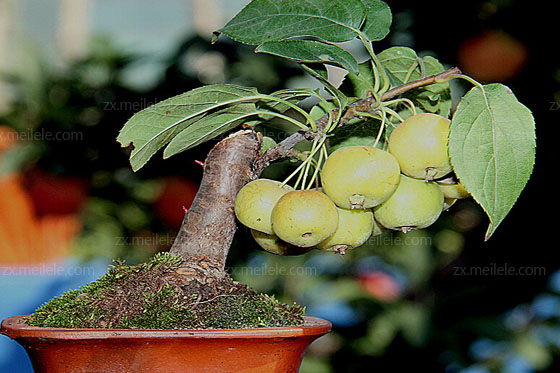
What is a dwarf fruit tree bonsai
In nature, the fruit trees we commonly see are relatively tall trees or shrubs, so when people want to make them into bonsai, they use a cultivation technique called dwarf cultivation. This technique can make plants shorter than they would be under normal conditions, and the fruit tree bonsai made through this technique is what we often call dwarf fruit tree bonsai. The shapes of this kind of plant bonsai are mostly very classical and elegant, simple and beautiful, so this kind of bonsai has always had high ornamental and practical value, and is deeply loved and welcomed by people. Moreover, this kind of bonsai can also reduce unnecessary nutrient consumption and better promote fruit tree growth.
Notes on daily care of dwarf fruit tree bonsai
1. Because this is a plant bonsai, there are many things to note in the daily care process. The first is the preparation of potting soil. Usually, soil suitable for fruit tree growth is neutral soil, while individual fruit trees may need slightly acidic soil. At the same time, nutrient-rich sandy loam or sandy soil rich in humus is also suitable for fruit tree growth. So during care, everyone can mix potting soil themselves, using fully weathered garden soil, river sand, plant ash, and so on in proportion. However, everyone should note that when using culture soil, it should be disinfected beforehand, so that toxic molecules and pest risks in the soil are eliminated.
2. Plant growth needs sufficient nutrients and water, so in the daily care of dwarf fruit tree bonsai, fertilizer and water management is an issue everyone needs to pay attention to. Especially because when fruit trees are potted in flowerpots, the fruit tree can only absorb nutrients through the soil in the pot, so the nutrients in the soil are not enough for the plant's growth needs. At this time, when fertilizing the bonsai, some organic fertilizer needs to be applied. Before the plant buds, quick-acting nitrogen fertilizer and phosphorus fertilizer are applied. For regular fertilization, applying once every half a month is enough. In terms of watering, it can be done according to the specific water needs of the fruit tree, but keeping the potting soil moist is generally necessary, and the potting soil must not be too dry.
3. If dwarf fruit tree bonsai are to maintain a beautiful posture, daily care must also pay attention to the pruning and shaping of the fruit trees. You should know that as time passes, plants will gradually grow, and at this time the form of the fruit tree will change. In order to maintain the simple and elegant shape of the fruit tree, timely pruning and shaping work is indispensable. And this work must be analyzed according to specific problems, because the specific situation of each fruit tree may differ. In addition, when the nutrients in the bonsai potting soil have been largely consumed, everyone should not forget to do the repotting work. That is, dwarf fruit tree bonsai need to be repotted in time every 2 to 3 years to keep the soil fresh and fertile.
Conclusion: Dwarf fruit tree bonsai are a very popular indoor plant decoration today, but in daily care everyone still needs to put in effort, otherwise no matter how easy the plant is to grow, many problems will still appear.
How to dwarf fruit trees into bonsai and how much they cost
Fruit trees, many people like to grow them. If you want to turn a fruit tree into an indoor plant, you can only dwarf it. How are fruit trees dwarfed into bonsai? How much do dwarf fruit tree bonsai cost:
How to dwarf fruit trees into bonsai:
(1) Dwarfing measures
1. Choose dwarf varieties
If you want potted dwarf fruit trees, then first you must choose good varieties. With the current level of technology, fruit tree varieties suitable for dwarfing mainly include: 1) Citrus types: fingered citron, kumquat, lemon, four-season dwarf pomelo, dwarf late pomelo, etc.; 2) Peach trees: Dwarf Lihong, dwarf peach, Shouxing peach, etc.
2. Graft with dwarfing rootstock
If you want to dwarf fruit trees well, then in addition to choosing good varieties, you also need to know a professional grafting method, which is grafting with dwarfing rootstock.
3. Root-restricting seedling cultivation
We all know that during the growth of normal fruit trees, their crowns and root systems keep growing, so if you want to dwarf them, you naturally have to control root growth. Methods such as cutting the main root and container seedling cultivation can be used to achieve a dwarfing effect. When planting in pots, use a small pot first, then gradually switch to a larger pot. When potting and repotting, shorten and prune the main root and lateral roots to limit root growth.
(2) Choose containers
When dwarfing fruit trees, an appropriate container should be chosen for potting, generally a round container with good air permeability.
(3) Soil, fertilizer, and water management
In terms of soil selection, neutral soil is generally preferred. At the same time, because the nutrients needed by fruit trees are mainly obtained through fertilization, fertilizer and water management must be emphasized during the growing period, and fertilization should mainly use organic fertilizer.
(4) Flower and fruit management
When the fruit begins to set, if the amount of flower buds is large and the fruits are set relatively densely, thinning should be carried out. If the amount of flower buds is small, more flowers can be kept. At the same time, artificial pollination should be carried out.
How much do dwarf fruit tree bonsai cost:
In the current market, the market price difference is still relatively large, mainly varying with the size of the bonsai, fruit tree variety, and so on. For example, fruit seedlings are naturally cheaper than formed fruit trees. Based on the current market, the price of dwarf fruit tree bonsai seedlings is generally around ten-plus yuan each, while formed ones are over a hundred yuan. Of course, there are also more expensive ones, with a single one costing several thousand yuan.
The methods and prices for dwarf fruit tree bonsai are introduced here. Those who need them can study them at home.