Poinsettia Pest and Disease Types and Control Methods
Common diseases of poinsettia include Pythium rot, gray mold, powdery mildew, and Rhizoctonia, while common pests include whitefly, thrips, spider mites, and fungus gnats.
(1) Control of Pythium rot. Keep the potting soil moist, avoiding drying out, overwatering, and excessive salt levels; check the root system regularly, and if the potting soil has dried out, water thoroughly with clean water before fertilizing. If the roots are found to be possibly damaged, drench with a 1000-fold dilution of thiophanate-methyl solution.
(2) Control of gray mold. Maintain ventilation and low humidity, especially before harvest; overhead watering should only be done in the morning; spray with an 800-fold dilution of Kelu, and note that it can only be used after rooting.
(3) Control of powdery mildew. Maintain smooth ventilation and slightly lower humidity, and apply a 1000-fold dilution of propamocarb once every 5 days for 3 consecutive applications, which can effectively prevent powdery mildew; one more application may be made after the bracts have colored.
(4) Control of Rhizoctonia. Maintain the salt level in the substrate and moderate moisture content. Spray with a 1000-fold dilution of carbendazim and a 1000-fold dilution of chlorothalonil, alternating them every 4 weeks.
(5) Control of whitefly. Applying prodiamine to the soil can also effectively suppress the development of whitefly populations. Relatively safe products include Yibianjing, imidacloprid, and Jiqi; note that before large-scale use, always test with double the dosage to see whether it causes damage.
(6) Control of thrips. Control with a 1200-fold dilution of Caixi, or spray with a 1000-fold dilution of abamectin.
(7) Control of red spider mites. Spray with a 2000-fold dilution of Chongmanke or a 3000-fold dilution of pyridaben, applying once a week for 4 consecutive weeks.
(8) Control of fungus gnats. This pest mostly occurs in the early propagation stage and during the first thinning of seedlings; spraying the floor weekly with an ordinary broad-spectrum insecticide can greatly reduce the population.
What are the common pests and diseases of poinsettia, and the control methods for poinsettia pests and diseases
The poinsettia has an elegant plant form and a refined, high-end presence, making it very suitable for traditional Chinese festivals, and it seems almost tailor-made for China. Because the poinsettia blooms right around New Year's Day and the Spring Festival, it carries the beautiful meaning of universal celebration and welcoming new life. However, during home cultivation there are always some unsatisfactory aspects that affect the poinsettia's ornamental effect. So what are the common pests and diseases of poinsettia? Below, we introduce the control methods for poinsettia pests and diseases.
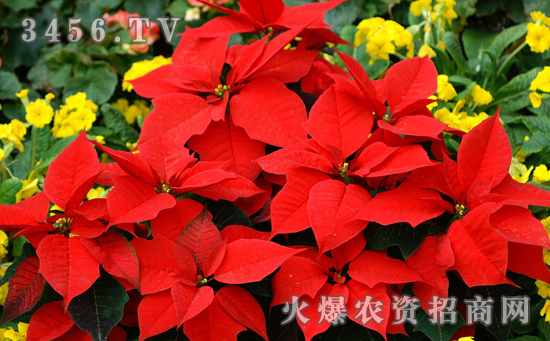
What are the common pests and diseases of poinsettia
The common pests and diseases of poinsettia include gray mold, root rot, leaf spot, and whitefly. These diseases not only affect the overall home ornamental effect of the poinsettia but in severe cases can even cost the poinsettia its life, so everyone should pay extra attention to poinsettia pests and diseases.
Control methods for poinsettia pests and diseases
Gray mold
Gray mold mainly occurs in winter, right during the poinsettia's flowering season. Once there is continuous rain, dampness, and no sunlight, it can harm the poinsettia's inflorescences, bracts, leaves, and branches. Generally, water-soaked lesions first appear on the inflorescences. Afterward, the lesions are covered with a layer of the pathogen's conidia, and the pathogen continues to spread to the bracts. On the bracts, water-soaked discolored spots initially appear, then gradually expand into irregular shapes; the pathogen then spreads to the branches, producing yellow-brown to brown lesions on the branches. In the later stage, the lesions clearly sink downward and turn dark brown, and in severe cases the lesion areas become dry and withered. The pathogen is Botrytis, which can survive on dead plant tissue or other organic matter and has a wide host range. It can survive at temperatures of 0-38°C, and as long as there is moisture, it is present. If the greenhouse is too humid, cold, and dim, after 1-2 d the pathogen produces large numbers of spores that float in the air and begin infecting plant tissues.
Control methods: Taking advantage of the closed nature of the facility, create a high-temperature, low-humidity ecological environment to control the occurrence and development of gray mold. At night, indoor humidity in the facility is often above 90%; after pulling up the straw matting in the early morning, promptly open the vents to ventilate and remove moisture, reduce indoor humidity, and control disease development with a lower temperature. After 9 o'clock, when the indoor temperature rises faster, close the vents and quickly raise the indoor temperature to about 32°C.
Root rot
Root rot and stem rot can infect mature plants and can also infect during the seedbed stage, causing serious losses. It generally occurs more severely in high-temperature seasons, and is also very likely to occur when the cultivation soil has high water content. In the early stage, the plant shows wilting; if the stem base is examined at this time, a light brown constriction can be seen, but the infected plant shows no decay or hydrolysis. Later, the lesions gradually spread upward, and the wilting gradually becomes more severe; the stem lesions are slightly sunken and yellow-brown. In the later stage, the tissue at the lesion disintegrates, causing the plant to wither and die from severe water shortage. Sometimes the whole plant turns yellow in a water-soaked manner and eventually rots and dies. Near the ground, white mycelium may be visible, and in severe cases it can spread into the cultivation soil. When the roots are affected, root rot often results, initially affecting the plant's normal growth and in severe cases leading to death. The main pathogens are Phytophthora, Rhizoctonia solani, Pythium, and others. When salts accumulate on the surface of the medium; Pythium appears when poinsettia is a mature plant, and it may already have invaded at the cutting stage; when the environment is suitable for reproduction, it worsens, causing root rot and death; high temperature and excessive irrigation (adverse conditions) can cause Phytophthora damage.
Control methods:
1. Practice crop rotation. For lightly diseased fields, rotate every other year; for heavily diseased fields, rotate after 3-5 years.
2. Deep plow and improve the soil, increase the application of organic fertilizer, irrigate and drain reasonably, and enhance disease resistance.
3. Strictly select seeds and eliminate unqualified seeds. Treat seeds with 50% carbendazim wettable powder at 0.5% of seed weight.
4. When disease occurs, spray the stem base of peanuts with a 1000-fold dilution of 50% carbendazim wettable powder, using 25-30 kg of solution per mu each time.
Leaf spot
Leaf spot occurs more severely mainly in spring and summer, and the lesions mostly begin on old leaves. In the early stage, small purple-red to brown spots appear on the leaves; the lesions are nearly circular to irregular, and later gradually expand. Many lesions can merge with each other to form one large lesion, and in the later stage the center of the lesion gradually turns gray-brown. In severe cases, the lesion tissue becomes gangrenous, causing the leaves to twist and dry up.
Control methods:
Remove diseased tissue promptly and burn it in a centralized manner; practice crop rotation (soil can be replaced in the greenhouse); do not spray or water the plants; begin spraying from the early stage of disease to prevent the disease from spreading and expanding.
Whitefly
The main insect pests of poinsettia include whitefly, spider mites, and thrips. The adults and larvae of whitefly prefer dense, shaded environments and gather on the underside of the upper leaves of poinsettia, using piercing-sucking mouthparts to suck sap, causing leaves to fade or develop chlorotic spots, affecting photosynthesis and leading to poor plant growth; the honeydew excreted by the insects often causes sooty mold. Adults are attracted to yellow. Emergence begins at 6 a.m., with the largest emergence between 7-8 a.m. and the lowest in the evening. Whitefly is most vulnerable as newly mobile larvae, followed by newly emerged adults, which are sensitive to pesticides and suitable for spray control. Whitefly generally occurs in large numbers under high temperature and low humidity, with the peak period from late September to late November. The optimal control period is late September, and the spraying time is 6-10 a.m.
Main pests and diseases of poinsettia and their control
Poinsettia is an evergreen shrub of the Euphorbiaceae family. Its flowering period falls around New Year's Day and the Spring Festival, and its bright red, gorgeous yet soft bracts make it much loved. In Europe, America, Japan, and the Taiwan region of China, it is an important commercial potted flower, and it has now become a major potted category in the domestic potted flower market with low investment, quick results, and high returns. However, during its production and cultivation, various pests and diseases are likely to occur; if reasonable control measures are not taken in time, the plants will suffer severe damage and lose their ornamental value. I. Main pests and diseases and the conditions for their occurrence1. Main disease symptoms and conditions for their occurrence
(1) Powdery mildew
In the early stage of infection, spots resembling pesticide residue appear on the leaves and bracts. Then powdery mildew spreads rapidly, and the typical white mold-like substance appears on the plant surface, while the infected tissue necroses. Symptoms of powdery mildew first appear on the underside of the leaves, while green patches often appear on the upper surface of the leaves.
The pathogen is leveillula clavata of the powdery mildew genus, which harms leaves, flowers, and tender shoots. In the early stage, it produces a white sticky powdery mold layer, which later turns gray. The spores of powdery mildew spread very easily through the air along with the plants. This disease can occur throughout the poinsettia production season, with spring or late autumn being its peak seasons. It is prone to occur in hot, humid environments, or when too much nitrogen fertilizer is applied and the soil lacks calcium or potassium. Under cool, highly humid conditions with large day-night temperature differences, powdery mildew can easily and rapidly become epidemic.
(2) Gray mold
Gray mold is the most common disease in poinsettia cultivation. It can appear throughout the entire growing season of poinsettia, and all parts of the plant can be infected. It mainly occurs in winter, which is exactly the poinsettia flowering season; once there is continuous rain, dampness, and no sunlight, it often becomes uncontrollable.
It mainly harms poinsettia inflorescences, bracts, and tender shoots. Generally, water-soaked lesions first appear on the inflorescences, then gradually expand, and the diseased tissue turns brown to black and rots. Under humid environmental conditions, a gray to gray-brown mold layer forms on the surface in the later stage, and the lesions are covered with a layer of the pathogen's conidia. The pathogen continues to spread to the bracts; on the bracts, water-soaked discolored spots initially appear, then gradually expand into irregular shapes. After the flower organs are infected, they also turn brown, rot, and fall off. The pathogen then spreads to the branches, producing yellow-brown to brown lesions on the branches; in the later stage, the lesions clearly sink downward and turn dark brown, and in severe cases the lesion areas become dry and withered, completely losing ornamental value. When the bracts are infected, the red bracts become light purple leaves after infection. Young plants sometimes become diseased near the surface of the cultivation medium. Under relatively high air temperature conditions, a gray downy mold, namely the pathogen's conidiophores and conidia, forms on this rotting tissue. On mature branches and stems, a black rot appears, and this black rot develops around the stem and branches, causing the leaves on the damaged surface to wilt.
The pathogen is botrytis cinerea pers. of the Deuteromycotina, and the pathogen is found almost throughout the entire greenhouse. It can survive on dead plant tissue or other organic matter, and is prone to grow and develop on succulent, aging, and wounded tissue, with a wide host range. As long as there is moisture, it is present, but it prefers cooler temperatures and is likely to occur under low temperature and high humidity (relative humidity 90%-100%).