How to Grow Poinsettia? A Detailed Guide to Flowering Period Regulation Methods
Under natural light conditions, poinsettia blooms in November to December. If you want to make it bloom earlier or later, you need to carry out treatment.
To advance the flowering period, short-day treatment is mainly used, that is, once the plant is basically or fully formed, cover the plant with a small arched shed plus black film, taking care that the shading is tight. If light leaks through, the expected effect will not be achieved (generally a light intensity of around 100 lux is enough to stop flower bud differentiation and development). The daily dark period should be 14 to 15 hours, that is, cover at 6 to 7 pm each day and uncover at 8 to 9 am the next day. The shading must be carried out continuously, every day without interruption; if interrupted, the earlier treatment will not work.
When the temperature is too high, between 10 pm and 2 am the next day, it is best to remove the black film to ventilate and let air through, avoiding yellowing and withering of leaves caused by high temperature, and this also helps flower bud formation. After 22 to 28 days of this treatment, flower bud differentiation is complete, and you can see the flower buds at the top of the plant's branches clearly swelling; after about 35 days the bracts begin to turn red, and when one bract at the branch tip has turned completely red, stop the shading treatment; at 60 to 70 days it enters full bloom. From this, you can calculate the time to start treating the plant according to the desired blooming time. If you want it to bloom with strong light for National Day, treating in mid-July is best.
To delay flowering, night lighting treatment is mainly used. Generally, as long as there is a light intensity of 100 lux around the plant's height, flower bud differentiation can be stopped, and generally adding light from 10 pm to 2 am the next day gives good results.
Poinsettia Cultivation Methods and Precautions
Poinsettia Growth Habits
Poinsettia originated in the Taxco region of Mexico in Central America, and was introduced to the United States in 1825 by Joel Poinsett, the first U.S. ambassador to Mexico. It is a short-day plant and likes warmth. The suitable temperature is 18 to 25°C, from April to September it is 18 to 24°C, from September to the following April it is 13 to 16°C, and the winter temperature should not be lower than 10°C. It likes moisture; poinsettia is relatively sensitive to water, and during the growing period it only needs a sufficient water supply. It likes sunlight; during the stem and leaf growth period it needs sufficient sunlight to promote rapid and luxuriant stem and leaf growth.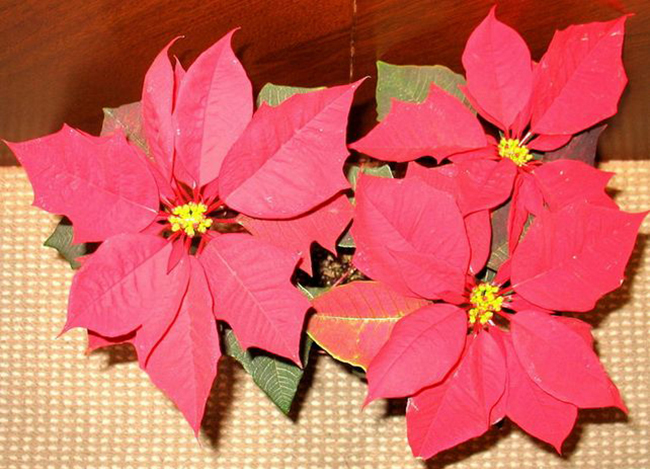
Poinsettia Propagation Methods
1. Cutting propagation:
Poinsettia cutting propagation mainly includes two methods: semi-hardwood cutting and softwood cutting, and there is also the old root cutting method. Regardless of which cutting propagation method is used, poinsettia cuttings should preferably be taken in the early morning, because at this time the cuttings have a relatively sufficient water content. When cutting the cuttings, the cut should be smooth, and the split epidermis and xylem should be trimmed off to avoid water accumulation and rot, which would affect healing and rooting.
2. Layering propagation:
Poinsettia generally uses the air layering method, and the best time for layering is April to July. Select woody branches, generally healthy and plump branches from the previous year, and make a ring bark cut on a smooth part. The width of the ring cut should be similar to the thickness of the branch at the ring cut site, generally 3 to 4 cm is suitable. After layering, roots generally grow in about two months, at which point it can be cut off and planted in a pot, forming a new plant.
Poinsettia Cultivation Methods
1. Soil:
Poinsettia likes loose, well-drained soil. Generally use 3 parts vegetable garden soil, 3 parts humus soil, 3 parts leaf mold, and 1 part decomposed cake fertilizer, mixed with a small amount of cinder.
2. Temperature:
Poinsettia likes warmth and fears cold. In mid-to-late September each year, move it indoors and strengthen ventilation so the plant gradually adapts to the indoor environment. In winter, the room temperature should be kept at 15°C to 20°C. At this time it is exactly the period of bract color change and flower bud differentiation; if the room temperature is below 15°C, the flowers and leaves will develop poorly. After mid-December it enters the flowering stage, and ventilation should be gradually increased.
3. Light:
Poinsettia likes sufficient light and is strongly phototropic; it is a short-day plant. It should receive sufficient light in all four seasons, and this is even more important during bract color change, flower bud differentiation, and flowering. If light is insufficient, branches tend to grow leggy and are prone to disease, and the flower color is dull. If placed in a dark place for a long time, it will not bloom and will drop leaves in winter. To advance or delay flowering, light can be controlled; generally giving 8 to 9 hours of light per day allows it to bloom in 40 days.
4. Fertilizing:
Poinsettia likes fertile sandy soil. In addition to adding organic fertilizer and horse hoof pieces as base fertilizer when potting and repotting, during the growing and flowering season apply a liquid fertilizer of fully decomposed sesame paste residue diluted 5 times once every 10 to 15 days. After autumn begins, you can also use 0.3% compound chemical fertilizer once a week for 3 to 4 consecutive times to promote bract color change and flower bud differentiation.
5. Watering:
Poinsettia is neither tolerant of drought nor of waterlogging. Watering should be flexibly controlled according to the weather, potting soil, and plant growth conditions. Generally, watering should keep the potting soil moist without accumulating water, but after flowering, watering should be reduced. Watering should be even to prevent excessive dryness or wetness, otherwise it will cause the lower leaves of the plant to turn yellow and fall off, commonly known as "bare legs," or cause uneven branch growth.
6. Pinching:
After poinsettia has been planted for 3 weeks, the root system has grown, and at this time it can be pinched. When pinching, leave 4 to 6 leaf nodes, raise the temperature to a daytime temperature of 28 to 30°C and a nighttime temperature of 23°C, and mist frequently to increase humidity. After about two weeks, when buds are seen growing, slowly lower the temperature to 25 to 28°C during the day and also lower the humidity. During this period, according to the plant's uniformity and fullness, carry out a second pinching, supplement nutrients, and combine with dwarfing agent treatment.
7. Pruning:
Around Qingming Festival, repot the dormant old plant, cut off old roots and diseased or weak branches to promote new shoots. During growth it needs pinching twice, the first in late June and the second in mid-August. In cultivation, heavy fertilizer and heavy watering should be controlled, especially before the plant takes shape in autumn. When the branches grow to 20 to 30 cm, begin shaping and bending, with the aim of making the plant short and compact, with neat flower heads distributed evenly, improving ornamental value.
8. Plant control:
During poinsettia cultivation, plant growth regulators must be used to dwarf the plant height, so as to meet the requirement that commercial flowers have a consistent height. In addition, maintaining consistency between day and night temperatures during cultivation is also crucial and should be tracked and monitored at all times. When the day-night temperature difference exceeds 3°C, after sufficient pinching, spray 750 to 1000 ppm chlormequat 1 to 4 times to inhibit stem legginess.
Precautions for Cultivating Poinsettia
(1) Poinsettia is relatively sensitive to water. During the growing period, as long as water is sufficient, stems and leaves grow rapidly. Conversely, lack of water or alternating dry and wet conditions will cause leaves to fall off. Therefore, water control directly affects the growth and development of poinsettia.
(2) Poinsettia is a light-loving flower and grows robustly under strong light. Except in midsummer when shade and cooling are needed, it should have sufficient light in other seasons. Even in summer, shading will cause thin stems and enlarged leaves.
(3) Poinsettia enters the shed in mid-to-late October. When first entering the shed, open both ends of the shed to reduce the temperature difference inside and outside the shed, avoiding yellowing or leaf drop that affects flower quality. In winter, keep it above 20°C during the day, and the nighttime temperature must not be lower than 15°C, otherwise growth is slow, which is unfavorable for bract formation, and too low a temperature will also cause yellow leaves and leaf drop. Indoor poinsettias should have their pots turned every day to maintain even light and prevent branches from growing crooked. After entering the shed, the watering amount for poinsettia must be strictly controlled; if humidity is too high, flowers and leaves easily rot; if the pot lacks water, leaves easily turn yellow and fall off. After flowering, water less.
Poinsettia Pest and Disease Control
1. Gray mold
[Symptoms]Gray mold mainly occurs in winter, which is exactly the poinsettia flowering season. Once there is continuous rain, dampness, and no sunlight, it can harm poinsettia inflorescences, bracts, leaves, and branches. Generally, water-soaked lesions first appear on the inflorescences. Afterward, the lesions are covered with a layer of pathogen conidia, and the pathogen continues to spread to the bracts. At first, water-soaked faded spots appear on the bracts, then gradually expand into irregular shapes. The pathogen then spreads to the branches, producing yellow-brown to brown lesions on the branches. In the later stage, the lesions clearly sink inward and become dark brown, and in severe cases the lesions become dry and withered.
[Control]Taking advantage of the closed characteristics of the facility, create a high-temperature, low-humidity ecological environment to control the occurrence and development of gray mold. At night, indoor humidity in the facility is often above 90%. After pulling up the mat in the morning, immediately open the ventilation openings to ventilate and remove moisture, reduce indoor humidity, and control disease development with a relatively low temperature. After 9 o'clock, when the indoor temperature rises faster, close the ventilation openings to quickly raise the indoor temperature to around 32°C.
2. Root rot
[Symptoms]It generally occurs more severely in high-temperature seasons, and is also very likely to occur when the cultivation soil has high water content. In the early stage, the plant shows wilting. If the stem base is examined at this time, a light brown constriction can be seen, but no rotting or hydrolysis is seen in the infected plant. Later, the lesions gradually spread upward, and the wilting gradually becomes more severe. The stem lesions are slightly sunken and yellow-brown. In the later stage, the tissue at the lesion disintegrates, causing the plant to wither and die due to severe water shortage. Sometimes the whole plant becomes water-soaked and yellowed, eventually rotting to death. White mycelium can be seen near the ground, and in severe cases it can spread into the cultivation soil. When the roots are affected, root rot often results, initially affecting the plant's normal growth and in severe cases causing death.
[Control]① Practice crop rotation: rotate every other year in lightly diseased fields, and rotate every 3 to 5 years in heavily diseased fields. ② Deep plowing and soil improvement: increase organic fertilizer, carry out reasonable irrigation and drainage, and enhance disease resistance. ③ Strict seed selection: eliminate unqualified seeds. Treat seeds with 50% carbendazim wettable powder at 0.5% of seed weight. ④ When disease occurs, spray the stem base of peanuts with a 1000-fold solution of 50% carbendazim wettable powder, using 25 to 30 kg of liquid per mu each time.
3. Leaf spot
[Symptoms]Leaf spot occurs more severely mainly in spring and summer, and the lesions mostly begin on old leaves. In the early stage, purple-red to brown small spots appear on the leaves. The lesions are nearly round to irregular, and later gradually expand. Many lesions can merge with each other to form one large lesion, and in the later stage the center of the lesion gradually turns gray-brown. In severe cases, the tissue at the lesion becomes gangrenous, causing the leaves to twist and dry up.
[Control]① Remove diseased tissue promptly and burn it in a concentrated manner. ② Crop rotation (soil can be changed in greenhouses). ③ Do not spray water over the plants. ④ Start spraying from the early stage of disease to prevent the disease from spreading and expanding.
4. Whitefly
[Symptoms]Adult and larval whiteflies like dense, shaded environments and gather on the backs of the upper leaves of poinsettia, using piercing-sucking mouthparts to suck sap, causing leaves to fade or develop chlorotic spots, affecting photosynthesis and leading to poor plant growth. The honeydew excreted by the insects often causes sooty mold. Adults are attracted to yellow.
[Control]For whitefly, the newly hatched mobile larvae are the most vulnerable, followed by newly emerged adults, which are sensitive to pesticides and suitable for spray control. Whitefly generally occurs in large numbers under high temperature and low humidity, with the peak period from late September to late November. The optimal control period is late September, and the spraying time is from 6 to 10 am.
Poinsettia Cultivation Methods and Management
The alias of poinsettia is: ivory red, laolai jiao, Christmas flower, Christmas red, milkweed.. It is also called Christmas flower (called Christmas red in Taiwan, China), and is a famous red flower used for decoration at Christmas, because its bright red color is full of Christmas atmosphere. The red parts that people think are flowers are actually leaves, and the real flowers are in the middle of the leaf cluster. Poinsettia is usually 60 cm to 3 m tall, and its dark green leaves are about 7 to 16 cm long. Its topmost leaves are flame red, red, or white, so they are often mistaken for flowers. There are also literary works and related legends named after this.Poinsettia Cultivation Methods:1. Potting soil
Poinsettia likes loose, well-drained soil. Generally use 3 parts vegetable garden soil, 3 parts humus soil, 3 parts leaf mold, and 1 part decomposed cake fertilizer, mixed with a small amount of cinder.
2. Pinching
After 3 weeks of planting, the root system has grown, and at this time it can be pinched. When pinching, leave 4-6 leaf nodes, raise the temperature to a daytime temperature of 28-30°C and a nighttime temperature of 23°C, and mist frequently to increase humidity. After about two weeks, when buds are seen growing, slowly lower the temperature to 25-28°C during the day and also lower the humidity. During this period, according to the plant's uniformity and fullness, carry out a second pinching, supplement nutrients, and combine with dwarfing agent treatment.
3. Temperature
Poinsettia likes warmth and fears cold. In mid-to-late September each year, move it indoors and strengthen ventilation so the plant gradually adapts to the indoor environment. In winter, the room temperature should be kept at 15°C to 20°C. At this time it is exactly the period of bract color change and flower bud differentiation; if the room temperature is below 15°C, the flowers and leaves will develop poorly. After mid-December it enters the flowering stage, and ventilation should be gradually increased.
4. Light
Poinsettia likes sufficient light and is strongly phototropic; it is a short-day plant. It should receive sufficient light in all four seasons, and this is even more important during bract color change, flower bud differentiation, and flowering. If light is insufficient, branches tend to grow leggy and are prone to disease, and the flower color is dull. If placed in a dark place for a long time, it will not bloom and will drop leaves in winter. To advance or delay flowering, light can be controlled; generally giving 8 to 9 hours of light per day allows it to bloom in 40 days.
5. Fertilizing
Poinsettia likes fertile sandy soil. In addition to adding organic fertilizer and horse hoof pieces as base fertilizer when potting and repotting, during the growing and flowering season apply a liquid fertilizer of fully decomposed sesame paste residue diluted 5 times once every 10 to 15 days. After autumn begins, you can also use 0.3% compound chemical fertilizer once a week for 3 to 4 consecutive times to promote bract color change and flower bud differentiation.
6. Watering
Poinsettia is neither tolerant of drought nor of waterlogging. Watering should be flexibly controlled according to the weather, potting soil, and plant growth conditions. Generally, watering should keep the potting soil moist without accumulating water, but after flowering, watering should be reduced. Watering should be even to prevent excessive dryness or wetness, otherwise it will cause the lower leaves of the plant to turn yellow and fall off, commonly known as "bare legs," or cause uneven branch growth.
7. Pruning
Around Qingming Festival, repot the dormant old plant, cut off old roots and diseased or weak branches to promote new shoots. During growth it needs pinching twice, the first in late June and the second in mid-August. In cultivation, heavy fertilizer and heavy watering should be controlled, especially before the plant takes shape in autumn. When the branches grow to 20 to 30 cm, begin shaping and bending, with the aim of making the plant short and compact, with neat flower heads distributed evenly, improving ornamental value.
8. Plant control
During cultivation, plant growth regulators must be used to dwarf the plant height, so as to meet the requirement that commercial flowers have a consistent height. In addition, maintaining consistency between day and night temperatures during cultivation is also crucial and should be tracked and monitored at all times. When the day-night temperature difference exceeds 3°C, after sufficient pinching, spray 750 to 1000 ppm chlormequat 1 to 4 times to inhibit stem legginess.Poinsettia Management:
Poinsettia likes a warm, humid, and ventilated environment, is not tolerant of low temperatures, and both excessive sunlight and insufficient light are equally unfavorable to growth. During the growing period, care work such as fertilizer and water management and pinching to set the head must be done well.
When watering, be careful to prevent excessive dryness or wetness, otherwise it will cause the lower leaves of the plant to turn yellow and fall off and cause uneven branch growth. In hot summer weather, the amount of watering should be appropriately increased, but do not let water accumulate in the pot, so as to avoid root rot. In other seasons, decide according to the specific dry and wet conditions of the potting soil.
Poinsettia is not strict about soil requirements; ordinary fertile sandy soil is fine. When repotting, add decomposed organic fertilizer in a timely manner as base fertilizer. During the growing and flowering season, apply liquid fertilizer once about every half month. After autumn begins, apply some fertilizer rich in potassium and phosphorus to promote flower bud differentiation and ensure the bracts are bright red and pure in color.
After poinsettia enters the growing period, it grows relatively quickly. At this time, be sure to pinch to set the head, otherwise the branches will grow too tall, and besides being prone to falling over, it will also affect the appearance and shape, reducing ornamental value.
Poinsettia propagation can use the cutting method. In spring and summer, cut off a section of branch, apply some plant ash to the cut to prevent the cut from rotting, and insert it into the soil; it will take root in about 25 days.
In addition, the sap of poinsettia is toxic. When pinching and taking cuttings, do not touch it, so as to avoid skin discomfort.