What pests and diseases affect gladiolus? Detailed guide to prevention and control methods
The main pests and diseases of gladiolus include corm rot, fusarium wilt, rust, nematodes and root mites.
Prevention and control of corm rot: this is a disease that frequently occurs during corm storage. Initially, light brown slightly sunken and wrinkled lesions appear on the corms, which shrink and become dry and hard, with a blue-green mold layer forming on them. After planting, the plants either fail to sprout or grow abnormally, with yellowing leaves and failure to bloom. During storage, damage to the corms should be avoided, and conditions should be well-ventilated, dry and cool. Remove diseased corms promptly, and they can be disinfected by soaking in 0.3%-0.4% potassium permanganate solution for 30 minutes.
Prevention and control of fusarium wilt: this is a common leaf disease of gladiolus. In the late stage of the disease, the leaves wither and dry up, leading to the death of the entire plant. When the seedlings have grown 2 leaves, spray with 0.5% Bordeaux mixture or 800 times zineb solution, once every 10 days, for 4-5 applications. In the early stage of the disease, 50% zineb water dispersible powder at 600 times dilution or 50% thiophanate powder at 800 times dilution can be used for control. The planting site should be disinfected, and before storage the corms should be soaked in 800 times mercuric chloride or 70% ethanol for 20 minutes for disinfection.
Prevention and control of rust: this disease is prone to occur when the temperature is 25°C and the relative humidity is above 85%. Under conditions of low-lying terrain, poor drainage, heavy clay soil, high planting density and poor ventilation, the disease is severe. Excessive application of nitrogen fertilizer also easily leads to the occurrence of rust. Planting density should be reasonable to keep the plants well-ventilated and well-lit. In the early stage of the disease, use 15% triadimefon wettable powder at 1000-1200 times dilution, or 80% zineb at 500 times dilution, or 20% carboxin emulsifiable concentrate at 400 times dilution, spraying once every 10-15 days, for a total of 3 sprays.
Prevention and control of nematodes: they damage the roots, causing the whole plant to turn yellow and die. Spray with 20% wettable ovotran solution at 800-1000 times dilution, or before planting apply furadan, metham sodium, dazomet, nematode-killing ester, ethylene dibromide, etc. into the soil.
Prevention and control of root mites: one of the underground pests, they directly feed on the root system of the corms and transmit other fungal diseases, causing poor plant growth, and in severe cases the leaves dry up. When diseased plants are pulled up, the corms can be seen to be rotten with no fibrous roots. Select mite-free corms. When the disease occurs, drench with 50% chlorobenzilate at 1000 times dilution or 25% phosmet emulsifiable concentrate at 1000 times dilution. Avoid continuous cropping.
Prevention and control of white grubs: white grubs is the general term for the larvae of scarab beetles. In spring and autumn, under warm and humid conditions, white grubs cause severe damage. In plots with heavy application of barnyard manure, white grubs also occur more severely. They mainly feed on the corms of the plants, and in severe cases the plants wither and die or lodge. Deep plow the soil to catch and kill the insects, apply barnyard manure reasonably, and when the infestation is severe, apply 50% phoxim emulsifiable concentrate at 1000 times dilution to drench the soil.
Pest and disease prevention and control techniques for bulbous iris
Bulbous iris is also called Alice or blue butterfly. It is a flower of the Iridaceae family, Iris genus. The flowers are large and beautiful, with unique colors, like irises or butterflies. The leaves are fresh and green, like swords or ribbons. It has long been known by the name of Iris, the rainbow goddess, and is a world-famous garden flower and an excellent cut flower variety.
Bulbous iris is highly cold-resistant. It prefers loam that is well-drained, moderately moist and slightly acidic, and can also grow in sandy soil and clay soil. It is tolerant of dryness.
Based on several years of production practice, the pest and disease prevention and control methods for bulbous iris have been studied, and they are introduced as follows.
I. Diseases caused by fungi
1.Damping-offIn plants affected by damping-off, the base of the corm scales softens, then turns grayish-brown, covered with white mold-like material, and finally completely rots away. The cause is mainly infection by spores. Generally, the higher the temperature, the faster the disease develops and spreads.
Prevention and control methods: 1. Disinfect the corms with chlorothalonil and benomyl. 2. Sterilize the soil with steam sterilization or methyl bromide. 3. Rotate with gladiolus and freesia.
2.Root rotIt mainly manifests as localized growth obstruction of the plant, withered flower buds, and water-soaked rotting of the root system. The cause is nematodes infecting the roots through the soil, and it is relatively difficult to control.
Prevention and control methods: 1. Disinfect the corms with chlorothalonil + benomyl. 2. Soil disinfection, or in the early stage of disease after planting, disinfect with 5-8 grams of etridiazole per square meter or 7-14 milliliters of propamocarb. 3. Disinfect with methyl bromide treatment.
3.Bottom rotIris affected by bottom rot shows poor growth, yellowing leaves, and soon withers; the base of the corm rots, and later white mold grows on it.
Prevention and control methods: 1. Soil disinfection with metham sodium. 2. Soak the corms for disinfection with benomyl.
II. Diseases caused by viruses
Viral diseaseAlso calledmosaic disease, it mainly manifests as grayish-white ring spots or yellow and white streaks on the leaves. When the plant leaves are viewed against the light, there are many transparent small spots, which soon turn into purple spots, and the plant withers from the lower leaves upward. The main cause is that the virus is transmitted by aphid vectors or by contact with hands and tools.
Prevention and control methods: 1. Select disease-free plants or corms for propagation. 2. Disinfect hands, cutting tools and other tools. 3. Use pesticides such as malathion, omethoate and pirimicarb to control aphids.
III. Other pests and diseases
1.Root rot nematodeAfter the plant is damaged, there is localized growth obstruction, withered flower buds, and the root system shows many short, narrow, black roots. In severe cases, the corms will rot away. The prevention and control method is steam sterilization or soil disinfection with methyl bromide.
2.CricketsCrickets mainly breed in weeds. They first feed on the growing tips of plant buds, and soon afterward feed on the plant leaves. Prevention and control methods: 1. Spray heptachlor to kill the insects. 3. Remove weeds early.
In addition, during the growth process, iris is also prone to pests such as aphids and red spider mites. They mainly occur under high temperature and dry conditions, and once an outbreak occurs, they are difficult to eradicate. Therefore, organic sulfur agents (propargite, tetradifon, etc.) and other acaricides should be sprayed early. At the same time, using insecticidal fumigants such as dichlorvos can also achieve good control results. However, under high temperature and high humidity and throughout the flowering period, phytotoxicity is likely to occur, so use should be avoided, or the plants should be rinsed with clean water after spraying. If conditions permit, using a syringe for pressurized water spraying also gives very good insect control results.
How to prevent and control pests and diseases of gladiolus?
Gladiolus, also known as: ten-pattern brocade, sword orchid, gladiola, and water chestnut lotus; Latin name: Vaniot Houtt; Iridaceae, Gladiolus genus perennial herb. The corm is flattened and round. Its original species comes from the Cape of Good Hope in South Africa and was formed through multiple interspecific hybridizations. Cultivated varieties are widely distributed around the world. The flower stem rises above the leaves, and the corolla tube is an enlarged funnel shape. Flower colors include red, yellow, purple, white, blue and other single or compound colors. It is commonly cultivated around the world. The main producing countries are the United States, the Netherlands, Israel and Japan, etc. Gladiolus is an important cut flower and can be used in flower baskets, bouquets, vase arrangements, etc. It can be used to arrange flower borders and specialized flower beds. Dwarf varieties can be potted for ornamental viewing. Together with cut roses, carnations and gerberas, it is known as one of the “four major cut flowers of the world.” Varieties include Gladiolus tristis, Gladiolus gandavensis, etc. In addition, vitamin C can be extracted from the stems and leaves.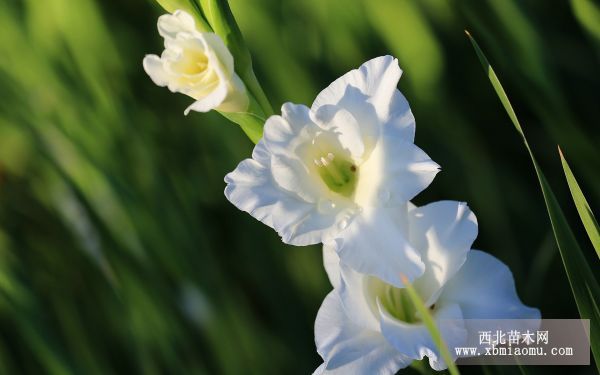
Corm rot is a disease that frequently occurs during storage. After infection with this disease, yellow-brown slightly sunken lesions appear on the surface of the corm, surrounded by black ulcer-like areas. When air humidity is high, the lesions rapidly expand, and a blue-green mold layer appears on the surface, causing the corm to shrink and become dry and hard. The preventive measure is to be careful when digging up the corms to avoid wounding them. After harvesting the corms, it is best to first soak them in cold water, then disinfect them with alcohol and dry them in the shade for storage, and keep the storage room ventilated and dry, maintaining a low temperature of 4-5°C.
Leaf blight mostly begins at the tips of the lower leaves of gladiolus, initially as faded green yellow spots, and later the lesions dry up and black-brown mold layers appear. The disease is more severe from July to September. The preventive measure is to peel off the dried scales of the corms before planting. And soak the corms in 0.5% potassium permanganate for 15 minutes for disinfection treatment. Or in the early stage of disease occurrence in the plants, use 1% equal-amount Bordeaux mixture or 50% zineb at 1000 times dilution, spraying once every 8-10 days.
Thrips: the adults and nymphs of this pest generally hide in the leaf axils during the day and damage the plants, while on cloudy days or at night they crawl onto the leaf surface to cause damage. They mainly feed on the leaves, stems and flowers of the plants, causing the leaves to discolor and leaving grayish-white dot-like feeding marks and egg-laying marks on the corolla, causing the petals to curl. They can be controlled by spraying 2.5% deltamethrin at 400 times dilution.
Slugs, commonly known as snivel worms, are pests with a wide distribution and omnivorous feeding habits. Their adults and nymphs mostly nibble on the tender buds and leaves of plants, and often leave silvery-white traces along the places they crawl over. They can be controlled by spraying 3% lime water or 100 times ammonia water.