What to Do When Orange Jessamine Gets Leaf Blight? Detailed Control Methods
[Symptoms] The disease occurs on the leaves, mostly starting from the leaf tips and margins, and in severe cases can also spread to the shoot tips and young stems. The lesions first appear as faded green yellow spots, spread rapidly, and soon infect the whole leaf, turning it yellowish-brown. In the later stage, the leaves dry up and are covered with black granular bodies, which are the pycnidia of the pathogen.
[Pathogen and Occurrence Characteristics] A fungus of the genus Macrophoma in the class Deuteromycetes. The pathogen survives on the diseased residues of host plants. The disease mostly infects plants that have been frostbitten or scorched; after infection, if high temperature and dry conditions occur, the disease becomes severe and often causes mass death.
[Control] (1) Strengthen maintenance and pay attention to cold protection. (2) In early spring, spray 0.3-0.5% Bordeaux mixture once every 7-10 days. (3) In the early stage of the disease, spray 70% thiophanate 1500 times solution or 50% Tuzet 1000 times solution.
What to Do When Orange Jessamine Gets Bugs: Pest and Disease Control for Orange Jessamine / 3 pests, 3 diseases, spray with pesticide
Orange Jessamine, a plant with very strong ornamental value, has a long flowering period, and the scenery when it blooms is very charming, deeply loved by flower lovers. In daily life, many flower lovers grow Orange Jessamine, but due to carelessness in maintenance and other reasons, it can attract pests and diseases. So what should you do when Orange Jessamine leaves have bugs? The following is the pest and disease control for Orange Jessamine. Flower lovers, you must take a look~
I. Orange Jessamine leaves have bugs, spray with pesticide
As an excellent choice for indoor cultivation, many people grow Orange Jessamine at home, but if you do not follow the cultivation methods for Orange Jessamine, it will get bugs and diseases, and flower lovers must be very anxious! Regarding what to do when Orange Jessamine gets bugs, we should determine which kind of bug it is and then solve it accordingly. For the pest and disease control of Orange Jessamine, the editor will explain pests and diseases separately.
(1) Pests and diseases of Orange Jessamine, 3 pests
Red spider mite, glossy green longhorn beetle, arrowhead scale
1. Red spider mite
This pest is one of the main pests of Orange Jessamine. It harms the plant's leaves and survives by sucking the juice from Orange Jessamine leaves. Symptoms of infestation: the plant becomes nutritionally imbalanced, and the symptom of Orange Jessamine leaves turning yellow appears.
Solution: If there are few red spider mites, you can directly remove the leaves and clean them up; when there are many red spider mites, promptly use pesticide to spray and kill them. You can use 20% dicofol emulsifiable concentrate 2000 times solution for spraying and killing; spraying several times will be enough.
2. Glossy green longhorn beetle
Another one of the pests and diseases of Orange Jessamine. The part it harms is the plant's branches and shoot tips. Symptoms of infestation: Orange Jessamine branches will break easily, or gradually dry up and die.
Solution: After discovering the above symptoms, you can inject 50-80 times solution of dichlorvos emulsifiable concentrate into the lowest hole in the branch, and after injection seal the hole with soil; in June-July, if you find adult glossy green longhorn beetles, you can spray 10% imidacloprid 2000 times solution to eliminate them.
3. Arrowhead scale
This pest mainly harms the young leaves of Orange Jessamine and sucks the sap of the flowers. Symptoms of infestation: Orange Jessamine leaves change from green to grayish-green, and finally to yellow. In severe cases, the branches and leaves are covered with scale insects, causing the entire plant to wither and die.
Solution: If there are few scale insects, you can directly scrape them off or pick them off with a toothpick; if the density of scale insects is high, you can use 550% malathion, 40% dimethoate 0.1% solution, etc. for spraying and killing.
(2) Pests and diseases of Orange Jessamine, 3 diseases
Powdery mildew, gray leaf spot, leaf blight
Regarding Orange Jessamine leaves having bugs, after reading the above content I believe everyone knows how to handle it! However, besides being harmed by insects, diseases also constantly threaten Orange Jessamine. It is understood that the main diseases of Orange Jessamine are 3 types: powdery mildew, gray leaf spot, and leaf blight. The specific symptoms and control methods are as follows:
1. Powdery mildew
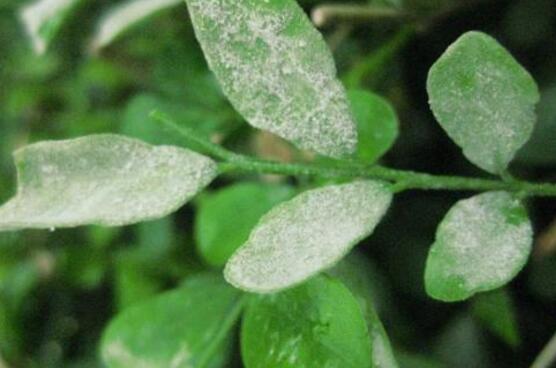
One of the main diseases of Orange Jessamine. It mainly harms the plant's leaves. Symptoms of the disease: in the early stage, small yellow spots appear on the leaf surface, followed by white powdery substances; in the final stage, Orange Jessamine stops growing, and may even fail to bloom or bear fruit.
Solution: When the above symptoms are found, spray 50% sulfur suspension concentrate 300-400 times solution; when the condition is severe, properly prune the branches and shoot tips of severely diseased plants, and spray 29% triforine 800 times solution once every 7-10 days; after several times it can recover.
2. Gray leaf spot
This disease mainly harms the leaves of Orange Jessamine, thereby forming lesions 1-6 mm in diameter. Symptoms of the disease: in the early stage, brown-black round or oval lesions appear on the leaves, the lesion edges are darker in color, and both sides are slightly raised; in the later stage, the center of the leaf becomes white, and small black dots appear on the surface.
Solution: When the above symptoms are found, pesticide should be sprayed immediately. You can choose to spray 60% zineb wettable powder 600-800 times solution; spraying continuously several times will solve it.
3. Leaf blight
Another one of the pests and diseases of Orange Jessamine. It mainly harms the leaves, and in severe cases also spreads to the branches, shoot tips, and young stems. Symptoms of the disease: in the early stage, the leaf lesions are faded green, then infect the entire leaf, turning the leaf yellowish-brown. In the later stage, the leaves dry up and are covered with black granular bodies.
Solution: When the above symptoms are found, spray 70% thiophanate-methyl 1500 times solution or 65% zineb wettable powder 600 times solution for control.
Regarding the pest and disease control of Orange Jessamine, the editor has introduced it here. I believe that when encountering the above symptoms in the future, everyone should know what to do! Overall, during the growth of Orange Jessamine, pests and diseases are unavoidable, so to avoid unnecessary trouble, flower lovers should keep the above methods firmly in mind.
Harmful Symptoms and Control Techniques of Citrus Yellow Leaf Disease
Citrus yellow leaf disease is also called huanglongbing, yellow shoot disease, yellow blight disease, green fruit disease, etc. It is a devastating disease in world citrus production, caused by a Gram-negative bacterium limited to parasitism within the phloem. It can infect many Rutaceae plants including Citrus, Poncirus, Fortunella, and Orange Jessamine. Now let us take a look at the control techniques for citrus yellow leaf disease!
Harmful symptoms of citrus yellow leaf disease
1. Mottled yellowing: after the leaves with mottled yellowing turn green, local areas fade green, forming mottled yellowing. The mottled positions and shapes are very irregular, appearing foggy, with no clear boundaries. Most mottling originates from the leaf veins, base, or margins.
2. Uniform yellowing: uniform yellowing mostly appears after local temperature drops in autumn, on the late autumn shoots that sprout. The new shoot leaves do not turn green and gradually form uniform yellowing, mostly appearing on the outer canopy, sunny areas, and top.
3. Nutrient deficiency-like yellowing: nutrient deficiency-like yellowing is not true nutrient deficiency. It is caused by huanglongbing causing local root rot, resulting in reduced fertilizer absorption capacity, causing leaf nutrient deficiency. It mainly manifests as symptoms similar to zinc deficiency and manganese deficiency, and is an auxiliary symptom for identifying huanglongbing.
Conditions for the occurrence of citrus yellow leaf disease
1. There is a source of disease in or near the orchard, namely diseased trees with yellow leaf disease.
2. There is a virus transmission vector in or near the orchard, namely the Asian citrus psyllid.
3. The Asian citrus psyllid can carry the virus after feeding on a diseased tree for a cumulative 5 hours.
4. The orchard has uneven growth, with young shoots emerging at any time, which can attract Asian citrus psyllids to come and feed and transmit the virus.
Control techniques for citrus yellow leaf disease
1. Strict quarantine system to prevent diseased seedlings and diseased scions from being introduced into disease-free areas and new planting areas.
2. Cultivate disease-free nursery stock.
(1) The nursery site should be selected in a disease-free area or a place with good isolation conditions, or use a plastic net shed for closed seedling cultivation.
(2) Establish a virus-free citrus breeding system. Any selected improved variety line must be tested through indicator plants or polymerase chain reaction (PCR). Obtain shoot-tip seedlings through shoot-tip grafting detoxification technology, and operate according to virus-free procedures to breed disease-free nursery stock.
(3) When the "system" has not been established, rootstock seeds should be collected from the fruit of disease-free trees. Soak the seeds in hot water at 50-52°C for 5 minutes, then after preheating soak them in hot water at 55-56°C, maintaining a constant temperature for 50 minutes. Scions should be collected from identified disease-free mother trees, soaked in 1000 times tetracycline hydrochloride solution for 2 hours, then rinsed clean with water before grafting.
(4) Strengthen the management system of the nursery.
3. Control the Asian citrus psyllid
(1) Strengthen cultivation management. Each time new shoots emerge evenly, spray pesticide uniformly for control. Spray the first pesticide at the budding stage to prevent adults from laying eggs in the bud gaps. Pesticides should be mainly organophosphorus, and options include isocarbophos, omethoate, or mineral oil emulsion, etc.
(2) Strengthen winter orchard cleaning and pesticide spraying to eliminate Asian citrus psyllids with poor activity during the overwintering period. This is the key to year-round control.
(3) Adjust the structure of fruit tree varieties. Do not plant Rutaceae plants such as wampee and Orange Jessamine in citrus production areas, to prevent the Asian citrus psyllid from transferring hosts.
4. Prevention first, integrated control. Persist in conducting comprehensive inspections for huanglongbing-infected plants after each new shoot turns green. Whenever one is found, dig it out, leaving no residual stump. Nowadays, the use of physical and biological integrated methods, including the use of low-temperature plasma compound preparations, has good results in control.
5. When rebuilding citrus orchards in diseased areas, the diseased and old trees should be dug out entirely, the environment cleaned up, and short-term crops planted for one year before planting citrus again. Isolated planting can also be used.
6. Develop citrus production through industrialized management, achieving unified planning of development scale, unified varieties within the park, unified measures in production, unified technical guidance, and unified regulations in management. This can effectively control the disease incidence rate.
7. Three-dimensional control
(1) Three-dimensional control in the growth period (in terms of time). The flower bud stage and leaf expansion stage are key periods susceptible to infection. The Chinese herbal medicine Wofengsu has the characteristic of high safety. Appropriate high-concentration use at this time plays a major role in disease control throughout the entire growth period. After fruit harvest in autumn is the key period for the pathogen to reproduce and hide, and it plays a major role in addressing the pathogen base and disease severity in the coming year.
(2) Three-dimensional control at different parts of the plant (in terms of space). The Chinese herbal medicine preparation Kuifuling has the characteristic of good conductivity. The roots, bark, leaves, and fruit of the tree can all absorb the effective ingredients of the medicinal liquid, and during the conduction process it can kill hidden pathogens (in the phloem and overwintering).
(3) Three-dimensional control in terms of application method. Chinese herbal medicine has the characteristic of nutritional rejuvenation, preventing and controlling diseases through two effects: rejuvenation to improve immunity and sterilization. Root irrigation, orchard cleaning (branch and trunk spraying), and spraying are the three-dimensional pathways to achieve these two effects.
8. Combination of Chinese and Western medicine: Chinese herbal medicine preparations have the advantages of being compounded from multiple ingredients, regulating growth, improving crop immunity, broad-spectrum sterilization, long duration of effect, and preventing and treating diseases from inside to outside. Conventional single-ingredient pesticides have the characteristic of quick effect (with relatively greater resistance). The combination of Chinese and Western medicine and compound use is conducive to complementary advantages and ensures effectiveness in treating severe cases.