How to grow variegated ivy? Care methods and points to note
Variegated ivy is a cultivated variety of ivy. This new variegated cultivar likes a humid, semi-shaded environment. It has low fertilizer requirements; even without fertilizing for a long time it still grows well. But if too much fertilizer is applied, it will grow rapidly and become over-luxuriant, causing the elegant variegation to disappear and plain wild-type green leaves to appear, losing its ornamental value. So fertilizing must be controlled; when you notice green, non-variegated leaves appearing on the variegated ivy, you can immediately remove them and stop fertilizing, only watering, so that it reverts to variegation.
Variegated ivy is not demanding about light; as long as there is a little light indoors, it can grow well placed indoors all year round. Grown under semi-shaded, weak light, the leaf coloration becomes more vivid and attractive.
It likes warmth; the optimum growing temperature is 20-25°C, and the wintering temperature is 5°C. During the growing season it needs ample watering, and the leaves should be sprayed with water often to keep the environment humid. In summer, pay attention to ventilation and shading, and repot once every 2 years.
The leaves of variegated ivy have three colors: light green, dark green and cream white; the leaf colors are variable and there are many cultivars. The leaf shapes are gorgeous and lovely, making it an excellent indoor foliage plant. Whether placed as a trailing pot on top of a cabinet or on a high shelf, or hung in front of a window, or allowed to climb around a central pole in the pot, it can achieve a very good ornamental effect.
Summer care of variegated ivy
The hot, stuffy climate of summer is very unfavorable for the growth of variegated ivy. At this time, avoid exposure to blazing sun and place the plant in a cool, ventilated spot indoors, or in a semi-shaded spot outdoors, which can make the leaf coloration vivid and lovely light green. From July to August, when the temperature rises above 30°C, it stops growing. At this time, do not water frequently just because the temperature is high; wait until the potting soil is dry before watering, following "alternate dry and wet", and at the same time stop fertilizing to avoid scorched leaf tips. Maintaining air humidity is another key to summer care. Spray water on the leaf surfaces and around the potted plant 2 to 3 times a day to lower the temperature and increase air humidity. You can also place the flower pot on a saucer filled with water, with the pot propped up on tiles so that it is separated from the water, creating a suitable micro-environment for the plant's growth. In the stuffy summer climate, variegated ivy is prone to pest problems, mainly scale insects, especially on the undersides of leaves and on the leaf stalks. Strengthening ventilation and air flow can reduce the occurrence of pests. If there are few pests, you can scrub them off with an old toothbrush dipped in soapy water. If there are many pests, you can spray with a 40% omethoate 800-fold solution, spraying once every seven days, for 2 to 3 consecutive sprays, with remarkable results.
.
Propagation methods for variegated ivy
Variegated ivy is a variety of ivy. Because a single leaf of variegated ivy contains three colors - light green, dark green and cream white - with variable coloring, it is named accordingly. Variegated ivy has fairly strong adaptability and is not difficult to grow; it is generally propagated by cuttings and layering.
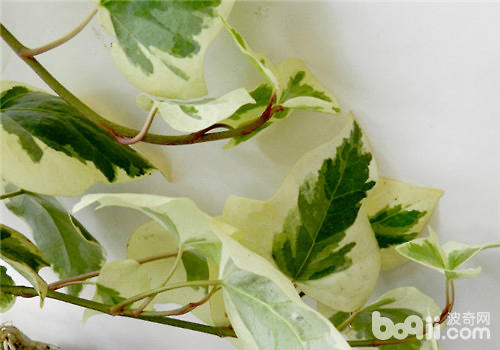
Variegated ivy
Variegated ivy can be grown by layering and by cuttings. For layering, choose a current-year branch and press it into the soil 2-4 cm, leaving the leaves and shoot tip exposed above the soil surface, and spray a suitable amount of water every day so that it grows and roots at the same time; the following spring it can be divided and transplanted, with an extremely high survival rate. For cuttings, take one-year-old branches in spring and current-year branches in autumn; the cuttings should be 10-15 cm, with one end retaining a leaf and the other end stripped of leaves, inserted into river sand; generally they will root after three weeks. If the cuttings are treated with 1000 ppm naphthaleneacetic acid, they begin to grow roots in two weeks, and after one month they can be transplanted, with a survival rate of up to one hundred percent. Practice has shown that potted variegated ivy grown under light conditions and under shade compare as follows: shaded plants grow better; placed indoors all year round, they are simple to care for and grow well.