What are the main pests and diseases of daffodils? How are they controlled?
The main pests and diseases include large brown spot disease (leaf spot disease), bulb rot, nematode disease, the narcissus fly, and the bulb mite (Rhizoglyphus echinopus), among others. The control methods are as follows:
(1) For large brown spot disease, from March to May, spray once every 10 days with a 700x dilution of 75% chlorothalonil wettable powder, or a 100x dilution of equal-amount Bordeaux mixture, or a 500x dilution of 65% zineb wettable powder. First soak the bulbs in clean water for 1 hour, then soak them in a 750x dilution of mercuric chloride solution for 30 minutes before planting.
(2) For bulb rot and nematode disease, disinfect the bulbs and soil using the same methods as for other flowers.
(3) For the bulb mite (Rhizoglyphus echinopus), spray with a 1000x dilution of 40% dicofol emulsifiable concentrate, or a 1000x dilution of 25% phosmet emulsifiable concentrate, or a 1000x dilution of 50% chlorobenzilate, or a 1000x dilution of 50% fenitrothion emulsifiable concentrate.
(4) For the narcissus fly, fumigate the bulbs with carbon disulfide, or dissolve 23 g of mercuric chloride in 36 kg of water and use it as a drench during the growing season.
How to deal with pests on daffodils, daffodil pest and disease control / 4 pests, 4 diseases
The beauty of daffodils is beyond doubt, but during cultivation, improper care and other factors can invite pests and diseases. Once daffodils are infested with pests or fall ill, their ornamental value is severely affected. So how do you deal with pests on daffodils? Below is a carefully compiled guide to daffodil pest and disease control, covering 4 pests and 4 diseases. Let's take a look together.
I. How to deal with pests on daffodils: identify the pest
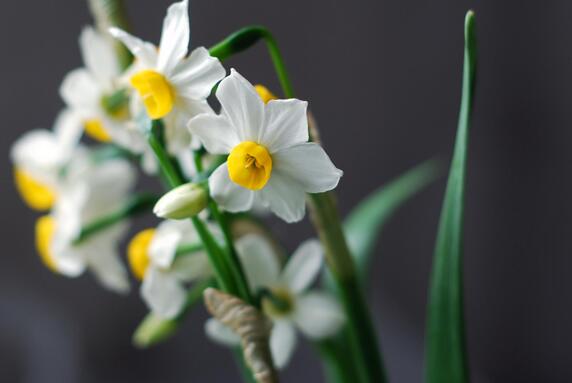
Daffodils are very beautiful and elegant, but once attacked by pests they become withered and limp, which affects their ornamental value. As for how to deal with pests on daffodils, first we must determine which pest it is, and then treat it accordingly. It is known that the common pests of daffodils include aphids, nematodes, the bulb mite (Rhizoglyphus echinopus), and the narcissus fly. The specific symptoms and solutions are as follows:
1. Aphids
As one of the common pests of flowers, aphids also harm the growth of daffodils, mainly attacking young branches and leaves. Symptoms: The leaves of daffodils lose their green color, and in severe cases the leaves curl, become hard and brittle, cannot absorb nutrients, and flowering is affected.
Solution: After confirming it is aphids, gardeners should buy pesticide and spray. You can choose to alternate spraying with a 1000x dilution of omethoate or a 1000x dilution of pyrethrins.
2. Nematodes
Another pest that attacks daffodils, it is a type of tiny animal with a body length of less than 1 mm. Symptoms: Daffodils grow poorly, the plants are stunted, the leaves are wrinkled, and they may even die early.
Solution: After discovering the above symptoms, spray with chemicals such as dibromochloropropane, carbofuran, or dazomet. The effect is very good.
3. Bulb mite (Rhizoglyphus echinopus)
One of the common pests of daffodils, it is shiny white in appearance and similar to adult mites, but the bulb mite's legs are lighter in color. It mainly harms the roots of daffodils.
Solution: When you find it is the bulb mite, gardeners can spray with a 1000x dilution of 40% dicofol, etc.
4. Narcissus fly
Besides the above pests, gardeners should also consider the narcissus fly, because it is also a common pest of daffodils. It is known that the narcissus fly lays eggs in the soil, and the hatched larvae invade the bulb. Symptoms: The daffodil bulb rots and turns black.
Solution: Control of the narcissus fly focuses on prevention. During the growing season, gardeners can drench daffodils with carbon disulfide.
II. Daffodil pest and disease control: 4 diseases
Regarding how to deal with pests on daffodils, after reading the above, everyone should know what to do! However, some gardeners do not follow the proper cultivation methods for daffodils, and besides inviting pest attacks, this can also trigger various diseases. It is known that the main diseases of daffodils are 3 types: large brown spot disease, mosaic disease, gray mold, and leaf blight. The specific symptoms and solutions are as follows:
1. Large brown spot disease
One of the main diseases of daffodils, it generally occurs from March to May. Symptoms: The leaf tips of daffodils turn brown, with a clear boundary from the healthy part. Afterwards, lesions also appear on the edges and middle of the leaves, and the flower stalk can also be infected.
Solution: After discovering the above symptoms, gardeners should spray once every 1-2 weeks, using a 700x dilution of 75% chlorothalonil.
2. Mosaic disease
Another disease of daffodils. Symptoms: In the early stage, symptoms are not obvious, or slight green mottling appears; in the middle stage, obvious mosaic symptoms develop; in the late stage, the daffodil leaves yellow and twist, and the plants are noticeably stunted and thin.
Solution: After discovering the above symptoms, gardeners should cut off diseased leaves and pull out diseased plants to reduce the source of infection. During the disease period, spray with 1% Bordeaux mixture.
3. Gray mold
This disease is one of the diseases of daffodils, mainly harming the leaves, flower stalks, and flowers of daffodils. Symptoms: The leaves produce yellow-green to dark-green water-soaked patches that gradually expand, becoming soft and rotting when humid, and the affected parts produce gray, earthy-yellow mold layers.
Solution: When this disease is found, diseased leaves should be removed promptly to prevent contact transmission. In severe cases, spray with a 500x dilution of 50% carbendazim or a 500x dilution of 75% chlorothalonil. After spraying a few times, it can basically be resolved.
4. Leaf blight
This disease mainly occurs on daffodil leaves, mostly starting from the leaf tips. Symptoms: In the early stage, the leaves fade to green-yellow spots that spread inward in a fan shape; in the late stage, the leaves dry up and black granular bodies appear. It is worth mentioning that this disease is also one of the causes of yellowing daffodil leaves.
Solution: When the above symptoms are found, spray with a 1000x dilution of 50% thiram, which has a very good therapeutic effect. Of course, leaf blight is best controlled by prevention. Before planting, remove the dried scales and rinse 2-3 times with a dilute potassium permanganate aqueous solution.
That's all for the introduction to daffodil pest and disease control. After reading the above, I believe everyone can properly handle the situations above when growing daffodils! Overall, as long as everyone is a bit more careful during care, pests and diseases are unlikely to appear. Finally, may everyone's daffodils bloom into beautiful flowers!
Control of the main pests and diseases of daffodils
Daffodil mosaic disease
Symptoms: In the early stages of daffodil growth, no symptoms are shown, or slight green mottling appears. As the disease develops, obvious mosaic symptoms only appear in the middle stage of growth. In severe cases, the leaves yellow and twist, and the plants are noticeably stunted and thin. The pathogen is the daffodil mosaic virus. It is transmitted through leafhoppers, sap, and contact, and virus-carrying bulbs and daughter bulbs are also an important route of transmission. This virus also infects ornamental plants such as the pheasant's eye narcissus (Narcissus poeticus), yellow daffodil (Narcissus pseudonarcissus), hyacinth, periwinkle, globe amaranth, petunia, three-colored convolvulus, and blanket flower. In addition, cucumber mosaic virus can also cause daffodil mosaic disease.
Control methods:
1. Use a combination of shoot-tip tissue culture and heat treatment to eliminate the virus, cultivate virus-free plantlets, and establish a virus-free mother bulb base.
2. Pay attention to field hygiene. Pull out and destroy diseased plants immediately upon discovery to avoid spreading the virus.
3. Spray insecticides to control virus-transmitting insects such as the green peach aphid and other aphids as well as leafhoppers. The above methods should be used in combination for integrated management, and all can achieve good control results.
Daffodil gray mold
Symptoms: After the daffodil bulb is affected, the basal plate rots and becomes soft, and a gray mold layer grows on the surface.
Control methods:
1. Horticultural control
The bulbs should preferably be placed in a thin layer on bamboo curtains. The storage area should be dry, well-ventilated, and well-lit.
2. Chemical disinfection
Treat the bulbs with 0.5% formalin solution for half an hour, then wash with water and dry in the shade before storing.
3. Manual control
During storage, if diseased bulbs are found, pick them out and destroy them immediately.