What are the control methods for hyacinth root rot?
It occurs from time to time in hyacinth growing areas, harming hyacinths and other flowers and causing root rot.
Symptoms
After the plants are affected, they grow weakly and become stunted, and cannot bloom normally; when the soil is dug open, most or all of the roots on the bulbs can be seen to be rotten. Disease pattern: the pathogen is Fusarium, a fungus. The pathogen overwinters in the residues of diseased plants and spreads through rainwater, irrigation water, field gardening operations and so on.
Control methods
(1) Strengthen cultivation management. Hyacinths prefer cool conditions but are not cold-tolerant, and they favor a humid environment with plenty of sunlight. They like fertilizer and require a sandy loam rich in humus and with good drainage. In autumn they root and sprout, in early spring they leaf out and bloom, in midsummer the stems and leaves turn yellow and dry up, and the bulbs go dormant and differentiate flower buds. In autumn they are propagated by dividing the bulbs. In North China, choose a wind-sheltered, sunny environment for planting; with a little winter cover they can overwinter. Apply plenty of base fertilizer before planting, topdress before flowering, restrict fertilizer and water later, and after summer dormancy lift the bulbs and store them in a dry, cool, ventilated place.
(2) Do not plant with diseased bulbs; the potting soil of diseased plants should be replaced, and disease-free soil should be used for planting; Dexon can also be used to disinfect the soil.
(3) Soak the seeds for disinfection in a 800-fold dilution of 50% benomyl wettable powder, etc.
How to control hyacinth soft rot
In the greenhouse, severely infected bulbs no longer sprout, the bulbs become soft, and the bulb tissue becomes transparent and is accompanied by white or yellow spots. These infected bulbs also give off an unpleasant odor. The symptoms of less severe infection are: some wet, dark green elongated areas form from the base of the leaves, first growth is inhibited, and then the plants wilt until they die.
1. Cause
This disease is caused by Erwinia bacteria. These bacteria are mostly parasitic and mainly infect frozen or overly wet tissues. Another form of infection is through wounds where early roots or small bulblets have detached when the temperature is too high or the soil is too wet. This problem is mainly caused by soil temperature being too high or too wet during natural cold treatment in autumn.
Manifestations of soft rot: the top of the bulb becomes water-soaked, slimy and soft-rotted, the base of the flower stalk then rots, the flower does not open and the flower bud drops first, or later an abnormal flower forms and then drops. After the buds are infected they first turn white, then become sticky and soft, with a foul odor. The leaves also develop water-soaked rot, but this disease is not contagious in the greenhouse; although infected tissue usually appears butter-yellow, infection does not occur again in other parts.
2. Control methods
(1) Bulbs are usually planted under the recommended conditions, that is, natural treatment or keeping the rooting room at low temperature (9°C), and at the same time not too humid.
(2) During planting and throughout the greenhouse period, infected bulbs and plants should be removed; this can prevent Erwinia bacteria from spreading to neighboring bulbs through irrigation water.
Control methods for bacterial soft rot of iris
Bacterial soft rot is one of the most common diseases of iris; whether bulbous iris or rhizomatous iris, this disease occurs frequently. Below, based on many years of cultivation experience, I will discuss the control methods for iris soft rot.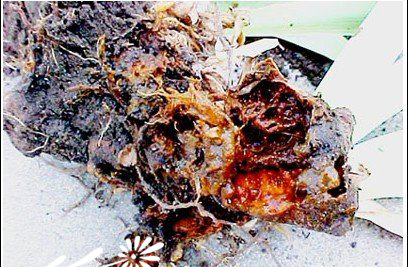
The pathogens of iris soft rot are bacteria; two species are currently known, namely Pectobacterium carotovorum subsp. carotovorum and Erwinia carotovora, both belonging to the order Eubacteriales and the genus Erwinia. Besides iris, they also harm many ornamental plants such as cyclamen, hyacinth, lily and tulip.
The disease pattern is generally that the pathogens overwinter in the soil and on crop residues; they can survive in the soil for several months, and if they are inside diseased plant residues they can survive for a long time. They survive more easily when the temperature is high and the humidity is great. Therefore, the disease generally occurs more when the soil is moist, and more in places that are planted too densely and have heavy shade cover.
If this disease has already occurred, the method that should be adopted immediately is: choose streptomycin or a mixed solution of streptomycin plus oxytetracycline (10:1) and spray the plants and the ground, spraying 2-3 times in succession; the effect is very good. After the disease occurs, agricultural streptomycin solution can also be sprayed once a month, which can likewise control the spread of the disease.