What are the control methods for Podocarpus leaf blight?
[Distribution]South China, Southwest China, Central China, East China, greenhouses in the north.
[Symptoms]Occurs on Podocarpus leaves. In the early stage, the lesions mostly appear at the leaf tip, as yellow withered spots with a clear boundary between diseased and healthy tissue; in the later stage, the lesions turn grayish-yellow, dry up, and bear black granular bodies.
[Occurrence pattern]The pathogen is a weak parasite, mostly infecting poorly developed plants with weak growth vigor. Under greenhouse conditions it can cause disease year-round, while during open-air cultivation the disease is most severe after autumn.
Causes of leaf blight in Podocarpus, and control methods for Podocarpus leaf blight
Podocarpus is ancient and vigorous, evergreen all year round; its posture is like an old man wearing a monk's robe, hence the name "Arhat" pine. However, during the process of growing Podocarpus, some diseases may appear that affect its overall ornamental effect. So what are the causes of leaf blight in Podocarpus? Below, let us introduce the control methods for Podocarpus leaf blight.
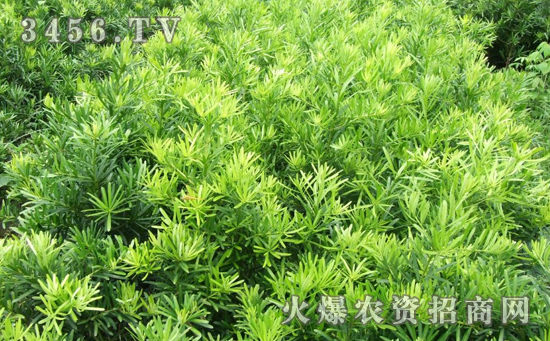
Causes of leaf blight in Podocarpus
Podocarpus leaf blight is the most troublesome problem for many flower growers. The disease mainly occurs on the young leaves of Podocarpus shoots. After infection, the leaf color turns red, the lesions are irregular, and spread from the leaf tip toward the leaf base, causing the front half of the leaf to die back. In the later stage, the lesions are light brown. As the disease develops, small black spots appear on both the upper and lower surfaces of the diseased leaf parts, seriously affecting the growth and ornamental value of Podocarpus. The disease overwinters as mycelium in dead branches and fallen leaves. In the spring of the following year, the pathogen invades young leaves or enters branches through wounds. Generally speaking, conditions such as overly dense cultivation, poor ventilation, extensive management, and wounds caused by sunscald can all promote the disease, and it is more likely to occur in April to May and August to September.
Control methods for Podocarpus leaf blight
Control methods: In winter, cut off dead branches and heavily diseased leaves and remove diseased leaves on the ground surface for centralized destruction. Strengthening maintenance and management can enhance the disease resistance of the plants. In the early stage of the disease, spray with fungicides such as 1000-fold amobam solution, 500-fold 75% chlorothalonil solution, or equal-proportion 100-fold Bordeaux mixture, once every 7 to 10 days, for 2 to 3 consecutive sprays, to prevent the disease.
Control methods for leaf blight in precious Podocarpus
Precious Podocarpus not only has a beautiful tree shape, but also has strong resistance to sulfur dioxide and phosgene, and has the ability to absorb sulfur dioxide. It has a strong ability to adsorb smoke and dust, and can also purify air and absorb electromagnetic radiation. Therefore, it is not only suitable for large-scale planting, but is also very popular for home cultivation. Jiangxi Lvnong Agricultural Development Co., Ltd. now introduces the symptoms and control methods of leaf blight in precious Podocarpus as follows:
Symptoms:The disease occurs only on the leaves. The affected leaves start to turn red from the leaf tip, then turn light brown to grayish-white. The lesions are strip-shaped or irregular, with dotted black fruiting bodies on them; in mild cases, the front half of the leaf tip dies back. The boundary between diseased and healthy parts is obvious; in severe cases, all the leaves at the tip of the shoot die. Damage situation: The disease mainly damages the young leaves of precious Podocarpus. After infection, it can cause leaf tips to wither, and in severe cases it can also lead to the death of seedlings, affecting growth and ornamental value.
Occurrence pattern:The pathogen of this disease belongs to the Deuteromycetes among fungi, and overwinters as mycelium in dead branches and fallen leaves. In the spring of the following year, the pathogen invades young leaves or enters branches through wounds. After invasion, the pathogen absorbs nutrients from the host and forms acervuli under the epidermis. Under rainy or humid conditions, the acervuli release conidia, which spread and proliferate by wind and rain. The disease is severe under conditions such as excessive vegetative growth and high humidity. Conditions such as overly dense seedlings, poor ventilation, extensive management, freezing injury, and wounds caused by sunscald can all promote the disease.
Control methods:
1. Remove dead branches and fallen leaves and strengthen maintenance and management, which can enhance the disease resistance of the plants.
2. Avoid wind injury, freezing injury, sunscald, and artificial wounds, which can reduce the incidence of the disease.
3. Select disease-free and robust branches as propagation material.
4. In the early stage of the disease, use fungicides such as 1000-fold amobam solution, 500-fold 75% chlorothalonil solution, or equal-proportion 100-fold Bordeaux mixture, once every 10 days, spraying 2—3 times, to prevent the disease.