How do you propagate and care for Buddhist pine, and how do you shape it as a bonsai?
For home gardeners, the main purpose of growing Buddhist pine (Podocarpus macrophyllus) is to make stump bonsai. In its native range it grows naturally on high mountains above 1000 m altitude in the provinces south of the Yangtze, so it has a certain cold resistance and can withstand low temperatures of 0°C; it fears the intense heat of summer, and its optimum growing temperature is 15-28°C. It likes sunlight, but is also quite shade-tolerant, so it can be placed in a bright spot indoors. It requires loose, fertile, well-drained, slightly acidic soil; it is relatively drought-tolerant and also tolerates waterlogging.
Seed-grown plants grow slowly, while cuttings root easily. Take plump one-year-old shoot tips as cuttings, preferably with the terminal bud; the cuttings should be 8-10 cm long. Cut off the leaf clusters below the middle, trim the base flat with a blade, and insert into plain sand or vermiculite to a depth of 3 cm. Cover with plastic film to keep in moisture and keep in the shade. At a temperature of 20-28°C, roots form only after 2-3 months, and the plants are lifted and potted up half a year later. If the cut end can be treated with 0.3% a-naphthaleneacetic acid, the rooting time can be shortened and the cutting survival rate raised.
When potting, use acidic soil; once the shape is formed, plant it into a bonsai pot, and as long as it grows normally, try not to repot or change the soil. Large plants displayed in courtyards can be pruned into a spherical tree form, called a "Buddhist pine ball". In spring and summer it should be given appropriate shade, and in the dry season spray water frequently to raise air humidity; the potting soil should alternate between dry and moist, and 2-3 applications of topdressing should be given in late spring and early summer. Do not fertilize at other times, to prevent the branches from growing leggy and reducing cold resistance. In winter the room temperature should not be too high, to prevent leaf drop in spring.
How do you propagate and care for Buddhist pine?
For home gardeners, the main purpose of growing Buddhist pine is to make bonsai. It has strong cold resistance and can endure low temperatures of minus 2-3°C; it fears the intense heat of summer, and its optimum growing temperature is 15-28°C. Because it is a sun-loving plant, it is not afraid of direct sunlight, and it is also quite shade-tolerant. It likes loose, fertile, well-drained acidic soil and grows especially well in humus soil; if the potting soil contains alkali, the leaves turn yellow. It is relatively drought-tolerant and also tolerates wet conditions.Buddhist pine can be propagated by sowing or by cuttings; seed-grown plants grow slowly, while cuttings root easily. Take the shoot-tip part of plump one-year-old branches as cuttings, preferably with the terminal bud; the cuttings should be 8-10 cm long. Cut off the leaf clusters below the middle, trim the base flat with a razor blade, and insert into plain sand or vermiculite to a depth of 3 cm. After inserting, cover with plastic film to keep in moisture and keep in the shade. At a temperature of 20-28°C, roots form only after 2-3 months, and the cuttings are separated and potted up half a year later. If the cut end of the cutting can be dipped quickly in 3000 mg/L a-naphthaleneacetic acid, the rooting rate can be greatly increased and the rooting time shortened.
When potting, use acidic humus soil, and it can be planted in a shallow bonsai pot; as long as it grows normally, try not to repot or change the soil. Old bonsai stumps of Buddhist pine should not be exposed to the sun, and large potted plants displayed in courtyards should also be properly shaded in spring and summer. In the dry season, spray water frequently to raise air humidity; the potting soil should alternate between dry and moist, and 2-3 applications of topdressing should be given in late spring and early summer, after which fertilization stops, to prevent the branches from growing leggy and reducing cold resistance. In winter, move it into a cool room and keep the room temperature at 0-10°C. If the room temperature is too high, a large number of leaves will drop in early spring the following year.
If it is not for making bonsai but only for potted display, the tree should still be shaped reasonably. There are two shaping methods for Buddhist pine: one is to let the terminal shoot grow longer and longer to form a conical crown; the other is to make use of the Buddhist pine's characteristic of low branching by cutting off the terminal shoot and also shortening overly long side branches, thus forming a low, spherical crown known as a "Buddhist pine ball". Side branches inside the crown should not be thinned out; the denser the branches and leaves, the higher the ornamental value. Its leaves are small and dense, its branches are supple and easy to wire, and it tolerates pruning, so 2-3-year-old small plants can be used for mini bonsai, and old stumps can be used to make large and medium bonsai.
How do you grow potted Buddhist pine? Methods for growing potted Buddhist pine
How do you grow potted Buddhist pine? What exactly are the methods for planting potted Buddhist pine? Buddhist pine is generally distributed in the mountainous areas south of the Yangtze; its trunk is old and vigorous and full of strength, and it is a highly ornamental plant. Many people buy a potted Buddhist pine for their home, symbolizing longevity and health.
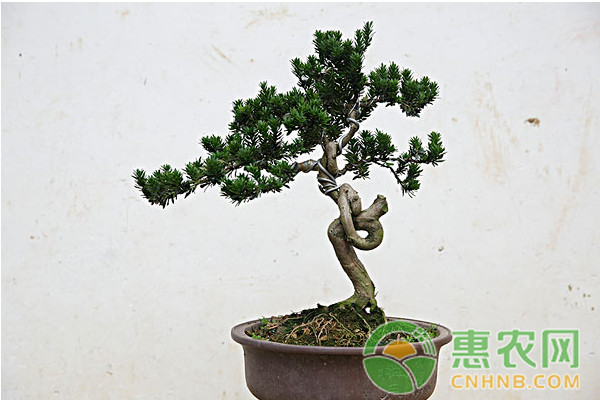
Methods for growing potted Buddhist pine
1. Potting soil. It likes a warm, humid and semi-shaded environment, and prefers fertile, moist, well-drained soil. For potting, a growing medium made from leaf mold or peat soil plus 1/5 river sand and mixed with a small amount of bone meal can be used.
2. Water and temperature. Buddhist pine tolerates shade and moisture, and during the growing season it should be watered frequently, but it should not be waterlogged. In summer, spray water on the leaves often so that the leaf color stays fresh green and the plant grows well. When the outdoor temperature is stable at around 10°C, move it outside to a south-facing balcony or a sheltered, sunny spot in the courtyard for care; after summer begins, move it to a semi-shaded place, and after rain be careful to tip out any accumulated water in the pot in time so it does not suffer from waterlogging. In summer water evaporates quickly, so watering should be more generous; if the potting soil is too dry, the leaves easily scorch. Water once on the day after fertilizing, as this helps the roots absorb nutrients. When the winter temperature drops to 5°C, move it indoors, and after moving indoors control watering and keep the room temperature at 7-8°C. Too high a room temperature is harmful to growth the following year.
3. Fertilizer. A finished bonsai should not be fertilized much; in spring apply 1-2 times a dilute cake fertilizer solution, and stop fertilizing in late autumn to avoid sprouting autumn shoots, which is unfavorable for overwintering. Alternatively, applying 2-3 times a dilute liquid fertilizer mainly based on nitrogen fertilizer in each of spring and autumn is enough for good growth.
4. Shaping. Buddhist pine can be pruned all year round, mainly cutting off leggy shoots and diseased or dead branches to maintain a beautiful tree shape. When it flowers, it is best to remove the flower buds in time, so that fruiting does not consume nutrients and affect growth vigor. For plants whose shape is already formed, pay attention to pinching and pruning to prevent the branches and leaves from growing leggy, so as to help maintain the original form. Pinching and pruning can generally be done during the spring and autumn growing seasons.
5. Repotting. It can be repotted once every 2-3 years, preferably in March-April in spring. When repotting, replace 1/2 of the old soil, and at the same time trim away dead roots and spread out the fibrous roots; if the plant has grown larger, it can be moved to a larger pot. In addition, combined with repotting, the roots can gradually be raised and rocks attached, to create a raised-root style or rock-attached style bonsai; alternatively, repot once every 1-2 years, and repotting can be done in either spring or autumn. When repotting, be careful to properly cut away some of the excess root system and rotten fibrous roots, and at the same time cut off overly dense branches and add new growing medium.
6. Pest and disease control. Common diseases include sooty mold and leaf spot, which can be controlled by spraying 0.5%-1% Bordeaux mixture once every 10 d, 3 times in a row. The main pests include bagworms, red wax scale insects and red spider mites, which can be killed by spraying with 1200-1500 times diluted dichlorvos; 1500 times diluted 40% dimethoate can also be used.
The above are the daily cultivation and management methods for potted Buddhist pine prepared by the editors of Huinong.com for everyone. Friends who like it can give it a try, and farmer friends who want to make money by growing Buddhist pine can also refer to it, but each specific case should be analyzed on its own, so please consult a more professional expert!