High Survival Rate in Podocarpus Cuttings: Mastering the Method Is Key
Podocarpus (Podocarpus macrophyllus) is a rather precious ornamental garden tree species and also an excellent material for stump bonsai. However, its seed sources are scarce, it grows slowly, bears fruit very late, and seed propagation is very slow. To speed up propagation, the author conducted cutting propagation experiments, and the survival rate was very high.
The cuttings were done in an open-field seedbed. The nursery was set on sandy loam dry land, and the seedbed was 1 m wide. The cuttings were taken from the basal sprouts and the upper and middle old lateral branches of short-leaved Podocarpus and 30-year-old long-leaved Podocarpus. Two sections were cut downward from the top of each branch, each about 5-10 cm long; note that the cuttings should retain the terminal bud or 1-2 intact lateral buds. Keep 2-3 whorls of leaves near the buds, and remove all other branches and leaves, then cut the base of the cutting into a single horse-ear shape. The cut is best made at the node of the branch to promote rooting. After cutting, immediately dip the cutting in yellow clay slurry, and insert it after the slurry dries slightly. When inserting, first poke a hole in the bed surface with a finger, then gently insert the cutting to a depth of about 2/3 of the cutting length. After insertion, press lightly with the hand so that the cut end makes full contact with the soil, and finally water thoroughly.
Management measures: after insertion, set up a shade shed for shading. For the first half month, water once every 2-3 days on sunny days. After that, decide according to the specific situation; generally water when the soil is dry.
Test results: This experiment was checked after 6 months; the survival rate of short-leaved Podocarpus reached 98%, and that of long-leaved Podocarpus reached 95%. The root systems were all very well developed, with as many as 100 roots per plant, and roots reaching 3 cm in length. However, cuttings that were too tender or too old both had lower survival rates.
Morphological Characteristics of Podocarpus and Its Propagation Methods and Uses
Podocarpus is a type of pine, also known as Luohanshan, Evergreen Luohanshan, Tushan, Money Pine, Xianbai, Luohanbai, and Jiangnanbai. It is an evergreen tree that can reach 18 m tall and is usually pruned to keep it low. The leaves are alternate and arranged in a spiral. It is also dioecious; the seed-bearing structure is larger than the seed and turns red when mature; together with the green seed, it looks like a bald monk wearing a red monk's robe, hence the name Luohansong (Arhat Pine). Podocarpus is commonly found in southern China, including the Hong Kong, China area. Because potted Podocarpus is ornamental, and its wood is used for construction, medicine, and carving, its value is very high. This has led to many incidents of Hong Kong, China Podocarpus being illegally logged by illegal immigrants from the mainland.
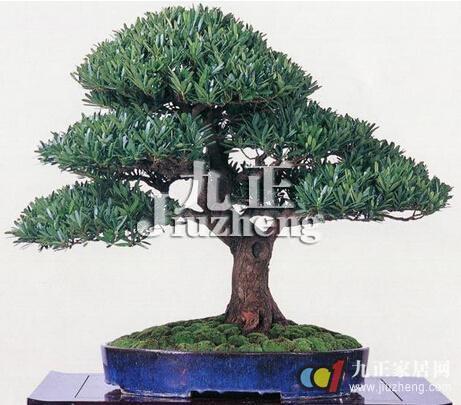
Morphological Characteristics of Podocarpus
Branches
Podocarpus (the original variety) is a tree up to 20 m tall and up to 60 cm in DBH; the bark is gray or grayish brown, shallowly longitudinally fissured, and sheds in thin flakes; the branches spread or slant outward and are rather dense.
Leaves
The leaves of Podocarpus are spirally arranged, linear-lanceolate, slightly curved, 7-12 cm long and 7-10 mm wide, with a pointed apex and wedge-shaped base; the upper surface is dark green and glossy, with the midrib distinctly raised, while the lower surface is whitish, grayish green, or pale green, with the midrib slightly raised.
Flowers
The male cones of Podocarpus are spicate and axillary, usually 3-5 clustered on a very short peduncle, 3-5 cm long, with several triangular bracts at the base; the female cones are solitary in the leaf axils, stalked, with a few bracts at the base.
Seeds
The seeds of Podocarpus are ovoid, about 1 cm in diameter, with a rounded apex; when mature, the fleshy aril is purple-black with a white bloom, and the fleshy seed receptacle is cylindrical, red or purplish red, with a stalk 1-1.5 cm long.
The flowering period is April-May, and the seeds mature in August-September.
Ecological Habits of Podocarpus
Podocarpus prefers a warm and humid climate and has weak cold tolerance; in North China it is grown in pots for ornamental viewing; it has strong shade tolerance; it prefers moist sandy loam with good drainage, has strong adaptability to soil, and can even survive on saline-alkali soil; it has relatively strong resistance to various polluting gases such as sulfur dioxide, hydrogen sulfide, and nitrogen oxides; and it has strong resistance to pests and diseases.
Cultivation Techniques for Podocarpus
It prefers a warm, humid, and semi-shaded environment, has slightly poor cold tolerance, fears waterlogging and direct strong light, and requires fertile, well-drained sandy loam. Transplanting is best done in spring from March to April; small seedlings need to be kept with soil, and large seedlings with a soil ball, or they can be potted. After planting, water thoroughly. Keep the soil moist during the growing season. In the hot midsummer season, it should be kept in a semi-shaded place. Fertilize once every 2 months. In winter, potted plants should be protected from the cold; the pot can be buried in the soil, and watering should be reduced.
Key Management Points
Light
Podocarpus is a neutral to shade-leaning tree species; it can accept relatively strong light and can also grow in a shadier environment. Although summer temperatures are high and sunlight is intense, because large Podocarpus trees benefit from high temperature and strong light in maintaining their tree posture and leaf shape, there is no need to shade large Podocarpus trees in summer. However, because Podocarpus seedlings have tender tissues, they should not be exposed to strong light for long periods; it is best to place them under tree shade for care.
Watering
Podocarpus is not a plant of the pine family and is not drought-tolerant. On the contrary, Podocarpus is tolerant of shade and moisture, and during the growing season it should be watered frequently, but it should not become waterlogged. In the Shunde area, on sunny summer days, water frequently; generally water once in the morning and once in the evening, and also spray water on the leaves frequently so that the leaf color stays fresh green and growth is good. Summer rainfall is usually also plentiful, and Podocarpus is not tolerant of waterlogging, so be careful to prevent long-term standing water.
Fertilizing
Podocarpus likes fertilizer and should be fertilized lightly and frequently, mainly with nitrogen fertilizer; an appropriate amount of black alum can be added and fermented into alum fertilizer water. During the growing season, fertilize once every 1-2 months, and fertilizing can be done together with watering (water-to-fertilizer ratio 9:1). For large-area plantations of Podocarpus, the half-ring trench application method can be used, applying 300-500 g of quick-soluble compound fertilizer each time. For potted plants, spray water-soluble fertilizer containing 0.5%-1.0% compound fertilizer or dilute cake liquid fertilizer each time.
Propagation Methods of Podocarpus
Podocarpus is commonly propagated by sowing and cuttings. For sowing, sow immediately after collecting seeds in August, and they germinate in about 10 days. For cuttings, carry them out in spring and autumn; in spring select dormant branches, and in autumn select semi-lignified young branches, 12-15 cm, and insert them into a seedbed of half sand and half soil; they root in about 50-60 days.
Softwood Cuttings
Softwood cuttings refer to the cutting method in which, during the growing season of the nursery stock, semi-mature branches of the current year are used as cuttings. It is mainly suitable for evergreen and semi-evergreen woody flowering plants, such as camellia, azalea, golden-leaf privet, osmanthus, Podocarpus, red-leaf photinia, yew, pittosporum, rose, cedar, and cypress species. For a few deciduous trees that are difficult to root, such as ginkgo, the softwood cutting method is also suitable. The specific operation method for softwood cuttings is: in the season of vigorous growth of the nursery stock, cut semi-lignified branches of the current year, make each section 2 to 4 nodes (one leaf or one pair of leaves counts as one node), each section about 10 cm long, retain 1 to 2 leaves on top, and remove 1 to 2 leaves at the bottom. For tree species with large leaves such as camellia, osmanthus, and photinia, the leaves can be cut off by 1/2, then cut or sharpen the lower end of the cutting into a slanted opening, then tie the cuttings in bundles of several dozen with string, and finally evenly coat the cuttings with mud slurry made from clean loess plus fungicide, rooting agent, and water; after the mud slurry dries slightly, they can be inserted into the prepared seedbed. Softwood cuttings require the seedbed soil to be fine, loose, and level, while removing weeds and other impurities, and the soil should be sprayed, disinfected, and insect-killed. The insertion depth is about 5 cm. After insertion, sprinkle thoroughly with water; after the water droplets on the leaf surface of the cuttings dry, immediately spray the seedbed again with pesticide to sterilize and kill insects, then insert bamboo hoops, cover with plastic film, then insert some more bamboo hoops, and cover the bamboo hoops with black shade netting. Both the film and the shade netting must be fixed well. The bamboo hoops supporting the shade netting should be 15 cm to 20 cm higher than the bamboo hoops supporting the film, to prevent the heat of the shade netting from being transmitted into the film and scalding the seedlings. At this point, the cutting work is all completed.
After cutting is finished, the seedbed must also be frequently inspected and cared for, checking whether the film and shade netting covering the seedbed have been bitten through by insects or rats or blown open by wind. About every 15 days, uncover the film and shade netting to inspect once, and spray pesticide to sterilize and kill insects, then cover the film and shade netting again. If the seedbed soil is found to be dry, sprinkle some water before spraying pesticide, and spray the pesticide after the water on the leaf surface dries. Generally, after uncovering the film and spraying pesticide 2 to 3 times, the cuttings have already rooted and survived, after which pesticide can be applied once every 1 to 2 months. After the cuttings survive, uncovering the film can be considered. Before formally uncovering the film, choose a rainy day, first uncover the film at one end or both ends of the seedbed for ventilation and hardening for several days, then remove all the film. After uncovering the film, the shade netting should still be kept covered. For nursery stock cut in the first half of the year, the shade netting must remain covered until late autumn before it can be removed, because the young seedlings cannot withstand strong sunlight. It is particularly worth mentioning that golden-leaf privet and Golden Sen privet are nursery stock prone to disease, and the film should be uncovered in time; generally about 20 days after cutting, when about 90% have rooted, hardening and film removal can begin. Immediately after removing the film, spray a fungicide once to prevent disease, then spray once every 7 to 10 days, for 3 to 4 consecutive sprays.
For softwood cuttings, in the first half of the year they are generally carried out from mid-to-late May to early July, and in the second half of the year from mid-to-late August to mid-to-late September. Cuttings inserted in the first half of the year should be protected against high-temperature scorching and disease. Cuttings inserted in the second half of the year should be protected against cold and freezing in the middle and later stages; the time to remove the shade netting is late November, and in drought years the time to remove the shade netting can be postponed to late December.
Hardwood Cuttings
Hardwood cuttings refer to the method of cutting in early spring from February to March, during the dormant stage before sap flow begins, using fully lignified thick branches from the previous year. This method is mainly suitable for deciduous trees such as crape myrtle, hibiscus, grape, poplar, and willow; a few evergreen trees can also use hardwood cuttings, such as oleander. For early spring hardwood cuttings, attention should be paid to raising soil temperature and controlling the air temperature inside the shed. In short, whether softwood cuttings or hardwood cuttings, the disinfection of cuttings and soil must be done effectively, and the seedbed temperature, humidity, and light must also be well regulated. In addition, to increase the survival rate of nursery stock cuttings, some measures to promote rooting should also be appropriately taken.
Uses and Purposes of Podocarpus
Economic Value
The wood of Podocarpus is fine and uniform, and easy to process. It can be used for furniture, utensils, stationery, and farm tools.
Although Podocarpus is native to China, for historical reasons, there are very few large Podocarpus trees old enough, and the number of large-sized Podocarpus landscaping seedlings is also extremely limited. As a slow-growing tree species, Podocarpus itself cannot be rapidly replicated, and the existing quantity is far from meeting the demand for courtyard greening and high-end residential landscapes, especially large-sized, beautifully shaped Podocarpus, which is even harder to find. It is understood that engineering seedlings with a DBH of more than 10 cm on the market mainly rely on imports.
In Guangdong, China, household consumption is the mainstay. It is understood that in Guangdong, households have become the main force in Podocarpus consumption, with a purchase proportion of about 30%, leaning toward mid-to-high-end products, followed by landscaping units at about 20%, enterprises and institutions at about 20%, collectors at about 15%, and other uses at about 15%.
Podocarpus has an elegant and upright charm, with a vigorous and powerful proud momentum, and in addition fits Chinese cultural meanings such as "longevity" and "keeping wealth and auspiciousness." Owners pursuing high-grade courtyard beautification often like to plant one or two Podocarpus trees, adding a finishing touch to creating their own "garden story."
The Flower Language of Podocarpus
Podocarpus flower language: youth, vitality, health, longevity, good luck, and wealth attraction.
After reading the above introduction to the propagation methods and uses of Podocarpus, do you have a better understanding of how Podocarpus is propagated? If you want to know more about Podocarpus, please keep following.
How Is Podocarpus Propagated?
Podocarpus is also known as Luohanshan, Evergreen Luohanshan, Tushan, Money Pine, etc. It is an evergreen coniferous tree of the genus Podocarpus in the family Podocarpaceae. It prefers a warm and humid climate, has weak cold tolerance, and is grown in pots for ornamental viewing in North China. It has extremely high ornamental value. In China it is distributed in Jiangsu, Zhejiang, Fujian, Anhui, and other places. Now let us take a look at how Podocarpus is propagated!
Podocarpus Seed Propagation
Podocarpus begins to bear fruit at about 10 years old, and the alternate bearing phenomenon is not obvious. Seeds are best sown immediately after collection and cannot be stored through the summer. Before sowing, soak the seeds for several days first; after the seeds have fully absorbed water and swollen, sow in rows or by spot sowing. The sowing depth should preferably just cover the seeds. After sowing, cover with grass to retain moisture and spray water once a day. If sown in the open field, in the southwestern region it is also necessary to cover with grass to protect it through winter. In other regions, basin sowing is required, and after sowing move them into a low-temperature greenhouse to overwinter. Seedlings can emerge in 8 to 10 days; after emergence, remove the covering grass and shade immediately; never expose them to the sun. For plants used for potting, the terminal bud can be removed at 1 year old to promote the sprouting of many branches. Generally, 1.5- to 2-year-old seedlings can be potted and planted, and branch bending and shaping can begin. For field-planted plants, generally 3-4-year-old large seedlings are suitable for leaving the nursery with a soil ball.
Podocarpus Layering Propagation
Podocarpus layering propagation is best carried out around the Jingzhe solar term in spring (that is, early March). Using a short Podocarpus ball, select a branch slightly smaller than a chopstick near the ground, and on the side of the base near the ground use a small knife to cut obliquely halfway through the branch. Use a prepared 1-cun-long bamboo strip, insert it horizontally into the cut, and insert a small wooden stick beside it to support the branch. Bind it gently with a plastic strip, then cover the cut with loose soil, press it gently, and cover with dried grass to keep it moist. After March, the branch can take root at the cut. After the Qiufen solar term, cut it off from the base of the branch with pruning shears and transplant it.
Podocarpus Cutting Propagation
1. Softwood cuttings: Podocarpus softwood cuttings are carried out in the first half of the year from mid-to-late May to early July, and in the second half of the year from mid-to-late August to mid-to-late September. Cuttings inserted in the first half of the year should be protected against high-temperature scorching and disease. Cuttings inserted in the second half of the year should be protected against cold and freezing in the middle and later stages; the time to remove the shade netting is late November, and in drought years the time to remove the shade netting can be postponed to late December.
2. Hardwood cuttings: Hardwood cuttings refer to the method of cutting in early spring from February to March, during the dormant stage before sap flow begins, using fully lignified thick branches from the previous year. For early spring hardwood cuttings, attention should be paid to raising soil temperature and controlling the air temperature inside the shed. In short, whether softwood cuttings or hardwood cuttings, the disinfection of cuttings and soil must be done effectively, and the seedbed temperature, humidity, and light must also be well regulated. In addition, to increase the survival rate of nursery stock cuttings, some measures to promote rooting should also be appropriately taken.