A detailed guide to growing narcissus in water: easily grow beautiful narcissus
From September to October, select plump, well-developed, robust bulbs free of pests and diseases, sun-dry them for a few days, remove the membranous outer scales of the bulbs, trim off the old roots, and then determine the water-culture timing according to when you want the flowers to bloom. In the central region of Guizhou Province, narcissus grown in ordinary households generally takes more than 2 months to bloom. In addition, because growers have different aesthetic tastes, before water culture you can carve and shape the bulbs carefully according to your own preferences, creating artistic forms full of poetic charm and in a thousand different postures. This is the traditional Chinese art of narcissus shaping.
Soak the bulbs treated as above in water for 2 to 3 days and nights so they absorb water fully. When new roots appear, take them out and make simple cuts to crack the shell. The cutting method is: generally cut into a "mountain ridge" shape, that is, the cut lines are set on the front and back of the main bulb, cut vertically from the top down to the basal plate, with a depth reaching 1/3 of the bulb diameter. Too deep will damage the central flower bud, too shallow will not achieve the purpose of "cracking the shell." If you cut vertically from the side, you will damage the side flower buds, so after treating the front with "shell cracking," then treat the back. After cutting, press with your hands to widen the cut gaps and loosen the tightly pressed scales, which helps the flower scapes extend freely.
After cutting, first soak the bulbs in water for 1 day, wash away the mucus secreted from the cuts, then according to the size and number of the bulbs, plant them in a shallow pot of suitable size, preferably a pottery or porcelain pot. When planting, use small stones to fix the bulbs, or use rocks to combine into a narcissus bonsai. Finally add water up to 1/3 of the bulbs, place in an environment with ample sunlight and a temperature of 12-20°C, and they will bloom in about 1 month. After blooming, place in a cool spot at 10-12°C, and the flowering period can be maintained for about 1 month. Every evening pour out the water in the pot, and add fresh water in the morning; no fertilization is needed.
The bulbs that have already bloomed in water culture have exhausted their nutrients and have no ability to renew themselves, so they cannot bloom the following year and can only be discarded and replaced with new bulbs.
During the Spring Festival, the gracefully upright narcissus adds a touch of fresh fragrance to the holiday home. But often this happens: perfectly good narcissus bulbs grow leaves very
quickly, while the flower stems hide under the leaves, greatly reducing the ornamental effect. The correct method is:
Place the purchased narcissus bulbs in a shallow pot for water culture. During the day, place the narcissus pot in a sunny place, with the temperature kept at 12-15°C. In the evening, pour out
all the water from the pot, and add clean water again the next morning. This way the leaves will not grow excessively, remaining both green and short, the flower buds will also develop well, and the flowers will be large and fragrant.
If you find that the narcissus leaves have already grown excessively, during the day place the narcissus pot outdoors in ample sunlight, with the temperature kept at around 5°C; the low-temperature environment will inhibit leaf
growth, but will have little effect on the flower stems inside the narcissus bulb. Once the flower stems exceed the leaves, you can switch to the temperature mentioned above for care and management.
How do you grow narcissus at home in water? Tips to note for growing narcissus in water
In the April days of the human world, clear and elegantly it comes across the water, graceful and slender, clear and shallow, flitting lightly to arrive, letting you show your smile fully. The curling music lightens the mood of the past, and the crescent moon that gently taps the window lattice still smiles like a flower. White clouds play the dance music of the soul, and the blue sky lifts up the pure dream. So do you know how to grow narcissus? Below, the editor will introduce it to you.
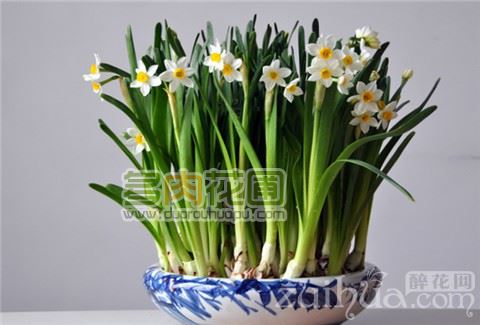
Narcissus can be grown in pots or in water; most households use water culture. The water-culture method for narcissus is as follows.
Peel off the outer skin of the purchased narcissus bulb, remove the protective mud and dead roots at the base, then use a small knife to peel off 3-4 layers of outer skin from the upper part of the bulb so that the flower buds between them are exposed; be careful not to damage the flower buds when peeling. Then soak the bulb in clean water overnight, wipe off the mucus flowing from the cuts the next day, then place it upright in a shallow narcissus pot, adding water until it covers one third of the bulb. Quartz sand, pebbles, etc. can be used in the pot to fix the bulb. During the day, the narcissus pot should be placed in a sunny place; at night move it indoors and pour out the water in the pot to control excessive leaf growth. Add clean water again the next morning, and be careful not to change the direction of the bulb. When newly potted, narcissus can have its water changed once a day, afterward once every 2-3 days, and after the flower buds form, once a week. Narcissus grows well at 10-15°C and will bloom in about 45 days, with the flowering period lasting more than a month. During the water-culture period, narcissus especially needs ample light; during the day it should be placed in a sunny spot, and at night it can be placed under lamplight. This can prevent excessive stem and leaf growth, making the narcissus leaves short, wide, thick, and sturdy, with a deep green leaf color and strongly fragrant flowers. Water-cultured narcissus generally does not need fertilization; if conditions permit, applying a little quick-acting phosphorus fertilizer during the flowering period can make the flowers bloom better.
Care points: narcissus is easy to keep alive, but harder to keep well.
The key is light and temperature. To make the narcissus plant robust and graceful, ensure ample sunlight every day, and the temperature must not be high. If it is always placed in a relatively shady indoor spot, receiving less than 3 hours of light per day, or the temperature is above 15°C, the narcissus leaves will "grow wildly," becoming fat and thin-soft, yellow in color, lacking vitality, prone to falling over, and reducing ornamental value. Therefore, it must be placed on a south-facing balcony to get as much sun as possible; this way the plant height can reach 30 cm, and the leaves will be thick and emerald green. Narcissus generally does not need fertilization, because the bulb itself stores sufficient nutrients. But if there are too many flower heads and the bulb is thin, you can also put a few drops of honey in the water each week to supplement nutrients, promote full blooming, and prevent "blind flowers." For carved narcissus, if the leaves near the cuts turn yellow, before the flowering period you can put a little urea in the water (dip the tip of a chopstick in water, then dip it in urea, and swish it in the narcissus pot), and the narcissus leaves will quickly turn emerald green and glossy.
Control the flowering time.
Under conditions of ample light and clean water, when the indoor temperature is 12°C-15°C, narcissus takes about 40 days from soaking to blooming; when the room temperature is around 18°C, about 30 days; when the room temperature is 20°C, it takes only 25 days to bloom; therefore you can determine the soaking date of the narcissus bulbs according to your needs, and enjoy the fragrant and beautiful narcissus flowers at the right time.
The above is all the content I learned today about narcissus. I hope flower lovers will find it helpful after reading this article. If you want to learn more about narcissus, please continue to follow our Succulent Garden for more content.