Why doesn't the hydrangea bloom?
The hydrangea, also known as eight-immortals flower, and also called purple-sun flower or shade hydrangea, usually blooms from June to July. If the hydrangea has thick stems, large leaves and deep green foliage but does not bloom, there may be the following four reasons:
First, the potted plant has not been purposefully pruned. Usually after the flowers fade, the branch tips must be cut short in time to encourage new branches to grow; when the new branches reach 8-10 cm, they can be cut back again, which encourages the lateral buds on them to develop and fill out early, and only in this way can flower branches grow the following year; that is, pinching the top suppresses the plant's vegetative growth so as to promote more lateral branches and the formation of flower buds.
Second, the types and proportions of fertilizer are unbalanced; there may be too much nitrogen fertilizer and too little phosphorus and potassium fertilizer, causing excessive vegetative growth, which is unfavorable for flower bud formation and prevents the plant from blooming normally in the second and third years.
Third, there may be too much watering. After the plant's new shoots have grown to a certain length, it should be given appropriate "water withholding" to suppress its vegetative growth and promote flower bud differentiation.
Fourth, light duration is not controlled properly. The hydrangea is a short-day plant; maintaining darkness for more than 10 hours per day for about 6 weeks is required to form flower buds. For plants grown for forcing, after 6-8 weeks of a cool (5-7°C) period, place the plant at 20°C to force flowering; when the inflorescence becomes visible, lower the temperature to about 16°C, and after maintaining this for about 2 weeks it will bloom.
When does the hydrangea bloom? Why doesn't the hydrangea bloom?
The hydrangea is a famous ornamental plant of the Yangtze River basin, also known as eight-immortals flower, powder-ball flower, grass hydrangea, etc. Its flowers are large and beautiful in color, full in shape, big and lovely, and the flower color can be red or blue. So when does the hydrangea bloom? Why doesn't the hydrangea bloom?
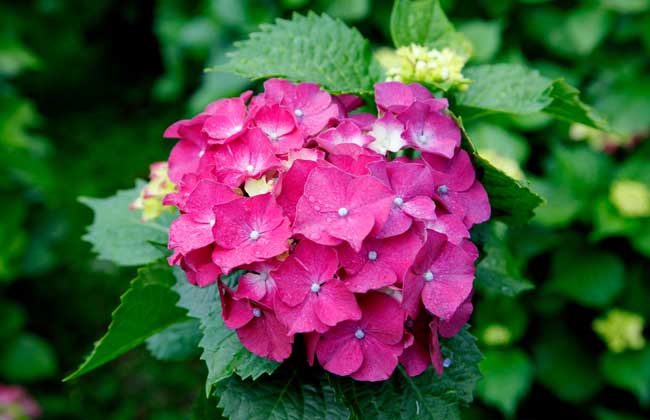
When does the hydrangea bloom:
The hydrangea generally blooms from June to August, and the time from blooming to fading is about 25 days. The flower colors of the hydrangea are pink, light blue or white, but the color of the hydrangea changes with the pH of the soil or medium. To deepen the blue, aluminum sulfate can be applied during the bud formation stage; to maintain pink, lime can be applied to the soil.
Why doesn't the hydrangea bloom:
1. Too much nitrogen fertilizer: In the early stage of flower bud differentiation, the hydrangea mainly needs nitrogen fertilizer, and during the differentiation stage it mainly needs phosphorus fertilizer. However, if excessive nitrogen and phosphorus fertilizer is applied in autumn and winter, it will cause nutrient excess in the plant, inhibit growth, make flower bud differentiation difficult, and affect blooming the following year.
2. Too little light: Home cultivation of the hydrangea is limited by conditions, and it receives less light, which causes leggy leaves and poor growth. The leaves consume too many nutrients, so there is insufficient nutrition during flower bud differentiation, affecting blooming.
3. Too much light: The hydrangea is a short-day plant, and during the flower bud differentiation stage the light duration must not exceed 10 hours. For eight-immortals flower kept indoors, long periods of lamplight at night increase the light exposure and affect flower bud differentiation.
4. Improper pruning: The flowering period of the hydrangea is from June to August. After the flowering period, the flower branches should be pruned to reduce nutrient loss. If the plant grows too vigorously and is also heavily pruned in early spring, it is very difficult for flower branches to form from June to August, resulting in reduced or no blooming.
How to grow the hydrangea well:
1. Soil: The hydrangea does best in loose, fertile and well-drained sandy loam, but changes in soil pH greatly change the flower color of the hydrangea. To deepen the blue, aluminum sulfate can be applied during the bud formation stage; to maintain pink, lime can be applied to the soil.
2. Watering: The potting soil of the hydrangea should be kept moist, but it should not be watered too much. Especially in the rainy season, drainage must be noted to prevent root rot caused by waterlogging. In winter, potted plants indoors are better kept slightly dry. If too damp, the leaves are prone to rotting.
3. Light: The hydrangea is a short-day plant. In ordinary cultivation, avoid direct sunlight, and 60-70% shade is ideal. In midsummer, when the light is too strong, appropriate shading can extend the flower-viewing period.
4. Temperature: The suitable growth temperature for the hydrangea is 18-28°C, and the winter temperature should not be lower than 5°C. Flower bud differentiation requires 6-8 weeks at 5-7°C; a temperature of 20°C can promote blooming, and after the flowers appear, maintaining 16°C can extend the flower-viewing period. Note that high temperatures make the flowers fade quickly.
5. Fertilizing: The hydrangea generally should be given a dilute cake fertilizer solution about once every 15 days. To keep the potting soil often acidic, 0.2% ferrous sulfate can be added when applying liquid fertilizer to make alum fertilizer water for irrigation, and during the bud stage add 1-2 applications of 0.5% superphosphate soaking solution.
6. Pruning: After the hydrangea blooms, be sure to remove the flower stems to encourage new branches. Proper pruning can keep the plant shape graceful. In early spring in March, cut off diseased, dead and weak branches from the base, keep 3-5 strong main branches and cut them back, leaving 2-3 buds on each branch.
7. Pests and diseases: The hydrangea mainly has wilt disease, powdery mildew and leaf spot disease, which can be prevented and controlled by spraying 600 times dilution of 65% zineb wettable powder. Pests include aphids and mirid bugs, which can be killed by spraying 1500 times dilution of 40% omethoate emulsifiable concentrate.
8. Repotting: The hydrangea generally needs to be repotted and have its soil changed once a year. When repotting, cut off rotten roots, decayed roots and overly long root fibers. After moving the plant into a new pot, press the soil firm, water thoroughly, place it in a shaded place for about 10 days, then move it outdoors for normal care.
Why doesn't the hydrangea bloom? What to do if the hydrangea doesn't bloom
The hydrangea, also known as eight-immortals flower, and also called purple-sun flower or shade hydrangea, usually blooms from June to July. The hydrangea has thick stems, large leaves and deep green foliage, but many hydrangeas do not bloom. So why doesn't the hydrangea bloom? What to do if the hydrangea doesn't bloom?
The potted hydrangea has not been pruned:
Usually after the flowers fade, the branch tips must be cut short in time to encourage new branches to grow; when the new branches reach 8-10 cm, they can be cut back again, which encourages the lateral buds on them to develop and fill out early, and only in this way can flower branches grow the following year; that is, pinching the top suppresses the plant's vegetative growth so as to promote more lateral branches and the formation of flower buds.
The hydrangea's fertilizer proportions are unbalanced:
There may be too much nitrogen fertilizer and too little phosphorus and potassium fertilizer, causing excessive vegetative growth, which is unfavorable for flower bud formation and prevents the plant from blooming normally in the second and third years.
It may be because there is too much watering:
After the plant's new shoots have grown to a certain length, it should be given appropriate “water withholding” to suppress its vegetative growth and promote flower bud differentiation.
Light duration is not controlled appropriately:
The hydrangea is a short-day plant; maintaining darkness for more than 10 hours per day for about 6 weeks is required to form flower buds. For plants grown for forcing, after 6-8 weeks of a cool (5-7°C) period, place the plant at 20°C to force flowering; when the inflorescence becomes visible, lower the temperature to about 16°C, and after maintaining this for about 2 weeks it will bloom.