What are the common pest and disease symptoms of Cymbidium orchids?
Because of differences in the parts affected and the symptoms produced, blight is divided into black rot, heart rot, stem rot, damping-off and so on. Under conditions of high cultivation temperature, overwatering and poor ventilation, a large amount of water accumulates in the leaf tips, and over time this most easily triggers the disease. June to August each year is the peak period for its occurrence. From seedlings to flowering plants, all can be affected.
Soft rot usually attacks the leaves, buds and pseudobulbs of Cymbidium orchids. It can occur from spring to autumn throughout the year, and is rarely seen in winter. It often occurs together with blight. Its main route of invasion is through wounds or natural stomata. In hot and humid conditions, this disease spreads extremely quickly. At 100% relative humidity and a temperature of 30°C, the invasion process is completed just 3 hours after artificial inoculation. Its symptoms are somewhat similar to those of blight, making it very hard for beginner orchid growers to tell them apart. The rotting tissue of blight has no sap or little sap, and has a fishy stench; if you squeeze a drop of the sap into a glass of clear water, no cloud-like turbidity is seen spreading out. In soft rot, however, the cells inside the epidermis of the diseased part are all broken down into watery sap containing countless white bacterial masses, and there is a great deal of sap; at the slightest touch, the sap flows out, along with a fishy stench, and if you drip a drop of the sap into a glass of clear water, cloud-like turbidity can be seen spreading out in all directions.
Root rot is a fungal disease. At any growth stage of a Cymbidium orchid plant, whether it is a seedling, medium seedling or large seedling in a clumping pot, or a mature flowering plant, it is easily infected. If left uncontrolled, the rot can spread to the stem and the lower parts of the leaves. During the course of infection, a ring of brown rot forms, encircling the base of the plant and causing seedling death. When mature plants are attacked, they gradually weaken. Generally the rot is confined to the roots, causing root death, but sometimes the rot also expands and invades the pseudobulbs, causing plants infected with root rot to decline in growth, with both leaves and pseudobulbs turning yellow, becoming thin and weak, twisted and shrunken, and eventually dying.
Anthracnose harms the leaves, pseudobulbs, sepals and petals of Cymbidium orchids. It belongs to an asexual generation of a fungus and is generally a weak parasite. Weak plants with poorly developed root systems caused by cold damage, pesticide damage, sun scorch, excessive nitrogen fertilizer application, overly acidic potting medium, overly dense planting, poor ventilation, water imbalance and so on are all easily affected. When the pathogen infects orchid leaves or pseudobulbs, the first symptom seen is the appearance of brown or yellow-green elongated irregular blotches, slightly sunken with clear edges. When mature, concentric ring patterns usually appear on the lesions, and conidia are produced on the ring spots. There is a clear dividing line between the diseased tissue and the healthy tissue. In the later stage, the lesions slowly join together into patches, the covered area gradually increases, and they sink to form necrotic canker spots.
Leaf blight is a fungal disease. It occurs near the leaf tips or at the front end of the leaves of Cymbidium orchids, initially producing small black spots. The spots gradually enlarge and become irregular lesions. The edges of the lesions form a dark brown color, the middle becomes light gray, and there are small black dots. In severe cases it can spread over the entire leaf surface, and finally the leaf withers and falls off.
What to do when Cymbidium orchids get pests, Cymbidium orchid pest and disease control / 4 pests, 4 diseases
Cymbidium orchid, an artificially bred orchid variety, has huge flowers that can reach 10 cm in diameter, and the flower colors are vivid, giving it high ornamental value, so many people keep it at home. However, in the process of growing Cymbidium orchids, many people encounter pest and disease problems. So what should you do when Cymbidium orchids get pests? Below are 8 common Cymbidium orchid pests and diseases; follow along with the editor to take a look.
1. Cymbidium orchids get pests, spray with pesticide
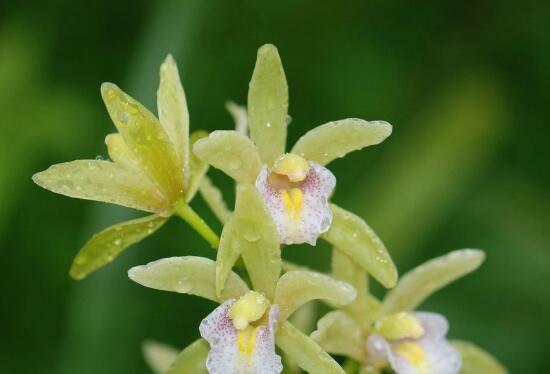
When growing Cymbidium orchids indoors, because there are many beginners, they often run into symptoms of pests and illness. At such times flower lovers must be very anxious, so what should you do when Cymbidium orchids get pests? First, do not panic; calmly identify the pest, then deal with it accordingly. For this, the editor has summarized 8 Cymbidium orchid pests and diseases, along with control methods. Let us continue reading.
2. Cymbidium orchid pest and disease control
1. Scale insects
The scale insects that harm Cymbidium orchids include the cottony cushion scale, the cotton scale, the black spot scale and others. They often parasitize the leaves, using their piercing-sucking mouthparts to penetrate deep into the plant's stomata and absorb nutrients. Symptoms: Cymbidium orchid leaves turn yellow, and in severe cases the plant dies.
Control method: after discovering a small number of scale insects, you can gently brush them off with a soft brush and then rinse with water. In severe cases, spray 40% dimethoate or omethoate emulsifiable concentrate at 1000 times dilution, or 50% trichlorfon at 250 times dilution for control. Generally, spraying 1-3 times in a row with an interval of 7-10 days each time gives better results.
2. Whiteflies
When care is improper and ventilation is poor, whiteflies will come to Cymbidium orchids. These insects are even smaller than scale insects and reproduce very quickly. Once they are discovered, they will be extremely dense and will cause the entire leaves of Cymbidium orchids to dry up and fall off.
Control method: after discovering whiteflies, control them promptly. You can spray 20% fenvalerate at 2000 times dilution for control, once every 5-6 days, and 2-3 consecutive sprays will show results.
3. Red spider mites
Mite pests are also one of the Cymbidium orchid pests and diseases, and the most commonly seen is the red spider mite. It is small in size and not easy to spot, but it causes great damage to the plant. Symptoms: red spider mites use their mouthparts to suck the nutrients from the leaves, causing an imbalance in the plant's water metabolism and affecting the plant's normal growth and development.
Control method: when the problem occurs, you can choose to evenly spray 40% dicofol emulsifiable concentrate at 1000-1500 times dilution, which gives good control results. Red spider mites generally reproduce in environments with higher temperatures and lower humidity, so in daily care we should pay attention to regulating the temperature.
4. Cockroaches
If there are cockroaches in your kitchen at home, and your Cymbidium orchid happens to be placed next to the kitchen, then the cockroaches will harm the plant's young shoots, flower spikes, flower buds, flowers and root tips. Symptoms: poor growth of the Cymbidium orchid and incomplete flower spikes and flowers, losing their ornamental value.
Control method: when you find cockroaches, drive them away directly, or spray a cockroach-killing product on the places where cockroaches appear. In addition, keep the potted Cymbidium orchid away from the home kitchen and clean the kitchen frequently.
5. Blight
One of the Cymbidium orchid pests and diseases, this disease is easily contracted when the temperature is high and there is overwatering. Symptoms: in the early stage, water-soaked spots appear on the diseased leaves, which then quickly expand and turn into dark brown rot, causing leaf drop. Sometimes a thin white mold layer appears on the affected surface of the leaves.
Control method: when the disease occurs, strictly control water and promptly remove diseased leaves and diseased plants. At the same time, you can spray diseased plants with 25% metalaxyl powder at 600 times dilution, 40% metalaxyl-copper wettable powder at 700 times dilution and so on for control.
6. Soft rot
This disease usually attacks the leaves, buds and pseudobulbs of Cymbidium orchids, and its symptoms are somewhat similar to those of blight, making it very hard for beginner orchid growers to tell them apart. How to distinguish: the rotting tissue of blight has no sap or little sap and no fishy stench; while the rotting tissue of soft rot has sap and a fishy stench.
Control method: soft rot can only be prevented; once the disease occurs we can only discard the plant. For prevention and control, you can spray 40% copper hydroxide at 400 times dilution, once every 7-10 days, and 3 to 4 consecutive sprays will show results.
7. Anthracnose
One of the common diseases of Cymbidium orchids, it mainly harms the leaves. Symptoms: in the early stage, several pale yellow, dark brown or light gray small patches appear on the diseased leaves, containing many black spots, and in severe cases it can infect the stems and branches.
Control method: cut off the diseased leaves and burn them in a concentrated manner to reduce the source of infection. In severe cases, spray 50% carbendazim at 1000 times dilution or 70% thiophanate-methyl at 1000 times dilution for anti-rot treatment, and results will appear after 2-3 applications.
8. Root rot
If your Cymbidium orchid shows loss of leaf color, scorched and withered leaf tips, or new shoots that are slow to emerge and grow abnormally slowly, then it may have contracted root rot. Symptoms: when you press hard on the ring-shaped or elongated ring-shaped brown spots on the Cymbidium orchid, water will spurt out.
Control method: if this disease is simply sprayed with chemicals, it is very hard to cure completely; only the root-drenching method can be effective: drench the roots with dexon at 600 times dilution or triadimefon at 600 times dilution. Only by controlling it from the root can Cymbidium orchid root rot be thoroughly cured.
That is all the editor has to introduce about Cymbidium orchid pest and disease control. I believe everyone now knows what to do when Cymbidium orchids get pests or become ill! Overall, Cymbidium orchids are very easily troubled by pests and diseases, so everyone must care for them according to Cymbidium orchid growing methods. Only in this way will pests not come knocking. Finally, may everyone's Cymbidium orchids bloom into beautiful flowers!
Cymbidium orchid leaf spot disease, Cymbidium orchid gray mold prevention
The main diseases of Cymbidium orchids include leaf spot disease and gray mold, and the specific control methods are as follows. The main pests include aphids, red spider mites, scale insects and so on. You can use fenitrothion and omethoate emulsifiable concentrate, each at 1000 times dilution, to control aphids, and use dicofol or dichlorvos at 800-1000 times dilution to control red spider mites, spraying once every 15 days.
Cymbidium orchid pests and diseases 1. Symptoms of Cymbidium orchid leaf spot diseaseIt occurs near the leaf tips or at the front end of the leaves of Cymbidium orchids, producing small black spots, and the spots enlarge to become irregular lesions. The edges of the lesions form a dark brown color, the middle becomes light gray, and there are small black dots. In severe cases, it can spread over the entire leaf, and finally the leaf withers and falls off.
Occurrence patternThe pathogen overwinters as mycelium and pycnidia on diseased leaves or diseased plant debris. The following year, conidia are produced and emerge from the openings of the pycnidia, spread by wind and rain, and invade through wounds or stomata, causing primary infection and reinfection. The disease is prone to occur at temperatures of 25-27°C after rain. The lesions sometimes perforate.
Control methodsa. Care carefully, and pay attention to improving the growing conditions of the orchid so that it has good ventilation and light.
b. Promptly cut off any lesions found, and remove or burn them in a concentrated manner.
c. When the disease occurs, spray 27% copper hydroxide suspension concentrate or 12% copper octanoate emulsifiable concentrate at 600 times dilution, 30% copper oxychloride suspension concentrate at 600 times dilution, 50% chlorothalonil wettable powder at 500 times dilution, or 53.8% copper hydroxide dry suspension concentrate at 1000 times dilution. Once every 10-15 days, for 2-3 treatments.
2. Symptoms of Cymbidium orchid gray moldIt mainly attacks the floral organs, and sometimes also harms the leaves and stems. After the petals or sepals are infected, small semi-transparent water-soaked spots appear within 24h, and the lesions then turn brown. Sometimes there is a ring of white or faint pink around the spots. The number of lesions on each flower varies, and the petals rot in a dark brown color. When humidity is high, a furry growth, namely the pathogen's conidiophores and conidia, grows from the rotting flowers.
Occurrence patternThe pathogen overwinters as sclerotia in the soil at 5-20cm. The following spring, when the temperature is 7-18°C and the relative humidity is above 88%, a large amount of mycelium and conidia are produced on the sclerotia. The conidia are spread by airflow, water droplets or dew, and horticultural operations. This fungus is a weak parasite, with an optimum development temperature of 20-23°C. A temperature of 20°C and relative humidity above 90% are suitable for the disease to become epidemic.
Control methodsa. Carry out routine disinfection of the greenhouse where Cymbidium orchids are to be planted, to eliminate the pathogen. Spray newly arrived Cymbidium orchids with 25% prochloraz emulsifiable concentrate at 800 times dilution; disinfect the growing medium, flower pots and soil-manure blocks with 25% prochloraz at 400 times dilution, and use them after drying.
b. Carry out isolated cultivation of diseased plants with gray mold.