Potted Peperomia obtusifolia: Care Methods and Precautions
Peperomia obtusifolia belongs to the Araliaceae family and the genus Fatsia, and is a perennial evergreen herbaceous plant. The plant grows about 20 cm tall, with round stems that often branch, light green with purplish-brown markings. The leaves are alternate, thick and fleshy, glossy on both sides, oblong-elliptical, with short petioles. The spike inflorescence bears small greenish-white flowers. The horticultural variety variegated Peperomia obtusifolia has light green stems with dark red markings. The leaf margins have yellow patches that later turn pale white. The central part of the leaf is light green with pale white markings. The markings vary greatly from plant to plant.
Peperomia is a large genus in the Piperaceae family, with more than 1000 known species today, all distributed in tropical and subtropical regions. The stemless peperomia type, Peperomia argyreia, also known as watermelon peperomia, has leaf markings that resemble the rind of a watermelon, with alternating light and dark stripes that are highly three-dimensional, hence its name. Peperomia argyreia grows 15-20 cm tall, with leaves clustered and almost no stem. The leaves are roundly peltate, green mixed with dark green or silvery-white veins, with slender red petioles, glossy upper surfaces, and red undersides. The spike inflorescence is composed of countless tiny flowers.
Peperomia obtusifolia prefers warm, humid air and a semi-shaded environment. The optimum growing temperature is about 25°C, with a winter room temperature of 10-15°C, and it must not drop below 10°C. It requires a culture soil rich in humus, loose and fertile, with good drainage.
Propagation is usually by cuttings. It can be done by stem cuttings or leaf cuttings. For stem cuttings, from April to July select robust terminal shoots about 7 cm long, insert them with leaves in river sand or vermiculite, and maintain a temperature of about 28°C and a humid environment; they will root quickly. For leaf cuttings, cut off fully grown leaves with petioles about 3 cm long, insert them 2 cm deep into vermiculite or washed river sand, and keep the substrate highly moist but not overly wet; they will root in about 3 weeks. After 50 days of careful care, several clusters of young plants will sprout, and when the young plants have grown into shape they can be transplanted. Division can also be used for propagation, carried out in spring together with repotting and soil changing.
Plants of the genus Peperomia are robust by nature and relatively easy to cultivate. The potting soil should be loose and well aerated, and can be made from leaf mold, peat soil, and river sand. During the long summer, it should be placed in a spot with scattered light indoors. Too strong light is harmful to plant growth, but too much shade will cause the leaf veins to fade. When winter temperatures are low, full light is preferable. During the growing period, its water requirement is slightly less than that of general high-temperature plants, and a dilute liquid fertilizer can be applied once every half month. Normally, watering should keep the potting soil moderately moist; when the air is dry, water can be sprayed on the leaves or misted. In hot and humid seasons, pay attention to ventilation, and the potting soil must not remain waterlogged for long, to prevent unsightly markings from appearing on the leaves, or even blackening and rotting.
Potted Plant Peperomia obtusifolia: Care Methods and Precautions
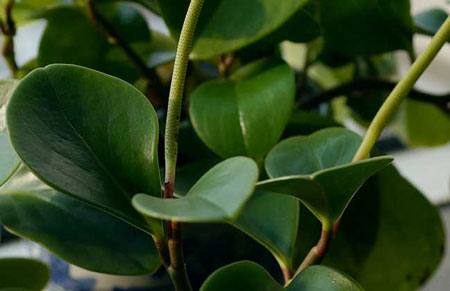
The scientific name of Peperomia obtusifolia is Peperomia, with aliases such as dou ban cai and dou ban ru yi. It is a herbaceous plant in the Piperaceae family and the genus Peperomia, with creeping stems and many branches. It can be grown as a potted ornamental and also has medicinal value: taken internally it treats rheumatoid arthritis and bronchitis, and applied externally it treats sprains, fractures, and boils and sores. Below, let us take a look at the care methods and precautions for Peperomia obtusifolia!
The Growing Environment of Peperomia obtusifolia
Peperomia obtusifolia grows on moist rocks or dead trees, and prefers a warm, humid, semi-shaded environment. The optimum growing temperature is about 25°C, and the minimum must not be below 10°C. It is not tolerant of high temperatures and requires relatively high air humidity. It avoids direct sunlight and prefers loose, fertile, well-drained moist soil. In China it is distributed in Taiwan, China, Fujian, Guangdong, Guangxi, Guizhou, Yunnan, Sichuan, southern Gansu, and southern Xizang. Abroad it is distributed in the Americas, Oceania, Africa, and the tropical and subtropical regions of Asia.
Propagation Methods of Peperomia obtusifolia
Peperomia obtusifolia is mostly propagated by cuttings and division. For cuttings, from April to May select robust terminal shoots about 5 cm long as cuttings, keep 1-2 leaves on the upper part, and after the cut surface has dried, insert them into a moist sand bed. Leaf cuttings can also be used: cut off leaves with petioles with a knife, let them dry slightly, then insert them obliquely into the sand bed, and they will root in 10-15 days. In a greenhouse with temperature control equipment, this can be done year-round. Division is mainly used for propagating variegated leaf varieties.
Care Methods for Peperomia obtusifolia
1. Soil: Peperomia obtusifolia prefers growing in loose, fertile, well-drained sandy soil rich in humus, and grows poorly in clay. A general substrate can be made by mixing leaf mold + river sand + a small amount of decomposed organic fertilizer; if conditions permit, a mix of peat soil and perlite can be used.
2. Light: Peperomia obtusifolia prefers semi-shade or scattered light. Except in winter, when full light is needed, it needs a little shading in other seasons, and especially more shading in summer. If placed in a shaded environment, it is prone to leggy growth, with longer internodes and reduced ornamental value, which is also undesirable. Under semi-shaded conditions, the leaf color is brighter and the gloss is better; variegated leaf varieties in particular need slightly more sunlight.
3. Temperature: Peperomia obtusifolia prefers a warm environment. The optimum growing temperature is between 20-30°C, and the overwintering temperature is best kept above 10°C. Growth stops below 10°C, and it is prone to frost damage below 5°C.
4. Humidity: Peperomia obtusifolia prefers a humid growing environment. Under high-humidity conditions it grows luxuriantly and its leaf color is vivid. When the temperature is high or the air is dry, spray the leaves more or sprinkle water in the growing environment to maintain relatively high air humidity, which is extremely beneficial to plant growth. It can also adapt to short periods of dryness, but not for long; generally humidity should be kept at about 70%.
5. Watering: Peperomia obtusifolia prefers water and is not tolerant of drought. During the growing period it should be watered frequently. When the temperature is above 25°C or the air is dry, water more, but also prevent waterlogging. When the temperature is below 25°C, water thoroughly only when the soil surface is dry. When the temperature is below 10°C, it can tolerate several days of dryness without watering.
6. Fertilizing: When the temperature is above 18°C, a small amount of fertilizer is needed. When the temperature is below 18°C or above 30°C, it is best to apply little or no fertilizer. Fertilizing is best done in small amounts and frequently, and watering with diluted fertilizer solution instead of clear water is best. It is not tolerant of raw fertilizer or concentrated fertilizer, which can easily cause fertilizer damage. Fertilizer solution can also be sprayed on the leaves, with good results. Fertilizer should be mainly nitrogen and potassium, with phosphorus secondary.
7. Pruning: For newly propagated young plants of Peperomia obtusifolia, pinch the tips when the seedlings are about 10 cm tall to increase the number of branches, so the plant shape is fuller and the ornamental value is higher. Pruning of large plants is generally determined by their growth vigor; cut back leggy branches, which can be used as cutting material and root easily, inserted in clean river sand or vermiculite, or directly inserted into sandy soil.
How to Grow Potted Peperomia obtusifolia Well: Propagation Methods of Peperomia obtusifolia
Peperomia obtusifolia is also known as dou ban lv, dou ban cai, dou ban ru yi, etc. It is a herbaceous plant in the Piperaceae family and the genus Peperomia. It is often grown in white plastic pots or white porcelain pots and placed on coffee tables, decorative cabinets, curio shelves, or office desks, or its branches can be allowed to trail down and hang indoors in front of windows or in bathrooms. It has a certain purifying effect on formaldehyde, xylene, secondhand smoke, and the like. Below, let us take a look at how to grow potted Peperomia obtusifolia well!
The Growth Habits of Peperomia obtusifolia
Peperomia obtusifolia is native to the West Indies, Panama, and northern South America, and was later introduced to China. It is now produced in Taiwan, China, Fujian, Guangdong, Guangxi, Guizhou, Yunnan, Sichuan, southern Gansu, and southern Xizang. It prefers a warm, humid, semi-shaded environment. The optimum growing temperature is about 25°C, and the minimum must not be below 10°C. It is not tolerant of high temperatures and requires relatively high air humidity. It avoids direct sunlight and prefers loose, fertile, well-drained moist soil.
Propagation Methods of Peperomia obtusifolia
Peperomia obtusifolia is mostly propagated by cuttings and division. For cuttings, from April to May select robust terminal shoots about 5 cm long as cuttings, keep 1-2 leaves on the upper part, and after the cut surface has dried, insert them into a moist sand bed. Leaf cuttings can also be used: cut off leaves with petioles with a knife, let them dry slightly, then insert them obliquely into the sand bed, and they will root in 10-15 days. In a greenhouse with temperature control equipment, this can be done year-round. Division is mainly used for propagating variegated leaf varieties.
How to Grow Potted Peperomia obtusifolia?
1. Soil: Peperomia obtusifolia prefers growing in loose, fertile, well-drained sandy soil rich in humus, and is not suitable for growing in clay, so the substrate is usually made by mixing leaf mold, river sand, and a small amount of decomposed organic fertilizer; for a better substrate, peat soil mixed with perlite can be used.
2. Watering: Peperomia obtusifolia prefers water and is not tolerant of drought. During the growing period it should be watered frequently. When the temperature is above 25°C or the air is dry, water more, but also prevent waterlogging. When the temperature is below 25°C, water thoroughly only when the soil surface is dry. When the temperature is below 10°C, it can tolerate several days of dryness without watering.
3. Humidity: Peperomia obtusifolia prefers a humid growing environment. Under high-humidity conditions it grows luxuriantly and its leaf color is vivid. When the temperature is high or the air is dry, spray the leaves more or sprinkle water in the growing environment to maintain relatively high air humidity, which is extremely beneficial to plant growth. It can also adapt to short periods of dryness, but not for long; generally humidity should be kept at about 70%.
4. Temperature: Peperomia obtusifolia prefers a warm environment. The optimum growing temperature is between 20-30°C, and the overwintering temperature is best kept above 10°C. Growth stops below 10°C, and it is prone to frost damage below 5°C. Temperature changes directly affect leaf color: the optimum winter temperature for variegated leaf types is 18-20°C, and for green leaf types about 15°C. It fears heat in midsummer, so it can be placed under a shade shed and misted to cool down, but note that excessive heat and moisture can both cause the stems and leaves to blacken and rot.
5. Light: Peperomia obtusifolia prefers semi-shade or scattered light. Except in winter, when full light is needed, it needs a little shading in other seasons, and especially more shading in summer. If placed in a shaded environment, it is prone to leggy growth, with longer internodes and reduced ornamental value, which is also undesirable. Under semi-shaded conditions, the leaf color is brighter and the gloss is better; variegated leaf varieties in particular need slightly more sunlight.
6. Fertilizing: When the temperature is above 18°C, Peperomia obtusifolia needs a small amount of fertilizer. When the temperature is below 18°C or above 30°C, it is best to apply little or no fertilizer. Fertilizing is best done in small amounts and frequently, and watering with diluted fertilizer solution instead of clear water is best. It is not tolerant of raw fertilizer or concentrated fertilizer, which can easily cause fertilizer damage. Fertilizer solution can also be sprayed on the leaves, with good results. Fertilizer should be mainly nitrogen and potassium, with phosphorus secondary.
7. Pruning: Peperomia obtusifolia has strong branching ability and grows quickly, so attention should be paid to pruning normally. Cut off branches that are too tall or too dense; this not only improves air circulation among the branches and stems, but also keeps the plant shape attractive. For newly propagated young plants, pinch the tips when the seedlings are about 10 cm tall to increase the number of branches. Pruning of large plants is generally determined by their growth vigor.
Precautions for Peperomia obtusifolia
1. Peperomia obtusifolia has relatively few pests and diseases. The diseases that generally appear are all caused by improper care and an unsuitable environment, and it can gradually recover after adjustments. The main pest is red spider mite, but it can be prevented by maintaining relatively high air humidity. When it occurs, it can be controlled by wiping the leaves with a damp cloth or spraying a specialized pesticide.
2. When growing Peperomia obtusifolia in summer, strengthen air convection so that the heat inside the plant can dissipate. Place it in semi-shade, or give it 50% shade. At the same time, mist appropriately, 2-3 times a day.
3. When growing Peperomia obtusifolia in winter, move it indoors to a bright spot for care. Outdoors, it can be wrapped in plastic film to overwinter, but every two days at the warmer noon time the film should be opened to let it breathe.
4. Peperomia obtusifolia has high fertilizer and water requirements, but it most fears indiscriminate fertilizing, concentrated fertilizer, and one-sided application of nitrogen, phosphorus, or potassium fertilizer. It requires following the fertilizing (and watering) principle of "apply dilute fertilizer frequently, use small amounts and many times, and provide complete nutrition."
5. Peperomia obtusifolia fears direct strong light and needs to be kept in semi-shade for care, or given 70% shade. When cared for indoors, place it in as bright a spot as possible, and every one or two months move it outdoors to a semi-shaded spot or a spot with shade for a month of care, so that it can accumulate nutrients and restore its growth vigor.