How to propagate Fuchsia? A detailed guide to common propagation methods
Native to tropical America and New Zealand. It prefers a cool and humid environment. It is not tolerant of high temperatures, and the optimal growing temperature is 10-15°C. A fertile sandy loam rich in humus and with good drainage is ideal.
1. Propagation methods
(1) Seed propagation Some varieties that readily set seed can be propagated by seed. In spring and autumn, sow in a seedling tray in the greenhouse using the broadcast sowing method. At a temperature of 15-20°C, seeds germinate in about 15d, and plants sown in spring will not flower until the second year.
(2) Cutting propagation Cuttings root very easily, and cuttings taken from one-year-old branches have the highest survival rate. Cuttings are generally taken in spring and autumn. Cut 5-8cm long vigorous shoot tips as cuttings, keep 2 small leaves, remove the rest, then insert them into plain sandy soil, burying them 1.2cm deep. Shade, keep warm, and maintain humidity. At a temperature of 15-28°C, all cuttings can root in about 15d. Cuttings taken in summer often rot and die, with a low survival rate.
(3) Tissue culture Stem tips and young apical leaves can be used as explants for tissue culture propagation.
2. Cultivation and management
Fuchsia grows rapidly and blooms profusely, so fertilizer and water supply should be strengthened during the growing period. Apart from not fertilizing in midsummer, apply fertilizer once every 10-15d at other times. Fuchsia prefers a cool environment and enters a semi-dormant state above 30°C. In summer, the plant should be placed under a shade canopy, with frequent misting of the leaves or sprinkling of water on the ground to enhance ventilation. Control watering so that it can remain dormant through the summer.
How to grow Fuchsia Fuchsia flower How to grow Fuchsia
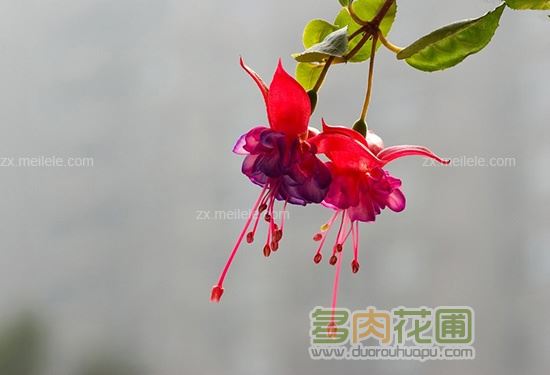
Fuchsia flower gets its name entirely from its appearance. Unlike flowers such as peonies, roses, and tulips, whose flower cups face upward, it hangs downward from the branches, like a suspended large bell. Because of this appearance, the fuchsia flower is also very easy to identify.
[Recommended reading] Lily Kalanchoe Globe amaranth Gardenia Clivia Guzmania Balloon flower Mulberry Winter jasmine Mimosa
Fuchsia flower How to grow Fuchsia
——————————————————————————————————————————————
[Plant profile]
——————————————————————————————————————————————
Chinese name:Fuchsia
Scientific name:Fuchsia
Alternative names:Lantern begonia, hanging-bell begonia
Family:Onagraceae
Genus:Fuchsia
Origin and distribution:Native to Peru, Chile, Argentina, Bolivia, Mexico and other Central and South American countries, now widely cultivated.
Morphological characteristics:Semi-shrub or small shrub, plant height 30-150 cm, stems nearly smooth, branches slender and slightly drooping, often tinged pink or purplish-red. Leaves opposite or in whorls of three, ovate to ovate-lanceolate; flowers solitary in the leaf axils of the upper branches, with long pedicels and drooping. Petals 4, often closed together or slightly spreading, and some are semi-double. Petals come in red, white, purple, etc., and the calyx also comes in red and white. Flowering period April-July.
Ecological habits of Fuchsia
——————————————————————————————————————————————
Fuchsia prefers a humid, cool environment and does best in fertile, loose, slightly acidic soil. It fears high temperatures and strong light. In summer it needs dry, cool, semi-shaded conditions; in winter it needs warmth and humidity, plenty of sunlight, and good air circulation. The suitable growing temperature for Fuchsia is 15-25°C. In winter the temperature should not be lower than 5°C. At 30°C in summer growth slows, and at 35°C it withers and dies.
Propagation methods for Fuchsia
——————————————————————————————————————————————
Fuchsia is mainly propagated by cuttings, generally taken in January, February, and October. The suitable temperature for cuttings is 15-20°C, and roots form in about 20 days. During the growing period of Fuchsia, apply liquid fertilizer once every 7-14 days. Fuchsia has strong phototropism, so the pot should be turned frequently to keep its appearance even.
Key care points for Fuchsia
——————————————————————————————————————————————
(1) Repotting and changing the soil: Fuchsia needs to be repotted once a year in spring or autumn before budding. Use a uniform mixture of leaf mold, sandy loam, decomposed organic fertilizer, and phosphate fertilizer.
(2) Fertilizing: For Fuchsia, master the technique of applying light fertilizer frequently, applying a thin cake fertilizer or compound fertilizer about once every 10 days. During the flowering period, apply a liquid fertilizer mainly of phosphorus and potassium once a month, and stop applying fertilizer in the hot season.
(3) Temperature: Do a good job of cooling in summer; in winter, ensure plenty of sunlight and take insulation measures. Whether in winter or summer, always pay attention to ventilation.
(4) Watering: Water Fuchsia as soon as the soil is dry, and water thoroughly, but avoid waterlogging. In summer, it is better to keep it on the dry side, but mist the leaves and ground to increase air humidity.
(5) Placement: To keep Fuchsia full and well-shaped, change its position frequently to avoid leaning to one side and spoiling its shape. However, during the flowering period it should be moved as little as possible, otherwise it will cause buds and flowers to drop.
"Conclusion:Now that the information about the fuchsia flower has been introduced, do you recognize this flower with such a distinctive appearance? The fuchsia flower can be grown indoors. Once you have learned how to grow Fuchsia, go buy a pot and start growing it!
【More plant encyclopedia】
Poppy Night-blooming jasmine Rose Azalea Lavender Pothos Asparagus fern Peperomia Hyacinth Anthurium Cherry blossom Calla lily
African jasmine Rose flower Spring Festival flowers Succulents Tropical plants Rosa rubus Agave Canna Lycoris Forget-me-not Dandelion
Dendrobium officinale Yew Kapok Osmanthus Crabapple Hydroponic plants Home feng shui plants Bedroom feng shui plants Plum Aloe
Jasmine Radiation-absorbing plants Pennywort Potted plants Bonsai making Drug plants Mistletoe Indoor flowers Money tree Japanese evergreen Lucky bamboo
Potted plant making Anthurium Mint Lithops Geranium Garden Crab cactus Peace lily Snake plant Kunlun snow chrysanthemum Water lily Blue enchantress
How to grow Fuchsia
You may not know that there is a plant called Fuchsia. This rather unusual-looking plant is a succulent. People who like succulents must have learned about Fuchsia. Below we will share with you some methods for growing Fuchsia.
How to grow Fuchsia1. What is Fuchsia
Fuchsia is a succulent plant. The plant can reach a height of about 30 cm, with many branches and stem nodes. This plant, Fuchsia, grows branches at the top; they are slender and develop a curved, arc-like form on the outside. The color of Fuchsia is light green, and its flowers are yellow. Fuchsia is worth acquiring for plant lovers.
2. How to grow Fuchsia——Environment
Fuchsia likes warm and dry growing conditions, and there are many places where it can be cultivated. This type of succulent shrub plant begins to enter dormancy in summer, so at this time its resistance is relatively poor.
3. How to grow Fuchsia——Cuttings
During the growth of Fuchsia, a section of branch can be cut off for cuttings. After inserting it into the soil, do not water it immediately; let the plant adapt first, otherwise the plant will become more prone to rotting. Newly inserted cuttings have weak resistance, so choose tender tips for cuttings.
4. How to grow Fuchsia——Temperature
Fuchsia begins to go dormant when temperatures rise in summer, so appropriate shading treatment is needed. Long-term exposure to the scorching sun will cause the plant to dry up. Watering, ventilation, and light fertilizer will enhance the results of growing Fuchsia.