What are the planting methods and techniques for Kalanchoe blossfeldiana?
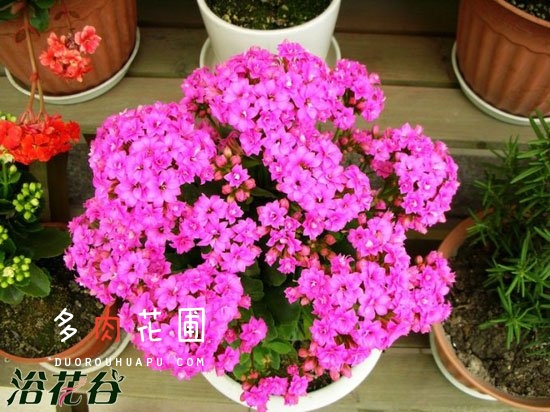
Kalanchoe blossfeldiana is a succulent plant in the Crassulaceae family, with thick, glossy leaves, a dwarfed, clumping growth habit, and evergreen foliage. It blooms in winter and spring, with a flowering period lasting as long as 4 months. It produces many branches, with each branch bearing several flowers. It is suitable for 12-15 cm pot cultivation. It prefers a warm climate, with an ideal growing temperature of 18-30°C. It is mainly propagated by cuttings, with an ideal cutting temperature of 20-25°C.
For pot cultivation, a substrate with good drainage is suitable, mainly peat soil with an appropriate addition of perlite or vermiculite. The growing medium should be slightly acidic, with a pH of 5.8-6.2. Kalanchoe blossfeldiana has a low fertilizer requirement; in the early stage, a compound fertilizer solution with a nitrogen:phosphorus:potassium ratio of 20:10:20 can be applied once a week, and in the later stage, a compound fertilizer with a nitrogen:phosphorus:potassium ratio of 14:0:14 can be used. Kalanchoe blossfeldiana has a low water requirement; when watering, never allow water to accumulate on the leaves, as this will cause leaf rot, so the leaves must be kept dry before nightfall.
Kalanchoe blossfeldiana is a short-day plant. With a dark period of 14 hours per day, it can bloom after more than 6 weeks of short-day treatment. By making use of this characteristic, the flowering period of Kalanchoe blossfeldiana can be regulated to achieve blooming in time for holidays. When growing Kalanchoe blossfeldiana as a single plant, pinching is generally carried out 3-4 weeks after planting out to promote branching and thus obtain a better plant shape. When flower buds first appear, removing some of the buds can also promote the formation of more buds.
How to grow Kalanchoe blossfeldiana
Kalanchoe blossfeldiana has the advantages of many flower colors, easy propagation, and a long flowering period, but growing Kalanchoe blossfeldiana is not that simple. To get Kalanchoe blossfeldiana to bloom, not only must care be appropriate, pruning is also very important. Below is the experience of a flower enthusiast in growing Kalanchoe blossfeldiana.1. Soil
Kalanchoe belongs to the succulents and is not choosy about soil; it can grow in any soil. But according to my personal growing experience, it grows best in loose, breathable soil with good drainage. The soil I use is: 5 parts black mountain soil, 3 parts peat soil, 2 parts orchid stone (can also be volcanic stone, ceramsite, etc., with the granules being slightly smaller).
2. Fertilizer
Kalanchoe has low fertilizer requirements. I generally apply base fertilizer at planting time and do not fertilize at other times. For the base fertilizer, I generally use bone meal; when bone meal is unavailable, I use granular chicken manure fertilizer (crushed), with the amount being half that used for herbaceous flowers of the same pot diameter. That is to say, for a 20 cm herbaceous flower, the base fertilizer should be two handfuls, while one handful is enough for Kalanchoe.
3. Environment
Except when the temperature drops below 0°C in winter, when I move the Kalanchoe into the sunroom, at other times I let it be exposed to wind and sun on the terrace. People online say Kalanchoe cannot be exposed to strong sun in summer, but based on my personal growing experience, Kalanchoe is not afraid of strong sun.
4. Water
Kalanchoe is relatively drought-tolerant and afraid of waterlogging, so even in summer there is no need to water every day. I generally water only when the potting soil has completely turned pale and dried out; in a season like the present one, it is fine not to water for a month. In winter, water even less; even when the flowers are very splendid, water only when the potting soil has completely turned pale.
5. Pruning of Kalanchoe
After the flowers fade each year, carry out major pruning; for pruning done before July, only about 3 cm of stems need to be kept, and the rest can all be cut off (no leaves at all may be kept). When pruning, repotting and fertilizing should be done at the same time, and the pruned branches can be used for cuttings. Before long, Kalanchoe will grow many new shoots; afterward, keep the plant within 10-15 cm, and remove any parts that exceed this. Do not prune again after the end of September, because Kalanchoe begins to form buds and prepare to bloom.
How to grow Kalanchoe blossfeldiana
Kalanchoe blossfeldiana has the advantages of many flower colors, easy propagation, and a long flowering period, but growing Kalanchoe blossfeldiana is not that simple. To get Kalanchoe blossfeldiana to bloom, not only must care be appropriate, pruning is also very important. Below is the experience of a flower enthusiast in growing Kalanchoe blossfeldiana.
1. Soil
Kalanchoe belongs to the succulents and is not choosy about soil; it can grow in any soil. But according to my personal growing experience, it grows best in loose, breathable soil with good drainage. The soil I use is: 5 parts black mountain soil, 3 parts peat soil, 2 parts orchid stone (can also be volcanic stone, ceramsite, etc., with the granules being slightly smaller).
2. Fertilizer
Kalanchoe has low fertilizer requirements. I generally apply base fertilizer at planting time and do not fertilize at other times. For the base fertilizer, I generally use bone meal; when bone meal is unavailable, I use granular chicken manure fertilizer (crushed), with the amount being half that used for herbaceous flowers of the same pot diameter. That is to say, for a 20 cm herbaceous flower, the base fertilizer should be two handfuls, while one handful is enough for Kalanchoe.