Techniques for Quickly Growing Bonsai from Old-Branch Cuttings of Bougainvillea
Besides air layering, bougainvillea bonsai trunks can also be cultivated from old-branch cuttings, which has the following advantages: First, the shape is achieved quickly. Selected trunk branches can be potted and rooted directly as cuttings, and once leaves and branches grow, they can be pruned and wired. Generally, if cuttings are taken during the autumn "little Indian summer," they can be shaped and ready for sale the following year; if the trunk branch has a good shape and is cuttings taken in early spring, it can even bloom and be shaped and ready for sale by late autumn. Second, the mother plant is used highly efficiently. Especially branches and mother plants discarded due to heavy pruning and other reasons can all be used, large and small alike, turning waste into treasure, which air layering propagation for cultivating bonsai trunks cannot achieve.
The key technical points for rapidly cultivating bonsai trunks from old-branch cuttings of bougainvillea are summarized as follows:
(1) Cutting time: Cuttings can be taken in spring, summer, and autumn. For late-autumn cuttings, pay attention to cold protection and heat preservation:
(2) Cutting and treatment of trunk branches: According to your design concept, first cut off unnecessary branches in advance and shape the rough form of the trunk. Remove it with a saw or sharp knife; the cut should be slanted and smooth. Use it as soon as it is taken. The length of the trunk branch depends on need: short ones can be several dozen cm, long ones 1 m-2 m. Because they are old branches and very long, rooting is relatively difficult, so treating them with a rooting promoter gives better results. According to tests, soaking the base of the trunk branch in a 100 PPM aqueous solution of 1-naphthaleneacetic acid, ABT No. 1, or No. 2 rooting powder, then potting and rooting them two hours later, results in earlier rooting and a well-developed root system, which can increase the survival rate and shorten the time to shaping and sale.
(3) Potting: Choose ordinary sandy loam or sand with good air permeability, and mix it with organic fertilizer at a ratio of 2:1-3:1. Directly pot the trunk branch that has been treated with the rooting promoter, firm it down, water thoroughly, and shade it. If the trunk branch is unstable after potting, it should also be fixed with a support.
(4) Management: Do not water too frequently, so as to avoid water accumulating in the pot and rotting the branch; just keep the soil moist. After leaves grow, you can frequently mist the leaves. After rooting, proceed with normal water management. Those treated with rooting promoter root in about one month, while untreated ones root in about 2-3 months. When the trunk branch has just rooted, spray the leaves with a 0.2% urea or compound fertilizer solution to promote simultaneous growth of the aboveground and underground parts. After the root system is fully developed, proceed with normal fertilizer management; at this time, apply more phosphorus fertilizer or compound fertilizer to promote earlier and more abundant flowering.
(5) Styling: Old bougainvillea branches can use nutrients stored within the body and water absorbed through the branches to sprout and grow leaves and carry out photosynthesis. Therefore, they generally grow branches and leaves first and root afterward. Once new branches grow, they can be pruned and wired according to the pre-conceived bonsai styling until they are shaped and ready for sale, without having to wait until the root system is fully developed before shaping and styling.
Which Month Is Best for Bougainvillea Cuttings, Bougainvillea Cutting Methods / 4 Steps to Success with March Cuttings
The beauty of bougainvillea needs little description; anyone who has seen it should be deeply impressed. Its emerald-green leaves and brilliant flower colors are truly extremely beautiful. Besides being beautiful, bougainvillea also has many effects and functions, so it is propagated in large quantities. The most commonly used method of bougainvillea propagation is cuttings, so which month is best for bougainvillea cuttings? Below, the editor brings you a very detailed bougainvillea cutting method.
I. Which Month Is Best for Bougainvillea Cuttings, March to June
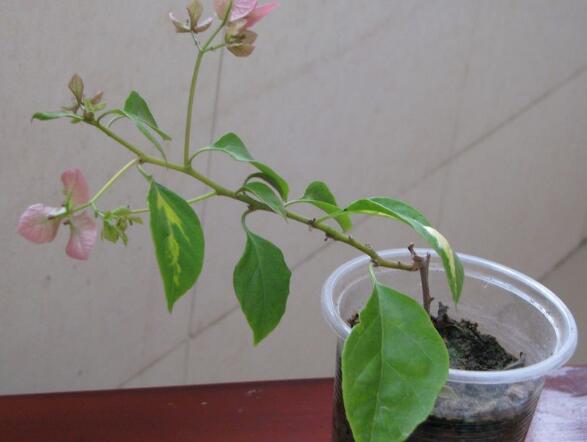
Bougainvillea propagation methods include cuttings, air layering, and grafting, but the most convenient is undoubtedly cuttings. However, if you want a high survival rate for bougainvillea cuttings, the choice of time is crucial. As for which month is best for bougainvillea cuttings, based on the personal experience of many flower growers, the conclusion is: March to June is suitable. Generally, at a temperature of around 25°C, rooting can occur in about 30 days.
II. Bougainvillea Cutting Methods
Materials: one flower pot, one bottle of rooting water
1. Selection of cuttings
Bougainvillea is toxic, and its branches have thorns, so when taking cuttings, it is best to wear gloves. Generally, choose sun-facing branches for cuttings; for new branches, it is best if they have a bit of old branch, keep a few leaves at the upper part, and cut off all the rest. If you are not taking cuttings at the optimal time but after June, then you should choose new branches that have already become semi-lignified as cuttings.
Treatment of cuttings: After selecting the cuttings, we still need to carry out some treatment. Soak the base of the cutting in rooting water for a period of time.
2. Cutting substrate
Before taking bougainvillea cuttings, the substrate needs to be prepared. According to the growth habits of bougainvillea, the commonly used cutting substrates are generally: river sand, vermiculite, perlite, plain sandy soil, peat soil, floral foam, etc. As for the editor, it can be simpler: choosing plain sand and perlite is enough. Then pour the substrate into the flower pot.
Soil selection: After pouring the substrate into the flower pot, you should also spread a layer of 7-8 cm of soil on top. As for soil selection, according to the soil requirements in bougainvillea cultivation methods, choose a nutrient soil containing humus that is loose and well-drained.
3. Starting bougainvillea cuttings
With the above preparations done, bougainvillea cuttings can formally begin. First, insert the cutting into the pot soil, leaving only the upper part with leaves exposed. Pay attention to the distance between cuttings; do not make them too dense. After the bougainvillea cuttings are completed, cover the flower pot with a layer of plastic wrap, and poke some holes in the plastic wrap with a needle for ventilation, paying attention to the spacing of the holes.
After that, move the flower pot to a place with light but not direct sunlight. Then spray a little water on the plastic wrap to keep it moist, so that the bougainvillea can better absorb water. After completing the above steps, the bougainvillea cuttings are basically done, and what follows is later care.
4. Care and management
Care after bougainvillea cuttings is also very important. About 5-7 days after the cuttings are completed, you can uncover the plastic wrap once to let the bougainvillea breathe. Then observe the moisture of the pot soil; if it is dry, water appropriately, and each time spray mist onto the branches and leaves. After about 30 days, the bougainvillea can root, and at this point you can completely uncover the transparent film for normal care.
That is all the editor has to introduce about bougainvillea cutting propagation methods. Although grafting, air layering, and other methods can also propagate bougainvillea, the most suitable for flower growers is still cuttings. So friends who want to turn one pot of bougainvillea at home into many pots, hurry up and try the above methods. The timing is just right now; if you miss it, you will have to wait another year.
Illustrated Guide to Bougainvillea Pruning, Cutting, and Grafting Techniques
I believe many people have grown bougainvillea and hope to obtain an exquisite bonsai through their own efforts. To obtain a beautiful bougainvillea bonsai made by yourself, you need to master the corresponding knowledge and techniques, such as bougainvillea cuttings, grafting, pruning, and so on. By mastering these techniques, I believe we can obtain the bougainvillea bonsai we desire.
Illustrated Bougainvillea Cutting Methods
First is the bougainvillea cutting method. Before cutting, the correct cutting branch should be selected. For cuttings, it is best to use sun-facing branches, with both new and old branches. For the cutting, use a knife to cut its bottom into a slanted surface; do not make the cut flat. After that, soak it in rooting powder. Next, make a hole, bury the cutting in the soil, and expose the node with leaves. Finally, water it, cover it with plastic wrap, and ensure ventilation and appropriate light. The basic method can be understood by referring to the figure below.
Illustrated Bougainvillea Grafting Techniques
Next is the grafting method. Grafting also requires selecting the correct branches and rootstock. For the scion, it is best to choose semi-lignified branches, which have more water and are easy to survive. After selection, comes the rootstock and scion. First cut both diagonally to ensure they can be closely combined. After that, wrap them well with plastic or tape to make them tighter. Finally, pay attention to care. Avoid the scion being exposed to rain for long periods, and ensure appropriate light. I believe that after careful care, new branches will gradually grow after more than ten days. Grafting can be understood through the figure below.
Illustrated Bougainvillea Pruning Methods
Finally, how should we prune bougainvillea? Pruning branches and leaves is a technical task and affects whether it can grow healthily and beautifully. Pruning emphasizes being short, heavy, and sparse. Its specific meaning is that horizontal branches and leaves should be cut back, new branches should be heavily pruned, and dense and weak branches should be thinned out. There are also requirements for pruning time. Generally, the first time is before budding, that is, between March and April; afterward, pruning should also be noted in summer to avoid branches and leaves being too dense. When pruning, attention should also be paid to the size of the pot; if the pot is small, ensure the plant does not grow too large. The branches that need pruning are dead branches, horse-riding branches, parallel branches, leggy branches, and so on. Finally, attention should also be paid to the cuts. You can understand this according to the figure below.
Complete Collection of Bougainvillea Bonsai Pictures
Through understanding knowledge such as bougainvillea cuttings, grafting, and pruning, I believe it can help you grow some exquisite bougainvillea bonsai by yourself, and ultimately allow you to enjoy the sense of harvest and satisfaction from doing it yourself. Let us discover the beauty of bougainvillea bonsai together.