A Detailed Guide to Growing Alocasia macrorrhizos in Water
Alocasia macrorrhizos, also known as giant taro and Guangdong wolf's bane, is an evergreen herb in the genus Alocasia of the family Araceae, native to southern and southwestern China. The plant is large, reaching up to 3 m tall, and prefers a warm, humid environment. Its optimum growing temperature is 25-30°C, the best overwintering temperature is above 10°C, and it can also tolerate lows of around 5°C.
Alocasia macrorrhizos grows quickly, so it has a high nutrient requirement. When growing it in water, it is advisable to add a nutrient solution, and foliar feeding can also be used as a supplement. For home water culture, it is best not to use an overly large plant; you can use the suckers from the base of the Alocasia macrorrhizos, dig them out and wash the roots clean, and new roots will grow in about 1 week. In the early stage of water culture, change the water once a day, and after roots form, change the water once a week.
Because Alocasia macrorrhizos grows fast, it needs more nutrients. During the growing season, carry out foliar feeding to supplement the lack of nutrients. Also pay attention to misting to keep it moist, so that the plant does not wilt from water evaporating too quickly. The sap of Alocasia macrorrhizos is toxic; do not swallow it by mistake, as in severe cases it can be fatal. Alocasia macrorrhizos has a graceful plant shape and is suitable for indoor dining table and desk decoration.
Can Alocasia macrorrhizos be grown in water? How to grow Alocasia macrorrhizos in water
Can Alocasia macrorrhizos be grown in water? What are the methods for growing Alocasia macrorrhizos in water? Alocasia macrorrhizos is a common potted green plant. The editor has seen both soil-grown and water-grown Alocasia macrorrhizos. Personally, I still prefer water-grown Alocasia macrorrhizos, because the leaves are glossy and clean, and you can also enjoy watching the roots of the Alocasia macrorrhizos grow. Seeing the roots multiply and grow longer brings great delight. The correct way to water-culture Alocasia macrorrhizos is as follows:
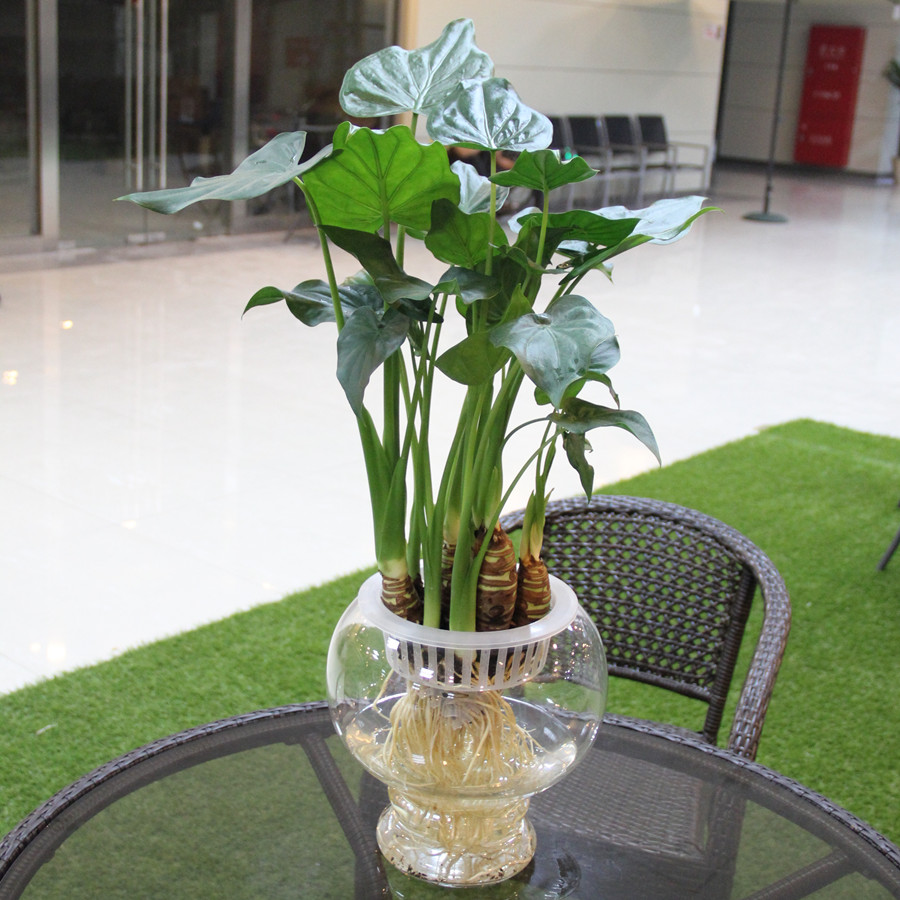
Steps for growing Alocasia macrorrhizos in water:
1. Take a potted plant directly and wash it clean; choose an Alocasia macrorrhizos with a beautiful shape and many branches for water culture, as this is best.
2. Cut the plant from the base at about 5 cm above the soil surface, and root the stem cuttings to encourage rooting.
3. Take the small leaf-bearing Alocasia macrorrhizos shoots sprouting around the tuber.
4. In autumn, when the fruit is ripe, harvest the orange-red seeds and sow them immediately after harvest to produce small plants.
Daily care for water-grown Alocasia macrorrhizos
(1) The tissues of the stems and root system of Alocasia macrorrhizos are relatively loose, and it has high water quality requirements. Be careful to keep the water clear and clean, otherwise the stems and root system are prone to rot.
(2) In the hot summer, increase the frequency of water changes, and keep air humidity no lower than 60%. Mist frequently to create a relatively cool and humid environment for it. In winter, to keep its leaves dark green, generally spray with warm water once a week.
(3) The water level only needs to cover 2/3 of the root system. Clean the inner wall of the container frequently to prevent the growth of algae.
(4) The sap in the stems and leaves of Alocasia macrorrhizos is toxic, so care should be taken during maintenance and management: do not put it in the mouth, and contact with the skin can cause itching and redness and swelling. Rinse promptly with water, or wear plastic gloves when handling it to be safer.
Can Alocasia macrorrhizos be grown in water? What are the steps and methods for growing Alocasia macrorrhizos in water? With the above steps and daily care tips, you no longer need to worry, right? For more flower care knowledge, visit China Fresh Flower Gift Network (abbreviated as "Huali Network").
Water-grown Alocasia macrorrhizos: how to grow Alocasia macrorrhizos in water
Selecting material for Alocasia macrorrhizos
Choose a well-grown Alocasia macrorrhizos free of pests and diseases as the mother material for water culture. Clear away old leaves and dead leaves on the stem, keeping only two or three new leaves. Loosen the potting soil, remove the plant from the pot, and then rinse the whole Alocasia macrorrhizos clean. It must not carry soil, because on the one hand it easily pollutes the water, and on the other hand it carries pathogens that easily cause root rot.
Potting Alocasia macrorrhizos
Step 1
After cutting off all the soil-grown root system from the base of the rinsed mother Alocasia macrorrhizos, carefully check the stem for rot and pest damage. Use a small knife to dig out the rotten stem until you reach the woody part, and remove the rotten material and pests.
Step 2
According to the size and shape of the Alocasia macrorrhizos, secure it with planting baskets of different sizes. Immerse the entire planting basket in a 3%-5% thiophanate-methyl solution or carbendazim solution to disinfect for 5-10 minutes, then place it in a cool place to dry.
Step 3
Plant the dried mother Alocasia macrorrhizos together with the planting basket in a perlite rooting bed. By controlling the water, nutrients, temperature, light, etc. of the bed, initial roots can grow in about 10-15 days.
Inducing Alocasia macrorrhizos
When the initial roots have grown to 2-3 cm long, they can be moved to an induction pool to induce water roots. At this stage, the dissolved oxygen content and EC value in the water and the adjustment of the nutrient solution ratio determine the success or failure of the induction. When the water roots have grown to a certain number and length, it means the plant has adapted to growing in water, and it can be placed in a bottle for static water culture.
Water for Alocasia macrorrhizos
Alocasia macrorrhizos has high water quality requirements. Be careful to keep the water clear and clean, otherwise the stems and root system are prone to rot. Choose unpolluted water with a pH of 6-6.5. If using tap water, let it sit for more than 1 day before use so that the chlorine in the water evaporates.
Changing the water for Alocasia macrorrhizos
When changing the water, gently rinse the plant's roots, remove the mucus from the roots, and at the same time cut off aged roots and rotten roots, and remove yellow and withered leaves that appear on the plant. When changing the water, clean the algae and water stains from the container thoroughly. Then add fresh water to the container, but it is best not to pour it in all at once; it is best to stir for a while. When changing the water and adding water normally, do not fill the water culture container too full; keep the water level 2-5 cm below the plant's stem base.
Fertilizing Alocasia macrorrhizos
Do not fertilize at random in the water. Choose a fertilizer specially made for water culture. Easily soluble fertilizers such as urea and monopotassium phosphate can be used for foliar feeding. The suitable fertilizer concentrations are: urea 0.1%, monopotassium phosphate 0.15%, ferrous sulfate 0.1%.
Root system of Alocasia macrorrhizos
When the root system grows too long and too dense, it is necessary to appropriately cut off old roots and shorten long roots to encourage new roots to sprout and enhance root vigor. In addition, if the plant's roots rot, promptly cut off the rotten roots completely and change the water once every 1-2 days, until the plant sprouts new roots, and only then return to normal care.