How to grow Alocasia macrorrhizos? A detailed guide to indoor care
Alocasia macrorrhizos is also called giant taro, a perennial herbaceous plant of the Araceae family. It gets the name "dripping Guanyin" because its flowers closely resemble Guanyin Bodhisattva, and because when the humidity is very high, water drips from the edges of its leaves. Generally, the sap of Araceae plants is toxic, but as long as you keep a proper distance from it and do not hold its stems, leaves or fruits in your mouth, there is no danger, and it can also absorb toxic substances indoors.
The leaves of Alocasia macrorrhizos are round. Plants of different sizes are cultivated in different forms: there are large potted plants over 2 m tall as well as ordinary small potted plants; they can be made into bonsai or grown hydroponically. Although the cultivation forms differ, there is no great difference in care methods.
(1) Soil
Alocasia macrorrhizos is not demanding about soil. It grows best in fertile, moist, acidic soil, and river mud can also be used directly to grow it.
(2) Humidity and light
When caring for Alocasia macrorrhizos indoors, maintaining high air humidity is key. Spray the leaves frequently; dry air or lack of soil moisture can easily cause the leaves to wilt. Alocasia macrorrhizos prefers shade and cannot take direct scorching sun, otherwise the leaves will scorch and wither. If Alocasia macrorrhizos is kept for a long time in the living room, bedroom and similar places, and the light is insufficient, the leaves will become smaller and yellow, and the leaf stalks will become thin and long. At this point, light should be increased appropriately or the plant should be periodically moved to a balcony to receive light.
(3) Temperature
Alocasia macrorrhizos likes a warm, humid environment and has poor cold resistance; the overwintering temperature must be above 10°C. For large plants with rhizomes, if the leaves are frost-damaged in winter, the leaf stalks can be gently peeled off, and new leaves will still sprout the following spring.
(4) Fertilizer and water management
April to October is the growing season for Alocasia macrorrhizos, so liquid fertilizer must be applied once a week, and the amount of nitrogen fertilizer should especially be increased. Only then can the leaves grow large; otherwise the leaves will be small and yellow. From April to November, water more; growth is rapid when the temperature is above 25°C. During the growing season, the watering principle for Alocasia macrorrhizos is "better wet than dry"; during the winter dormant period, watering should be controlled as much as possible, which helps improve cold resistance.
Indoor care methods for Alocasia macrorrhizos
Alocasia macrorrhizos is also called giant taro, a perennial herbaceous plant of the Araceae family. It gets the name "dripping Guanyin" because its flowers closely resemble Guanyin Bodhisattva, and because when the humidity is very high, water drips from the edges of its leaves.The leaves of Alocasia macrorrhizos are round. Plants of different sizes are cultivated in different forms: there are large potted plants over 2 m tall as well as ordinary small potted plants; they can be made into bonsai or grown hydroponically. Although the cultivation forms differ, there is no great difference in care methods. When growing Alocasia macrorrhizos indoors, pay attention to the following points:
1. Soil
Alocasia macrorrhizos is not demanding about soil. It grows best in fertile, moist, acidic soil, and river mud can also be used directly to grow it.
2. Humidity and light
When caring for Alocasia macrorrhizos indoors, maintaining high air humidity is key. Spray the leaves frequently; dry air or lack of soil moisture can easily cause the leaves to wilt. Alocasia macrorrhizos prefers shade and cannot take direct scorching sun, otherwise the leaves will scorch and wither. If Alocasia macrorrhizos is kept for a long time in the living room, bedroom and similar places, and the light is insufficient, the leaves will become smaller and yellow, and the leaf stalks will become thin and long. At this point, light should be increased appropriately or the plant should be periodically moved to a balcony to receive light.
3. Temperature
Alocasia macrorrhizos likes a warm, humid environment and has poor cold resistance; the overwintering temperature must be above 10°C. For large plants with rhizomes, if the leaves are frost-damaged in winter, the leaf stalks can be gently peeled off, and new leaves will still sprout the following spring.
4. Fertilizer and water management
April to October is the growing season for Alocasia macrorrhizos, so liquid fertilizer must be applied once a week, and the amount of nitrogen fertilizer should especially be increased. Only then can the leaves grow large; otherwise the leaves will be small and yellow. From April to November, water more; growth is rapid when the temperature is above 25°C. During the growing season, the watering principle for Alocasia macrorrhizos is “better wet than dry”; during the winter dormant period, watering should be controlled as much as possible, which helps improve cold resistance.
What are the growing methods for Alocasia macrorrhizos? How to grow Alocasia macrorrhizos
Alocasia macrorrhizos, of the Araceae family and the Alocasia genus, is also known as dripping lotus, Buddha's hand lotus and so on. It is one of the most common household plants, and gets its name because its flowers resemble Guanyin. Placing Alocasia macrorrhizos indoors to purify the air is indeed a good choice. Alocasia macrorrhizos is a very common home-grown green potted plant, but because it is a tropical plant, it generally does not bloom in the north. So what are the growing methods for Alocasia macrorrhizos? How do you grow Alocasia macrorrhizos?
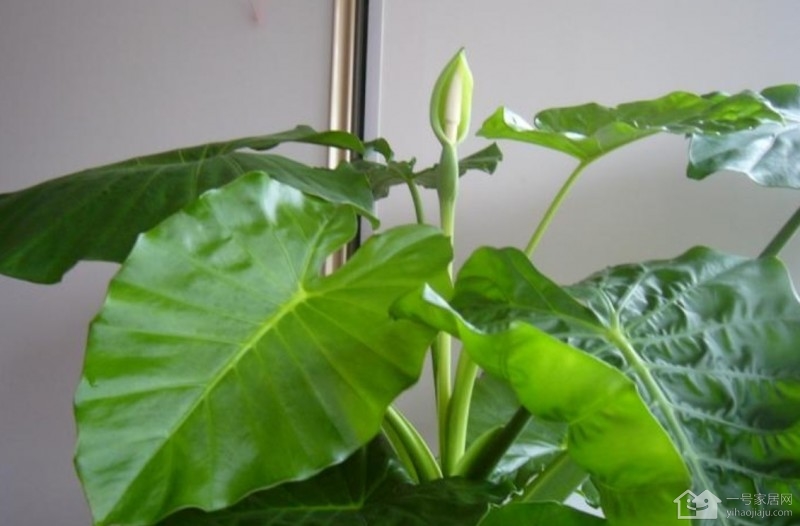
Growing techniques for Alocasia macrorrhizos
1. Basic information on Alocasia macrorrhizos
Alocasia macrorrhizos is a commercial name, also known as "dripping lotus" and Buddha's hand lotus; other common names include hen yam, langdu (Guangdong), wild taro, mountain taro, big-root taro, big worm taro, tianyu, tianmeng and so on. What is called calla lily in Taiwan, China refers to Alocasia macrorrhizos. This plant is a perennial evergreen herbaceous plant of the Araceae family (Araceae), Alocasia genus (Alocasia) -- Alocasia macrorrhizos, and has medicinal value. When the weather is warm and humid and the soil water content is high, water drips down from the leaf tips or leaf edges, and its flower is a spadix surrounded by a large green spathe that opens into a boat shape, like a seated image of Guanyin, so in many places it is called dripping Guanyin. It is native to the subtropics and likes warm, humid and semi-shaded environments. It is not cold-tolerant. In areas north of the Yangtze River basin in China, it is grown in pots and moved indoors before winter, while in the south it can grow in the open ground. The corm and leaves can be used medicinally, but they are toxic, and the leaf sap will cause poisoning if ingested.
2. Ecological habits of Alocasia macrorrhizos
Alocasia macrorrhizos is a plant that likes warm, humid and slightly shaded environments, but during its flowering period it requires sufficient sunlight, otherwise its spathe will take on a green color, thus affecting its quality. For Alocasia macrorrhizos, there must be 3--5 hours of light every day, otherwise its leaf stalks will elongate and its ornamental value will be affected. Alocasia macrorrhizos is not very cold-tolerant, and every year in mid-October it should be moved into a greenhouse. In summer, it needs to be kept in shade and sprayed with water frequently to cool it and maintain moisture. Alocasia macrorrhizos by nature likes moist, fertile soil, which is what farmers often call "heavy fertilizer and heavy water", so during its growing period it should be watered little and often. Alocasia macrorrhizos is currently a very common home-grown green potted plant, and because it is a tropical plant, it generally does not bloom in the north. However, if the temperature and humidity conditions at home are suitable, it may also bloom. Although Alocasia macrorrhizos is not demanding about soil, it is most ideal to plant it in well-drained sandy loam or humus loam containing organic matter, where it grows best.
3. Growing methods for Alocasia macrorrhizos
1. Suitable growing temperature for Alocasia macrorrhizos: 20--25°C is the most suitable growing temperature for Alocasia macrorrhizos. If the room temperature is below 18°C, Alocasia macrorrhizos will enter a dormant period and stop growing. Alocasia macrorrhizos likes a warm, humid, semi-shaded environment. During cultivation, you must pay special attention to changes in the seasons. Especially now that summer is about to begin, be particularly careful to place Alocasia macrorrhizos in a semi-shaded, ventilated place, and spray its leaves with water several times to maintain air humidity. Avoid excessively high temperatures causing abnormalities in Alocasia macrorrhizos. Alocasia macrorrhizos is not strongly cold-resistant; depending on the temperature difference between north and south, it needs to be moved indoors in autumn and winter.
2. How to fertilize Alocasia macrorrhizos: the fertilization cycle for Alocasia macrorrhizos is once a month. It must be given additional fertilizer once every 2 weeks. The potting soil of Alocasia macrorrhizos also needs to be moistened. Fertilization requirements: use nitrogen fertilizer mixed with thin liquid fertilizer such as phosphorus and potassium fertilizers as a supplement. When topdressing, avoid pouring the fertilizer water onto the leaf sheaths, as this will cause Alocasia macrorrhizos to rot. If you want the leaves of Alocasia macrorrhizos to be large and green, applying some ferrous sulfate can achieve this. If you want Alocasia macrorrhizos to look beautiful, avoid a lack of fertilizer; once fertilizer deficiency occurs, the stem of Alocasia macrorrhizos will shrivel and become bare. The Alocasia macrorrhizos usually seen comes in large and small sizes. If you want to grow Alocasia macrorrhizos small and attractive, when the seedling grows to the height you want, such as 40 cm, spray the whole plant with a 2% paclobutrazol solution, and in the later growth process you will find that the growth height of Alocasia macrorrhizos will not exceed 40 cm. If Alocasia macrorrhizos continues to grow, the whole plant can be sprayed again. Generally, spraying once about every half a year can achieve the effect of controlling height.
3. Pest and disease control: diseases of Alocasia macrorrhizos show on the leaves, and there are generally two kinds, one is leaf spot disease and the other is anthracnose. For leaf spot disease, spray the leaf surface with 800-fold diluted chlorothalonil or carbendazim, 2--3 times in succession, with 7 days between each application. For anthracnose, spray the leaf surface with 500-fold diluted 75% thiophanate-methyl, once every 7 days, 2--3 times in succession, which can basically bring it under control. Because Alocasia macrorrhizos is a foliage plant, once the leaves become diseased it will inevitably affect its ornamental effect, so prevention should be the main approach.
On the stems, there is a kind of wilt disease caused by bacterial infection. This disease is not easy to detect at first, and once discovered it is already very serious. If you find that the stem is leaning to one side, or there is a wilting spot, it must be wilt disease. You can use a small knife to cut out the diseased part; the boundary between the diseased part and the healthy part is very obvious, and generally it can be broken off by hand. If the diseased part is less than one third of the stem, you can apply a layer of chlorothalonil solution to the healthy part, keep it dry, apply it again after ten days, and it can basically heal after 20 days.
The most serious pest of Alocasia macrorrhizos is mites, that is, the commonly known red spider mite. Red spider mites generally live on the undersides of leaves. They not only suck the nutrients from the leaves but also spread various viruses, seriously affecting plant growth, so you must check frequently and treat immediately once found. They can be treated with medications such as mite clear, saomanjing and imidacloprid.
4. The light problem for Alocasia macrorrhizos: for plants that like semi-shade, direct sunlight is the biggest taboo. When the leaves of a cultivated Alocasia macrorrhizos droop, it may be due to a lack of fertilizer. At this time, you need to add some liquid fertilizer to Alocasia macrorrhizos. When Alocasia macrorrhizos enters its flowering period, ensure 3--5 hours of light every day. Otherwise, the flower buds will take on a green color and the leaf stalks will elongate, affecting its appearance.
The above is the relevant introduction in this article. I believe that after reading it, you have a simple understanding of this. If you need more, you can continue to follow No. 1 Home Network to learn more information.