How to care for Dieffenbachia? A complete guide to its care methods
Dieffenbachia, also known as dumb cane and spotted dumb cane, is a perennial evergreen herb in the Araceae family. Its stems are thick and fleshy, and its large, glossy leaves grow on the upper part of the stems. They are oblong or lance-shaped and deep green, dotted with numerous irregular white or pale yellow spots or patches. At present, the common cultivated horticultural varieties in China include Dieffenbachia 'Cream', Dieffenbachia 'Camille', and Dieffenbachia 'Rudolph', among others. It likes a warm, humid, and semi-shaded environment, and prefers loose, fertile, slightly acidic sandy soil.
For container growing, you can use leaf mold or peat soil, garden soil plus a small amount of river sand and bone meal as the potting mix. Dieffenbachia is fairly shade-tolerant and can grow well in a bright indoor spot. In summer, when grown in a pot, it is best placed indoors 80 cm from a south-facing windowsill, or in a shady spot outdoors; in winter, place it in a sunny spot indoors. In spring and autumn, it should receive a little more sunlight in the morning and evening, but in summer it needs shading. If exposed to direct sunlight, the leaf edges and tips easily scorch and turn yellow.
During the growing period, it does not need much water. When the surface of the potting soil turns pale, that is the time to water. In summer, water more generously, and be sure to frequently mist the leaves and sprinkle water on the ground to create a humid microclimate that helps it grow vigorously.
Apply a dilute fertilizer 1 to 2 times a month. Dieffenbachia is not cold-tolerant, and the overwintering temperature should be kept above 15°C. If the room temperature stays below 10°C for a long time, the leaves will turn yellow and drop. During overwintering, control watering and stop fertilizing, but still clean dust from the leaves with warm water 1 to 2 times a week to keep the foliage fresh.
Key care points for growing Dieffenbachia in water; how to handle Dieffenbachia after cold damage
Dieffenbachia is generally grown in pots, but many friends choose to grow it in water for a more attractive and cleaner look. So how do you grow Dieffenbachia in water? And how do you handle Dieffenbachia after cold damage? Let's find out together.
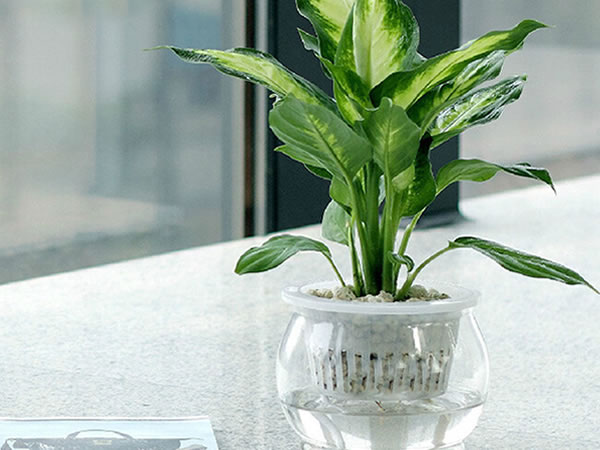
Dieffenbachia grown in water picture
I. Key care points for growing Dieffenbachia in water
1. Plant selection: To grow Dieffenbachia in water, you naturally need to choose the plant first. Generally, there are now two main methods. One is to take cuttings from a planted Dieffenbachia and root them in water, which can sprout new roots in about 10 days. You can also use the root-washing water culture method, which means washing the roots of a soil-grown Dieffenbachia and then growing it in water. You can rinse it repeatedly under running tap water, but be careful not to damage the roots.
2. Water quality: For the water used in growing Dieffenbachia in water, choose disinfected tap water that meets national drinking water standards, with a salt concentration of<300ppm添进的无机盐总浓度应<500ppm,<300ppm添进的无机盐总浓度应<500ppm。
3. Water amount: For a root-washed Dieffenbachia grown in water, no nutrient solution is needed in the early stage. This is because the roots are injured (they will inevitably be somewhat damaged when the soil is removed), and the water should not be too much; just enough to slightly cover the roots is fine. The water quality should be clean, and it is best to choose rainwater or tap water that has been left to stand.
4. Nutrient solution: When growing Dieffenbachia in water, you can add nutrient solution after about 3 weeks. Use a small amount the first time, and afterward apply it as needed according to growth. The pH of the hydroponic nutrient solution should be 6.0 to 7.0, and its height in the bottle should not exceed 50% of the root height. Replace the nutrient solution with fresh solution 1 to 2 times a week; the higher the ambient temperature, the more frequently the nutrient solution should be replaced. This is because the amount of dissolved oxygen in the nutrient solution should be increased as much as possible.
5. Humidity care: Dieffenbachia likes higher humidity and dislikes dryness. During the growing period, the stems and leaves should be misted frequently.
6. Safety maintenance: The sap in the stems and leaves of plants in the Dieffenbachia genus is toxic. When growing and propagating them in water, special care should be taken to prevent children from touching them, so as to avoid accidents.
Dieffenbachia grown in water picture
II. How to handle Dieffenbachia after cold damage
1. Slight cold damage: The leaf surface loses its proper gloss, and the leaves droop as if dehydrated. At this point, move the Dieffenbachia to a warmer place so it can gradually return to normal. Be careful not to raise the temperature suddenly after the damage, to avoid wilting the leaves.
2. Mild cold damage: In addition to drooping, the leaves develop cold-damage patches that look like scalding from boiling water. Treatment: Cut away the cold-damaged patches on the leaves and move the plant to a warm place.
3. Moderate cold damage: Most of the leaves show cold-damage patches, and the leaf stalks develop water-soaked patches and lose their green color. At this point, cut off both the leaves and stalks, smear the wounds with plant ash or coal ash, then place it in a warm spot, control watering appropriately, and let it slowly return to normal.
4. Severe cold damage: The young branches and new leaves lose their green color and show water-soaked patches, and the underground root system is damaged by cold and rots. The remedy is: promptly dig up the plant, cut off the underground part, and prune away the damaged branches and stems. After smearing the wounds with plant ash, store it in moist clean sand, and take cuttings in early spring. If severe cold damage occurs and the entire plant shows diseased spots, then the hope of saving it is very small, and you should consider replacing the plant.
Dieffenbachia grown in water picture
The above isDieffenbachia grown in wateran introduction to the key points and how to handle Dieffenbachia after cold damage. I hope it helps friends who like growing Dieffenbachia in water.
Key care points for growing Dieffenbachia in water; teaching you to grow Dieffenbachia in water correctly
In today's home greenery arrangements, people are increasingly favoring hydroponic plants, mainly because hydroponic plants are simple and easy to grow, and they also look great when placed in the home. They not only beautify the home but also make it look more stylish and elegant. Below, the editor will tell you what the key care points are for growing Dieffenbachia in water:
Key care points for growing Dieffenbachia in water:
1. Plant selection
To grow Dieffenbachia in water, you naturally need to choose the plant first. Generally, there are now two main methods. One is to take cuttings from a planted Dieffenbachia and root them in water, which can sprout new roots in about 10 days. You can also use the root-washing water culture method, which means washing the roots of a soil-grown Dieffenbachia and then growing it in water. You can rinse it repeatedly under running tap water, but be careful not to damage the roots.
2. Water quality selection
For the water used in growing Dieffenbachia in water, choose disinfected tap water that meets national drinking water standards, with a salt concentration of<300ppm;添进的无机盐总浓度应<500ppm。<><300ppm;添进的无机盐总浓度应<500ppm。<><300ppm;添进的无机盐总浓度应<500ppm。<><300ppm;添进的无机盐总浓度应<500ppm。<>
3. Water amount selection
For a root-washed Dieffenbachia grown in water, no nutrient solution is needed in the early stage. This is because the roots are injured (they will inevitably be somewhat damaged when the soil is removed), and the water should not be too much; just enough to slightly cover the roots is fine. The water quality should be clean, and it is best to choose rainwater or tap water that has been left to stand.
4. Use of nutrient solution
When growing Dieffenbachia in water, you can add nutrient solution after about 3 weeks. Use a small amount the first time, and afterward apply it as needed according to growth. The pH of the hydroponic nutrient solution should be 6.0 to 7.0, and its height in the bottle should not exceed 50% of the root height. Replace the nutrient solution with fresh solution 1 to 2 times a week; the higher the ambient temperature, the more frequently the nutrient solution should be replaced. This is because the amount of dissolved oxygen in the nutrient solution should be increased as much as possible.
5. Humidity care
Dieffenbachia likes higher humidity and dislikes dryness. During the growing period, the stems and leaves should be misted frequently.
6. Safety maintenance
The sap in the stems and leaves of plants in the Dieffenbachia genus is toxic. When growing and propagating them in water, special care should be taken to prevent children from touching them, so as to avoid accidents.
Growing Dieffenbachia in water is a common cultivation method in homes today. Using a glass bottle to grow it lets you admire not only the leaves but also the pure white root system, which is quite a sight. If you like hydroponic plants, Dieffenbachia is a great choice.