What are the propagation methods for the banyan tree? Explained clearly in one article
It prefers a warm and humid environment.
1. Propagation methods
(1) Seed propagation Banyan seeds mostly mature in October, and the seed germination rate is relatively low, reaching a maximum of 40%. The seeds must not be allowed to lose water, so they should be stored in moist sand or sown immediately after collection. Banyan seeds are small seeds; sow them broadcast in a seedling tray or directly in the nursery bed, but protect them from rain. They germinate 10 d after sowing and are transplanted after 2 months, and after 2 to 5 years of cultivation they can leave the nursery.
(2) Cutting propagation
In the south it can be done in March, and in the north it can be done in early spring by cutting in a high-temperature greenhouse. Select vigorous one-year-old branches as cuttings, about lcm thick, cut them into 15 to 20 cm sections, keep a few leaves at the upper part, insert them into plain sandy soil at a spacing of 20 cm, and maintain them under shade and moisture. At a temperature of 25 to 30°C, they root in 1 month, and the survival rate can reach more than 90%. After rooting, move them into the nursery, cultivate them for 2 to 4 years, and they can then be used as seedlings for landscape cultivation.
Cutting-propagated seedlings grow fast and have many branches. You can also use a thick trunk about 2 m long and about 6 cm in diameter, cut off the branches and leaves, wrap the top with mud, and plant it directly as a trunk cutting.
2. Cultivation management It grows well in moist, acidic soil.
Propagation methods of the banyan tree
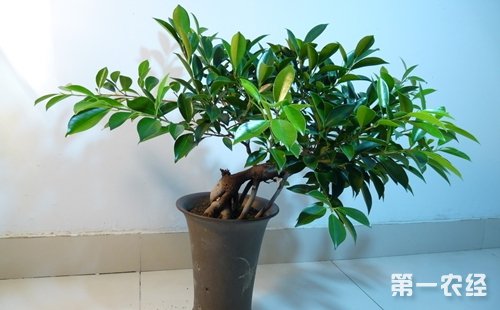
Image: banyan tree
[Common questions] What are the propagation methods of the banyan tree?
[Expert answer]
Cutting propagation:
When mass-propagating seedlings in South China and Southwest China, softwood cuttings are mostly taken in open-field nursery beds during the rainy season, and the survival rate can reach more than 95%. In the north, one-year-old plump and full branches can be collected in early May and cut in flowerpots, wooden boxes, or nursery beds. Cut the branches into sections of 3 nodes each, keep 1-2 leaves at the tip, insert them into plain sandy soil, maintain them in shade, spray water 1-2 times a day to increase air humidity, and be careful to protect them from wind. They can root successively after 20 days, and after 45 days the seedlings can be lifted and potted.
Layering propagation:
To cultivate large seedlings, you can use the softness of the banyan tree's large branches for layering. First place a large flowerpot near the mother plant and fill it with potting soil, then choose a large side branch with a good shape and bend it down into the flowerpot, press a stone on top, and the buried part can root without being wounded; after 2 months, cut it away from the mother plant, and a relatively large potted plant can be formed. You can also choose several very thick side branches on the mother plant's canopy for air layering, which not only takes shape quickly but is also relatively simple to operate.
[Editor's comments] The banyan tree can be used as a street tree, can be used as medicine, and can also be made into a potted plant for ornament. Although it can bear fruit every year, the seeds are very small and threshing is also very difficult, so banyan propagation is usually carried out by cuttings or layering.
Banyan tree cultivation methods and precautions Banyan tree cultivation methods and six major precautions
The banyan tree is a large tree plant. Its plant height reaches 15-25 m, and its crown is widely spreading. Older banyan trees often have rusty-brown aerial roots. The banyan tree has been rated as the provincial tree of Fujian Province and has also been rated as the city tree of Fuzhou and Ganzhou. The banyan tree has very strong adaptability and prefers a sunny, warm climate. Below, let us take a look at the introduction to the banyan tree cultivation methods and precautions.
Propagation methods among banyan tree cultivation methods
Although the banyan tree bears fruit every year, its seeds are very small and threshing is also very difficult. Generally, the best propagation methods for the banyan tree are cutting and layering propagation. Cutting propagation is mostly carried out during the rainy season, inserting softwood cuttings into open-field nursery beds. Layering propagation can use the softness of the banyan tree's large branches for layering. First place a large flowerpot near the mother banyan tree and fill it with potting soil, then choose a side branch with a good shape and bury it in the flowerpot, then press a stone on top, and after two months it can be cut away from the mother plant and planted.
Soil among banyan tree cultivation methods
The banyan tree likes loose and fertile acidic soil, and can also grow in poor sandy soil. So when growing it in pots, you can use black stone powder mud, river sand, construction stone powder, and coal cinder to plant it. However, the culture soil for planting the banyan tree is best made of loose leaf mold with good water permeability, and can be prepared with garden soil: humus soil: sand in a ratio of 2:2:1 for cultivation. When growing it in pots, it is best to place moss the same size as the pot on top of the bonsai; this is not only attractive but also plays a very good role in drainage and aeration.
Light among banyan tree cultivation methods
The banyan tree likes a sunny, warm and humid climate, so when growing it in pots, place the banyan tree in a ventilated place, and there must be a certain amount of spatial humidity. If sunlight is insufficient, ventilation is poor, and there is no certain spatial humidity, it will cause the plant to turn yellow and dry, leading to pests and diseases, and eventually death. The growth temperature of the banyan tree should not differ too much between day and night; during cultivation, it must usually be placed in a place with light and light transmission, and in summer cultivation attention should be paid to appropriate shading.
Watering among banyan tree cultivation methods
The banyan tree is a plant relatively tolerant of water and moisture, and it will not rot its roots even in short-term waterlogging. Because when growing it in potting soil, it is enough to cover the roots with culture soil, and the inserted tree should be about 3 cun deep. After watering to settle the roots, it can be placed in a cool and wind-sheltered place for cultivation. When watering the banyan tree, you can water according to weather conditions, keeping the culture soil moist but not waterlogged; too much waterlogging easily causes the roots to turn black and necrotic. If a surviving banyan tree is waterlogged for a long time, it easily grows only roots and no branches or trunk. In summer, the banyan tree will not die even if it is not watered for 2-3 days. So when watering the banyan tree, be sure to remember the rule of not watering frequently, and watering thoroughly when you do.
Fertilization among banyan tree cultivation methods
The banyan tree likes plenty of water and fertilizer, and is a plant that can tolerate both drought and moisture. Generally, after the banyan tree stump enters normal care, decomposed human and animal manure and urine or rotted cake fertilizer can be used as topdressing, applied once or twice a day as foliar feeding. When transplanting or changing pots, rotted chicken manure, bean cake, and bone meal can also be mixed into the culture soil as base fertilizer. Sufficient fertilizer can make the banyan tree's branches and trunk grow quickly and thicken quickly. Although the banyan tree likes fertilizer, excessive fertilization can also cause certain harm to it. So when fertilizing it, be sure to fertilize according to different seasons.
Precautions for the banyan tree
1. If during cultivation the banyan tree is watered improperly, it can easily cause the leaves to fall off. So when watering the banyan tree, be sure to adhere to the principle of not watering when dry and watering thoroughly when watering.
2. The banyan tree is a plant that likes heavy watering and heavy fertilizing, but fertilizing with high-concentration chemical fertilizer or organic fertilizer that has not been fermented and decomposed will cause fertilizer damage, with light cases causing leaf drop and severe cases causing death. So when fertilizing, be sure to use the method of light fertilizer applied frequently.
3. The banyan tree is a light-loving plant. If light is insufficient and ventilation is poor, it will cause its leaves to fall off and pest damage. So the banyan tree should grow in an environment with sufficient light, and when cultivating it in summer, it needs to be shaded.
4. The banyan tree is easily damaged by pests such as red spider mites, scale insects, and mealybugs, so during cultivation it must be placed in a ventilated place. If pests occur, spray the leaves with omethoate 500PPM or spray and kill with a 1000-times solution of 50% isocarbophos wettable powder.
5. When cultivating the banyan tree, it must be placed in a ventilated and light-transmitting place, and there must be a certain amount of spatial humidity. If sunlight is insufficient, ventilation is poor, and there is no certain spatial humidity, the plant can turn yellow and dry, leading to pests and diseases, and eventually death.
6. When pruning the banyan tree, it must be done during its dormant period, because during the growing period the sap flows relatively quickly, and after pruning more white viscous sap flows out, which is unfavorable to plant growth.
Summary: The above is the introduction to the banyan tree cultivation methods and the six major precautions for the banyan tree brought to you by the editor. After reading the editor's introduction, I believe everyone has a relatively good understanding. The banyan tree is a tree species with strong adaptability. It likes loose and fertile acidic soil, grows poorly under dry climate conditions, and can develop aerial roots in humid air, greatly improving its ornamental value.