How to make a banyan bonsai? A complete step-by-step guide
①Buy a banyan stump from the market with a good tree shape, many root tubers, few fibrous roots, glossy foliage and short internodes, and cut off dead branches, withered leaves and old leaves that are poorly shaped in some positions.
②For banyan cultivation, use slightly acidic mountain soil with base fertilizer added; after planting, place it in a shady spot and keep it moist, then gradually move it to a bright spot once it has established.
③For bonsai, tiger-striped banyan and sunflower-seed banyan are the best; tiger-striped banyan grows fast, and its aerial roots can merge with the trunk, making the tree shape even more graceful.
④Shaping
1) Arrange the existing roots in order and remove dry soil and bottom roots, but do not damage the surrounding root system.
2)The growing medium should be slightly acidic, fertile, strong in water and nutrient retention, and good in drainage and aeration.
3)Choose a pot of appropriate size as the base pot, place a small flower pot inside it, set the stump on the small pot, arrange the roots around the small pot, and make the roots sit slightly above the soil surface.
4)Cut and wound the trunk with a knife, apply rooting powder according to the instructions, wrap the wound with sand, secure it with a plastic tube and sprinkle rooting powder on it; when the new roots grow to 1 mm thick, remove the plastic tube and sand, then wrap the aerial roots around the tree as required by the design and secure them so they grow as desired.
5)For the above-ground part, depending on the design requirements, prop it up with stones or tap or stimulate it to make it thicken, keep it moist, and place it in a bright spot to grow.
6)In the third year, prune the branches according to the relevant methods, and frequently pinch out the growing tips and remove leaves to keep the leaves small. In the fourth year, pinch and prune in the same way to form the desired crown, and it is done.
⑤If making a rock-attached bonsai, first place the stump in a pot to cultivate; once it has grown thick, long roots, take it out and attach it to the rock, making the root system cling tightly to the crevices and pass through the holes in the stone, to create the impression of roots threading through crevices and crossing the rock.
The stone material selected should be porous, loose sandstone, reed-tube stone, water-rust stone and the like. If the root system is not long enough, pile up more soil to surround the roots, and once the roots have grown to meet the requirements, wash away the soil on top.
How to make a banyan bonsai: the method for making a banyan bonsai
Banyan is an excellent material for making bonsai; a bonsai made from it can be placed in a courtyard or indoors, beautifying the environment and purifying the air. However, many people in daily life do not understand how to make a banyan bonsai and feel they can never get it right. Today the editor will share some experience so everyone can easily learn how to make a banyan bonsai.
1. Selecting the stump
If you want to make a banyan bonsai yourself, you must choose a suitable banyan stump; it is best to go into the wild and select a natural wild stump, and the time can be between February and October each year, because stumps selected at this time root and sprout most easily, with a particularly good survival rate. In addition, after selecting the stump, handle it as soon as possible and plant it as soon as possible.
2. Preparing the potting soil
When making a banyan bonsai, preparing the potting soil is also very important. This plant likes loose, airy, slightly acidic soil. When preparing the potting soil, it is best to choose black stone, silt, river sand, and construction stone powder and coal cinder and other materials to mix and prepare; in addition, when preparing the potting soil, an appropriate amount of bone meal or soybean cake can be added as base fertilizer.
3. Planting requirements
When making a banyan bonsai, planting also has certain requirements. You can insert the banyan stump about three cun into the potting soil, then cover the top layer with growing medium and water thoroughly, place the pot in a cool, wind-sheltered place for care, and after it roots and grows new leaves, move it to a suitable environment for long-term display.
4. Daily management
When making a banyan bonsai, daily management is also very important. You must master the frequency of watering; ordinarily just keep the potting soil moist, do not let the potting soil become too dry, and even more do not let water accumulate in the pot. In addition, the banyan bonsai should be placed in a ventilated, well-lit place. If sunlight and water are insufficient, the banyan plant will turn yellow and dry out, and in severe cases the banyan will die outright.
How to make a banyan bonsai? The method for making a banyan bonsai
The banyan is known for “a single tree forming a forest” and has features such as beautiful aerial roots, beautiful root spread and beautiful branches, with high ornamental value. Therefore, banyan is often made into bonsai for decorating courtyards and bedrooms. So, how do you make a banyan bonsai? The method for making a banyan bonsai is introduced below.
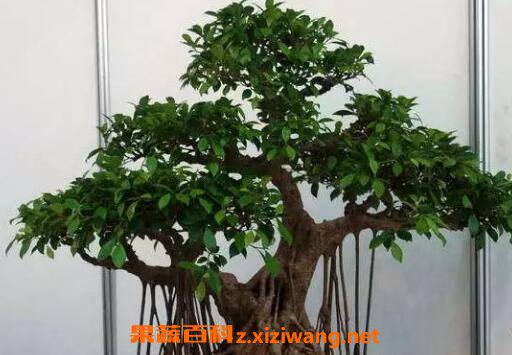
Image: banyan bonsai
I. Stump selection
The simplest and most commonly used method for selecting a banyan bonsai stump is to choose a natural wild stump. The collection time for wild stumps is between February and October each year, of which April to July is most suitable; during this period the climate is mild and the air humid, the stump roots and sprouts quickly, and the survival rate is high. After collecting the wild stump, handle it as soon as possible, cutting and selecting according to the stump material and cultivation goal. The banyan has strong vitality and wounds heal quickly, so the stump can be cut to the final form in one step.
II. Soil for bonsai
The cultivation soil for a banyan bonsai is generally required to be loose, airy, slightly acidic black stone powder mud, river sand, construction stone powder, coal cinder and the like, and these growing media are relatively easy to obtain.
Image: banyan bonsai
III. Water requirements
For banyan bonsai cultivation, it is enough for the growing medium to cover the roots, and when planting the tree, a depth of about 3 cun is suitable. After watering to settle the roots, place it in a cool, wind-sheltered place for care; for ground-planted ones, use a cover to shade them. Watering can be done according to weather conditions, keeping the growing medium moist but not waterlogged; too much waterlogging easily causes the roots to turn black and rot. If a banyan that has established is waterlogged for a long time, it easily grows only roots and no branches or trunk. In the dog days of summer, if it is not watered for two or three days, the tree will not die, but once it is watered, the leaves will wilt and drop while still green, affecting growth. Therefore, water management should follow the principle of watering when dry and letting it dry between waterings.
IV. Light requirements
A banyan bonsai should generally be placed in a ventilated, well-lit spot with a certain amount of air humidity; if sunlight is insufficient, ventilation is poor and there is no certain air humidity, the plant can turn yellow and dry out, leading to pests and diseases, and eventually death.
Image: banyan bonsai
V. Bonsai pruning
Pruning is one means of shaping a banyan. Through pruning, the goal of giving the banyan a graceful form can be achieved. Pruning should be timely and suited to the tree. A banyan can generally be pruned in all four seasons. In actual maintenance and shaping, pruning is primary and tying is secondary; pruning once a year is appropriate, and vigorous ones can be cut twice; after the short branches grow sturdy forked branches, cut again. The specific pruning methods for banyan include pinching out growing tips, bud removal, leaf removal, shortening, renewal pruning and thinning, among others.
VI. Bonsai fertilizing
The banyan is a tree species that likes plenty of water and fertilizer and can tolerate both drought and moisture. After the stump enters normal care, use decomposed human and livestock manure or rotted cake fertilizer as a top dressing, applying it as a foliar feed once or twice a day. When transplanting or repotting, rotted chicken manure, soybean cake and bone meal can also be mixed into the growing medium as base fertilizer. Sufficient fertilizer will make the branches and trunk grow fast and thick, allow more prunings per year, and achieve the goal of shortening the cultivation period.
[Editor's concluding remarks]The banyan bonsai is shade-tolerant and drought-tolerant, has strong vitality and is simple to care for, making it an indispensable indoor bonsai. The above has introduced the method for making a banyan bonsai, and I hope it can help everyone!