What are the characteristics of a ficus bonsai? A detailed analysis of its main features
The ficus is a tropical tree species, distributed in Fujian, Guangdong, Guangxi, Taiwan, China, Yunnan, Sichuan and other places. It likes light and warmth, adapts to humid and rainy climates, tolerates slight shade but not cold, and thrives in fertile, loose, moist alluvial sandy loam.
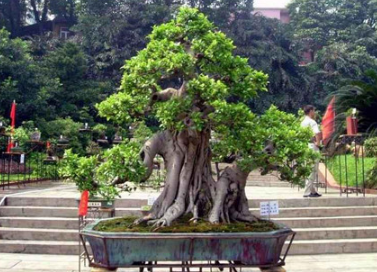
The ficus has strong vitality and adaptability, and can be cultivated long-term as a bonsai. The ficus has high ornamental value. An old, large ficus has an extraordinary presence, with lush branches and a trunk of varied form and elegant posture. Its trunk is thick and powerful, and both branches and trunk can grow aerial roots; the aerial roots hang down irregularly along the trunk, tightly embracing the trunk and merging with it as one, thickening the trunk, with trunk and roots interweaving and undulating, appearing especially majestic. The trunks each extend outward, influenced by their environment, either reaching upward, stretching sideways, or trailing downward, in a thousand varied forms. The crown is cloud-like or umbrella-like, a magnificent sight. Strong roots protrude and extend in all directions, forming claw roots and coiled roots, and interweaving to form buttress roots, appearing ancient and robust.
The ficus tolerates pruning, and wounds heal quickly after branch cutting. Buds at the base of pruned branches emerge evenly, with strong sprouting ability; branches pruned during the local growing season can also sprout. The branches are soft and can be freely wrapped and styled. The leaves at the base of the branches are relatively small, emerald green in color, and evergreen throughout the four seasons.
The ficus root system is well developed and soft, and can be freely bent, straightened, or redirected. After root pruning in hot seasons, the root tips grow roots quickly and abundantly, easily forming coiled roots, buttress roots, and exposed roots, and root lifting is fast.
Grafting can be used to supplement branches or roots in lacking areas. Its breeding is easy, its numbers are plentiful, it grows rapidly, its management is simple, it has few pests and diseases, and its ornamental value is high.
What are the characteristics of a ficus bonsai?
What are the characteristics of a ficus bonsai?
The ficus is a tropical tree species, distributed in Fujian, Guangdong, Guangxi, Taiwan, China, Yunnan, Sichuan and other places. It likes light and warmth, adapts to humid and rainy climates, tolerates slight shade but not cold, and thrives in fertile, loose, moist alluvial sandy loam.
The ficus has strong vitality and adaptability, and can be cultivated long-term as a bonsai. The ficus has fairly high ornamental value. An old, large ficus has an extraordinary presence, with lush branches and a trunk of varied form and elegant posture. Its trunk is thick and powerful, and both branches and trunk can grow aerial roots; the aerial roots hang down irregularly along the trunk, tightly embracing the trunk and merging with it as one, thickening the trunk, with trunk and roots interweaving and undulating, appearing especially majestic. The trunks each extend outward, influenced by their environment, either reaching upward, stretching sideways, or trailing downward, in a thousand varied forms. The crown is cloud-like or umbrella-like, a magnificent sight. Strong roots protrude and extend in all directions, forming claw roots and coiled roots, and interweaving to form buttress roots, appearing ancient and robust.
The ficus tolerates pruning, and wounds heal quickly after branch cutting. Buds at the base of pruned branches emerge evenly, with strong sprouting ability; branches pruned during the local growing season can also sprout. The branches are soft and can be freely wrapped and styled. The leaves at the base of the branches are relatively small, emerald green in color, and evergreen throughout the four seasons.
The ficus root system is well developed and soft, and can be freely bent, straightened, or redirected. After root pruning in hot seasons, the root tips grow roots quickly and abundantly, easily forming coiled roots, buttress roots, and exposed roots, and root lifting is fast.
Grafting can be used to supplement branches or roots in lacking areas. Its breeding is easy, its numbers are plentiful, it grows rapidly, its management is simple, it has few pests and diseases, and its ornamental value is high.
What four-season care tips are there for ficus bonsai, and what feng shui effects does it have?
The ficus is a symbol of pure love, recording the emotional journey of the human world. The ficus is regarded as a symbol of longevity and good fortune. It implies glory and wealth, and is therefore the best gift for birthday congratulations! If you want to give a gift to an elder, a ficus bonsai is a great choice, so come quickly and learn about ficus care tips.
What four-season care tips are there for ficus bonsai
1. Spring care for ficus bonsai
Repotting:
In spring, as temperatures rise and air humidity gradually increases, the metabolism of branches and leaves gradually speeds up and new leaves begin to sprout. At this time, carry out one round of loosening the soil or repotting. Loosen the soil once a year, choosing a sunny day. Use a bamboo stick or trowel, and be careful not to damage the root system.
As for repotting, choose a suitable pot according to the size of the plant to promote better growth.
Fertilizing:
Spring is the season when the ficus begins rapid growth, so timely fertilizing is very necessary. Apply nitrogen-phosphorus-potassium granules into the potting soil, cover with soil, and water the next day. Do not water too much. Avoid nutrients flowing out from the bottom of the pot.
Cleaning the leaves:
After a winter of indoor care, once spring arrives, rinse the leaves with clean water so they can carry out photosynthesis better.
2. Summer care for ficus bonsai
Watering:
Ensure watering once each in the morning and evening every day; you can also water on rainy days, but be careful not to let it be exposed to rain. For smaller pots, you can cover the pot surface with a damp cloth to prevent water evaporation, or place a tray without holes under the bottom of the pot so the roots can grow better.
Fertilizing:
In summer, even more ensure the ficus bonsai has sufficient nutrients, applying a compound fertilizer once every 10 days. If you are unsure about the right amount, it is recommended to choose liquid fertilizer, and after fertilizing do not place it directly in the sun to dry.
Pruning:
Summer temperatures are relatively high, and the ficus buds have strong sprouting ability, so pay attention to timely pruning, or wrap and shape the branches and leaves.
3. Autumn care for ficus bonsai
Watering:
Autumn is windy and dry, and the potting soil easily dries out, so watering is very important work in autumn. In early autumn, water once each in the morning and evening; by late autumn, watering once in the evening is enough. Pay attention to the method when watering; you can water in stages, first watering the leaves and branches, then watering the potting soil thoroughly.
Pruning:
Autumn is relatively cool, and the ficus grows relatively steadily. At this time, you can prune the branches that grew in summer, pinching the tips and removing buds, to keep the branches and leaves neat.
4. Winter care for ficus bonsai
Keeping warm:
Winter weather is relatively cold, and the ficus basically stops growing, so no fertilizing is needed. Move the plant indoors in time to avoid frost, rain and snow. Keep the indoor temperature above 5°C.
Supplementing light:
For a ficus bonsai kept indoors, place it in a spot with strong indoor light; at night you can use lights to increase the lighting time, and pay attention to timely ventilation and air exchange.
Watering:
In winter, likewise maintain the ficus's vitality, often wiping the leaves with a damp cloth to keep them clean. Maintain the soil's dryness level well, watering about once every 3 days to keep the soil moist. If yellowing leaves appear in winter, after ruling out pests and diseases, it is basically caused by lack of water, and timely watering will solve it.
What feng shui effects does a ficus bonsai have
1. The feng shui theory of the ficus
The ficus is beautiful and elegant. In the south, many villages plant a few at the entrance of the village as the village's landmark tree and feng shui tree, guarding the village and protecting the peace of the area. Moreover, this tall ficus can also bring a spot of coolness to people in the hot summer.
The ficus is called the king of trees. A ficus bonsai can provide greenery, and in feng shui it also has the effect of neutralizing petty people, can block all kinds of evil influences, and dissolve some unfavorable aspects.
2. Feng shui placement of the ficus
In the south there is a saying——ficus in front, bamboo behind, meaning the ficus should be planted in front of the house, while bamboo can be planted behind the house; the ficus provides shade in summer, and the bamboo blocks wind and protects against cold in winter. Therefore, when planting a ficus, planting it in front of the house is more appropriate; if you add bamboo behind the house, it will be even more favorable, just as people say——success in front, gain behind, implying good fortune. For this reason some people call the ficus the success tree, taking its auspicious meaning.
For the placement of a ficus bonsai, you can choose the due east direction, because due east belongs to wood, and wood is the only one among the five elements that has life. Placing a ficus bonsai in the due east direction is the best placement to activate this direction.
It should be noted that when cultivating a ficus, the ficus must be beautiful and healthy, and must not show signs of withering. However, the ficus itself is evergreen throughout the four seasons and has the characteristics of fast growth, easy rooting, easy shaping, good sensory appeal, and an elegant and refined plant form; care is simple, and as long as you tend it carefully, it rarely withers.