Detailed Guide to Making a Ficus Bonsai on Rock
Ficus trees have well-developed, soft, and long roots, making them excellent material for creating root-on-rock bonsai. When making root-on-rock bonsai, select mature Ficus stumps with good artistic shape and sufficiently long roots to create reasonable dynamism while also giving the trunk a sense of strength.
Choose rocks with many crevices and good posture, preferably independent single pieces with high ornamental value, such as sea mother stone, Yingde stone, sandstone, reed pipe stone, stalactite, axe-cut stone, etc.
For Ficus selected for root-on-rock bonsai, the stump should be removed from the soil during the plum rain season, and after bare-root attachment to the rock, it should be potted.
The specific potting procedure is as follows: First, take the selected rock and solidify its base with cement mortar, enlarging the support surface of the rock to help fix it to the bottom of the pot. Take the selected stump or shaped stump out of its pot, remove all soil, straighten the long roots, and cut off useless fibrous roots and surplus branch roots. According to the concept of combining tree and rock, reasonably express the artistic form of the root-on-rock bonsai. Inlay the tree roots into the rock crevices, thread them through the caves, and use fine hemp rope to tie and secure the roots tightly, so that the roots cling closely to the rock. Place the rock and tree into a bonsai pot or growing pot, and fill with growing soil. For the exposed portions of roots on the rock surface above the soil, cover them with plastic film or tubes made from cardboard or thin wooden boards, then add growing soil, and then cover the rock and roots. After planting and potting, water once thoroughly, place in a semi-shaded location, and thereafter water and mist according to the dryness and moisture of the potting soil to keep it moist. After 10 days, it can be exposed to sunlight and given regular fertilizer and water management. Pay attention to the care of the roots, avoiding bruising and sunburn damage to the roots, so as not to cause localized defects. Through half a year of growing period cultivation, the root-on-rock form is basically set.
Common styles of Ficus root-on-rock bonsai include cliff style and rock-embracing style. The upright height of the rock is 30-50 cm, with some reaching as high as 80 cm. The tree is planted at 2/3 of the distance from the pot surface, or planted on top of the rock. The trunk droops downward to form a cascading effect. Root-on-rock bonsai can be made as miniature bonsai, or as large bonsai over 1 m. Various root-on-rock bonsai can be made by fully utilizing local rocks.
In rock-embracing style bonsai, the rocks vary in height. The roots are planted on the rock, letting the roots tightly embrace the stone. With short rocks, the roots form a claw-style tree shape or curved trunk, slanting trunk, or upright large tree form, to increase the strength of the base. Tall rocks are thinner, expressing steepness and danger, but the rock base should be somewhat larger, and attention should be paid to the tree direction and root flow being smooth. With a short and sturdy tree on the rock, the rock is regarded as the trunk, expressing stability like Mount Tai. Both should embody the natural beauty of the roots, and also emphasize the tree's form and the perfection of the rock.
In interdependent-style root-on-rock bonsai, the trunk leans against the rock, the roots grow at the base of the rock, the trunk half-embraces the rock, and the tree top and rock top are separated, so that the rock reveals its peak and the tree shows its top. The tree momentum, rock momentum, and root direction should be unified to express the overall effect.
How to Make a Ficus Root-on-Rock Bonsai
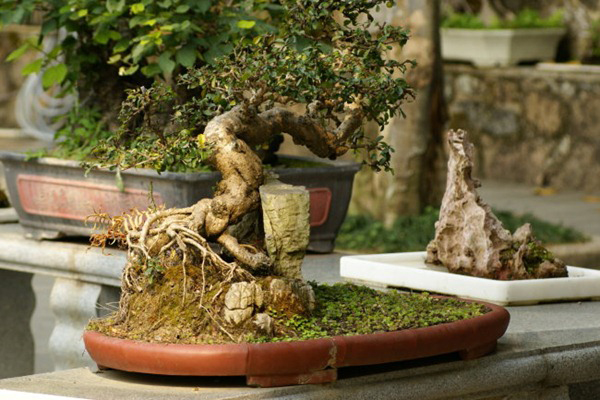
Ficus Root-on-Rock Bonsai Making: Material Selection
Choose relatively independent ornamental rocks with many crevices and good posture, such as sea mother stone, stalactite, axe-cut stone, Yingde stone, etc.
Select a Ficus plant, remove it from its pot and soil, and pot it with bare roots.
Ficus Root-on-Rock Bonsai Making: Potting
Fix the selected rock to the bottom of the pot with cement or adhesive.
Remove the selected Ficus from its pot, remove the soil, and cut off excess roots.
Inlay the Ficus roots into the crevices of the rock, secure the roots to the rock with hemp rope, and let the roots and rock combine closely.
Fill the flower pot with soil. For roots that cannot be covered by the potting soil surface, you can use plastic film or cardboard to cover them and then add soil.
After planting, water thoroughly, wet the rock, place in a semi-shaded area, and replenish water according to the dryness and moisture of the potting soil. After 10 days, move to sunlight and carry out normal care. Be careful not to bruise or sunburn the exposed roots, which would cause localized defects. After about half a year, the root-on-rock bonsai will be basically set.
Ficus Root-on-Rock Bonsai: Styling
Cliff style: Stand the rock upright in the pot, plant the Ficus at 2/3 of the distance from the pot surface, or directly plant it on top of the rock, with the trunk drooping in a cascading manner.
Rock-embracing style: The rocks vary in height, and the roots tightly embrace the rock. Tall rocks are thinner, expressing steepness and danger; short rocks are thick and sturdy, and the branches on the rock are short and sturdy, expressing stability like Mount Tai. The two depend on each other, embodying the natural beauty of the roots.
How Is a Ficus Root-on-Rock Bonsai Made?
How Is a Ficus Root-on-Rock Bonsai Made?
Ficus trees have well-developed, soft, and long roots, making them excellent material for creating root-on-rock bonsai. When making root-on-rock bonsai, select mature Ficus stumps with good artistic shape and sufficiently long roots to create reasonable dynamism while also giving the trunk a sense of strength.
Choose rocks with many crevices and good posture, preferably independent single pieces with high ornamental value, such as sea mother stone, Yingde stone, sandstone, reed pipe stone, stalactite, axe-cut stone, etc.
For Ficus selected for root-on-rock bonsai, the stump should be removed from the soil during the plum rain season, and after bare-root attachment to the rock, it should be potted.
The specific potting procedure is as follows: First, take the selected rock and solidify its base with cement mortar, enlarging the support surface of the rock to help fix it to the bottom of the pot. Take the selected stump or shaped stump out of its pot, remove all soil, straighten the long roots, and cut off useless fibrous roots and surplus branch roots. According to the concept of combining tree and rock, reasonably express the artistic form of the root-on-rock bonsai, inlay the tree roots into the rock crevices, thread them through the caves, and use fine hemp rope to tie and secure the roots tightly, so that the roots cling closely to the rock. Place the rock and tree into a bonsai pot or growing pot, and fill with growing soil. For the exposed portions of roots on the rock surface above the soil, cover them with plastic film or tubes made from cardboard or thin wooden boards, then add growing soil, and then cover the rock and roots. After planting and potting, water once thoroughly, place in a semi-shaded location, and thereafter water and mist according to the dryness and moisture of the potting soil to keep it moist. After 10 days, it can be exposed to sunlight and given regular fertilizer and water management. Pay attention to the care of the roots, avoiding bruising and sunburn damage to the roots, so as not to cause localized defects. Through half a year of growing period cultivation, the root-on-rock form is basically set.
Common styles of Ficus root-on-rock bonsai include cliff style and rock-embracing style. The upright height of the rock is 30-50 cm, with some reaching as high as 80 cm. The tree is planted at 2/3 of the distance from the pot surface, or planted on top of the rock, with the trunk drooping to form a cascading effect. Root-on-rock bonsai can be made as miniature bonsai, or as large bonsai over 1 m tall. Various root-on-rock bonsai can be made by fully utilizing local rocks.
In rock-embracing style bonsai, the rocks vary in height. The roots are planted on the rock, letting the roots tightly embrace the stone. With short rocks, the roots form a claw-style tree shape or curved trunk, slanting trunk, or upright large tree form, to increase the strength of the base. Tall rocks are thinner, expressing steepness and danger, but the rock base should be somewhat larger, and attention should be paid to the tree direction and root flow being smooth. With a short and sturdy tree on the rock, the rock is regarded as the trunk, expressing stability like Mount Tai. Both should embody the natural beauty of the roots, and also emphasize the tree's form and the perfection of the rock.
In interdependent-style root-on-rock bonsai, the trunk leans against the rock, the roots grow at the base of the rock, the trunk half-embraces the rock, and the tree top and rock top are separated, so that the rock reveals its peak and the tree shows its top. The tree momentum, rock momentum, and root direction should be unified to express the overall effect.