What is the correct method for root grafting on a ficus bonsai?
The beauty of a ficus bonsai lies in its roots, trunk, branches and leaves. If the trunk and branches are already well formed but the roots look thin and lacking in strength, with defects in some parts, too few roots, roots growing off to one side, or roots of uneven size, the overall appearance suffers. In that case, root grafting can be used to make up for it and give the tree a more perfect root system. When roots lean to one side or there are too few of them, one or several roots can be grafted on; when the roots are of uneven size, roots of the appropriate thickness can be grafted on. Once the grafted roots take and grow, they form a system centred on the trunk, spreading out in all directions as horizontal exposed roots. The longer the bonsai is cared for, the more beautiful the root spread becomes. Multiple claw roots, buttress roots and coiled roots are all hallmarks of an old ficus tree.
Root grafting can be done using the inverted cut-graft method, preferably during the plum rain season. Choose the spot where you want to add a root, then use a sharp grafting knife to cut along the bark of the trunk, gradually going deeper into the wood, making a cut of about 2 cm in one stroke to form a tongue shape; the cut surface should be smooth. Cut a root from a ficus tree; its colour and thickness must meet the requirements for the graft, and the length cut should be appropriate, about 15 to 20 cm or a little longer. Cut the end of the root into a wedge shape, with the size and length of the wedge face matching the tongue-shaped cut, then insert it. The cambium of the grafted root and the receiving trunk must be aligned on at least one side, then bind tightly with a long strip of plastic 1 cm wide, wrapping the joint. The other end of the grafted root can be buried directly into the potting soil and pressed firm, then water thoroughly once. Pay attention to watering normally, keep the soil moist, and it will soon take.
Do not fertilise within 1 month after grafting the root, to prevent the grafted root from rotting. Place the bonsai with the grafted root in a cool spot with plenty of light, but provide shade during hot weather and strong light, and do not touch the grafted root, so as to prevent it from loosening and affecting wound healing.
When grafting roots, a grafted root diameter of about 0.5 to 1 cm is generally most suitable. If the grafted root is too large in diameter, the scar at the joint is big and hard to heal. The cut should also not be peeled too wide or too deep, otherwise it is difficult to bind, hard to seal, and the survival rate is low.
How do you graft roots on a ficus bonsai?
How do you graft roots on a ficus bonsai?
The beauty of a ficus bonsai lies in its roots, trunk, branches and leaves. If the trunk and branches are already well formed but the roots look thin and lacking in strength, with defects in some parts, too few roots, roots growing off to one side, or roots of uneven size, the overall appearance suffers. In that case, root grafting can be used to make up for it and give the tree a more perfect root system. When roots lean to one side or there are too few of them, one or several roots can be grafted on; when the roots are of uneven size, roots of the appropriate thickness can be grafted on. Once the grafted roots take and grow, they form a system centred on the trunk, spreading out in all directions as horizontal exposed roots. The longer the bonsai is cared for, the more beautiful the root spread becomes. Multiple claw roots, buttress roots and coiled roots are all hallmarks of an old ficus tree.
Root grafting can be done using the inverted cut-graft method, preferably during the plum rain season. Choose the spot where you want to add a root, then use a sharp grafting knife to cut along the bark of the trunk, gradually going deeper into the wood, making a cut of about 2 cm in one stroke to form a tongue shape; the cut surface should be smooth. Cut a root from a ficus tree; its colour and thickness must meet the requirements for the graft, and the length cut should be appropriate, about 15 to 20 cm or a little longer. Cut the end of the root into a wedge shape, with the size and length of the wedge face matching the tongue-shaped cut, then insert it. The cambium of the grafted root and the receiving trunk must be aligned on at least one side, then bind tightly with a long strip of plastic 1 cm wide, wrapping the joint. The other end of the grafted root can be buried directly into the potting soil and pressed firm, then water thoroughly once. Pay attention to watering normally, keep the soil moist, and it will soon take.
Do not fertilise within 1 month after grafting the root, to prevent the grafted root from rotting. Place the bonsai with the grafted root in a cool spot with plenty of light, but provide shade during hot weather and strong light, and do not touch the grafted root, so as to prevent it from loosening and affecting wound healing.
When grafting roots, a grafted root diameter of about 0.5 to 1 cm is generally most suitable. If the grafted root is too large in diameter, the scar at the joint is big and hard to heal. The cut should also not be peeled too wide or too deep, otherwise it is difficult to bind, hard to seal, and the survival rate is low.
How to graft roots on a ficus bonsai
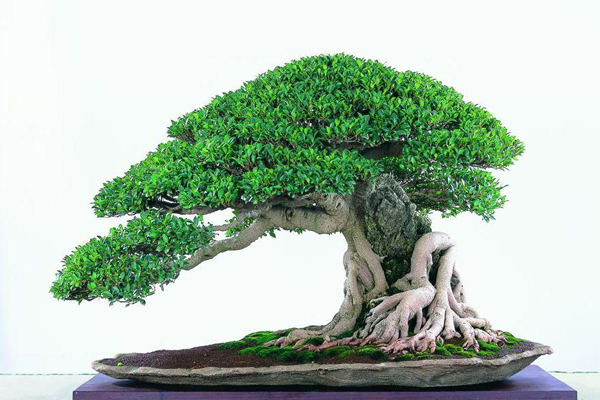
If a ficus tree's roots grow poorly, are few in number, or grow leaning to one side, they can be added to by grafting; when the roots are of uneven size, a thicker root can be grafted on. In short, all imperfections can be made up for by grafting roots.
Root grafting methods for ficus trees
Timing
This is generally done during the plum rain season, when the temperature and humidity are relatively suitable, and grafting promotes root growth.
Choosing the grafting position
According to the shape of the plant, choose the position where you want to add a root, then use a sharp knife to cut along the bark surface at that position, gradually going inward into the woody layer, making a cut of about 2 cm to form a tongue shape, making sure the cut surface is smooth.
Cutting the root
Cut a root from a healthy, well-growing ficus tree; its colour, thickness and length depend on the requirements of the graft, generally 15 to 20 cm long. Cut the root into a wedge shape, with the cut surface matching the shape of the grafting position.
Grafting the root
Align the root with the grafting position, wrap it with 1 cm plastic film, bury the other end of the root in the soil, then water thoroughly. After that, keep the soil moist, and it will soon take.
Points to note when grafting roots on a ficus bonsai
Do not fertilise
During root grafting, avoid adding any external nutrients, to prevent the roots from rotting. After grafting, place the plant in a cool spot with plenty of scattered light, and make sure there is good ventilation. Do not touch the grafted area, to avoid loosening the joint and affecting wound healing.
Strength of the grafted root
The diameter of the grafted root is generally best chosen at about 0.5 to 1 cm; if the grafted root is too large in diameter, the wound is very hard to heal. In addition, when cutting the joint, it should not be too deep, otherwise it is not only difficult to bind and hard to seal, but the survival rate of the grafted root also drops.