How do you cultivate an aged, ancient-looking tree form in a banyan bonsai?
Stump bonsai value an aged appearance, yet wild, aged banyan stumps are very limited. In recent years, more and more are being shaped by cultivating young trees and wiring them into form. To make the trunks and roots of young trees look aged, the following artificial processing methods can be used:
(1) Aluminum wire wiring. Wrap soft aluminum wire around the trunk; when the aluminum wire is about to cut in, loosen it, change to another position and continue wiring. Repeated over and over, this makes the bark of the trunk become rough and appear aged.
(2) Trunk chopping to make scars. While rapidly cultivating the trunk, repeatedly chop the trunk; the cut points gradually produce healed wounds, making the trunk have short internodes and many scars.
(3) Induce the trunk to grow aerial roots and fibrous roots, then arrange the aerial roots and fibrous roots and train them into attached trunk roots, the so-called "adding dragon whiskers," making the stump look aged.
(4) Carving to make scars. During the vigorous growth period of the stump, use a sharp knife to shave off the bark and cut down to the xylem, or gouge the xylem on the trunk into a hollow; after the carved area heals, scars form.
(5) Pruning to make scars. Cut off excess thick branches on the trunk flush with the trunk; the flush cut will produce swollen, protruding scars.
(6) Tapping to raise burls. Tap local areas of the base of the trunk with a hammer, causing the bark cells to continuously divide and proliferate due to mechanical bruising, forming tumor-like raised healing scars.
(7) Raising roots to expose claws. Gradually raise the roots above the soil surface to form claw roots; tap the exposed roots lightly with a hammer to make the root surface rough, giving a feeling of "having weathered all the vicissitudes of life."
How do you cultivate an aged banyan bonsai?
How do you cultivate an aged banyan bonsai?
Stump bonsai value an aged appearance, yet wild, aged banyan stumps are very limited. In recent years, more and more are being shaped by cultivating young trees and wiring them into form. To make the roots of young trees look aged, the following artificial processing methods can be used:
(1) Aluminum wire wiring. Wrap soft aluminum wire around the trunk; when the aluminum wire is about to cut in, loosen it, change to another position and continue wiring. Repeated over and over, this makes the bark of the trunk become rough and appear aged.
(2) Trunk chopping to make scars. While rapidly cultivating the trunk, repeatedly chop the trunk; the cut points gradually produce healed wounds, making the trunk have short internodes and many scars.
(3) Induce the trunk to grow aerial roots and fibrous roots, and arrange the aerial roots and fibrous roots and train them into attached trunk roots, the so-called "adding dragon whiskers," making the stump look aged.
(4) Carving to make scars. During the vigorous growth period of the stump, use a sharp knife to shave off the bark and cut down to the xylem, or gouge the xylem on the trunk into a hollow; after the carved area heals, scars form.
(5) Pruning to make scars. Cut off excess thick branches on the trunk flush with the trunk; the flush cut will produce swollen, protruding scars.
(6) Tapping to raise burls. Tap local areas of the base of the trunk with a hammer, causing the bark cells to continuously divide and proliferate due to mechanical bruising, forming tumor-like raised healing scars.
(7) Raising roots to expose claws. Gradually raise the roots above the soil surface to form claw roots; tap the exposed roots lightly with a hammer to make the root surface rough, giving a feeling of "having weathered all the vicissitudes of life."
Banyan bonsai pictures, banyan bonsai picture appreciation, banyan bonsai cultivation methods
With their natural form and unique charm, banyan bonsai are suitable for placing at home, in offices and in public places. So how should banyan bonsai be cultivated? What kind of care helps them grow well? Let us introduce it to you below!
The banyan tree itself is known for its unique tree structure, as well as its luxuriant branches and leaves and huge crown. Therefore it can become a potted banyan bonsai of unique artistic form. Banyan bonsai uses the banyan tree as material and, through pruning and branch training, after long-term careful cultivation, is made into a potted plant of unique artistic form.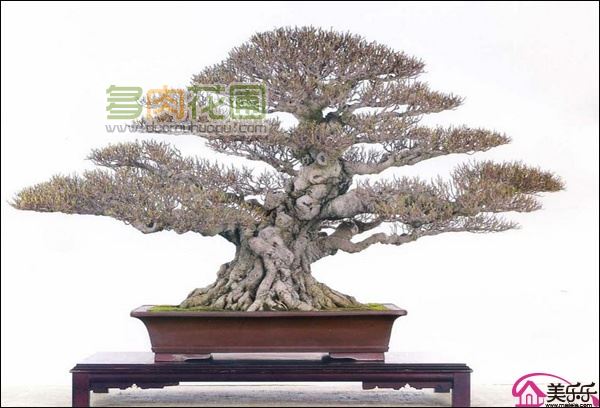
There are four important steps in banyan cultivation methods
1. Plenty of light
The banyan tree is a subtropical plant; it likes a sunny, well-ventilated and warm, humid environment. It is drought-tolerant and tolerant of partial shade. Generally it should be placed in a ventilated, well-lit spot, and the air humidity must be very sufficient. If sunlight is insufficient, ventilation is poor, and there is not a certain level of air humidity, the plant will turn yellow and dry out, and may even suffer pests and diseases, and in severe cases this can lead to death.
2. Appropriate watering
When a banyan tree is planted in a pot, if it is not watered for a long time to replenish moisture, the plant will wither from lack of water. Therefore observe promptly and water according to the wet or dry condition of the soil, maintaining a certain soil moisture. The watering method is: water until water seeps out of the drainage hole at the bottom of the pot, but do not give half-watering (that is, wet on top and dry below). When the soil surface turns pale and the surface soil is already dry, water a second time. Note that you must not wait until the potting soil is completely dry before watering. The number of waterings should be considered according to spring, summer, autumn and winter, that is, fewer in winter and spring, more in summer and autumn.
3. A small amount of fertilizer
The banyan tree does not like much fertilizer; applying just over 10 granules of compound fertilizer each month is enough. When fertilizing, bury the fertilizer into the soil along the edge of the flower pot, and water immediately after fertilizing. The main components of the fertilizer should be nitrogen, phosphorus and potassium.
4. Pruning work
To have a good potted plant, of course pruning is indispensable. For a wild stump to become a bonsai, pruning is a very important step. In the first year, first cultivate its root base and build up its vigor, only removing buds that are in the wrong position; only after the branches have grown thick and become woody in the second year can you prune. However, pruning should be the main method and tying and wiring secondary; the number of prunings should preferably be once a year, though vigorous ones can be pruned twice. After the forked branches growing from the shortened branches become thick and strong, prune again. Repeat this way, and if pruned properly, in less than four years a good bonsai will appear in your hands.
Precautions: In northern winters, banyan bonsai should be placed indoors and watered often; the most important thing is to maintain the humidity of the room, and the pot used must be deep enough, otherwise it will not easily take root. There are also many reasons for banyan bonsai dropping leaves, such as improper watering, insufficient light, pests and diseases, and so on. Pay attention and observe the specific cause, and treat it accordingly.
Conclusion: Have you all remembered clearly the banyan bonsai cultivation methods we introduced above? In fact, the cultivation methods for banyan bonsai are relatively simple; the banyan's root bark is thick and it is very easy to keep alive! You can give it a try!
More information
|What does a white rose represent|What plants protect against computer radiation|Geranium|Rhododendron cultivation methods and precautions|Golden-heart spider plant|
|Lavender flowering period|Indoor foliage plants|Boston ivy|How to fold a lily|Mint's effects and functions|Mimosa cultivation methods|
|How to grow succulents|Osmanthus|Effects and functions of Jiaogulan|Handmade roses|Effects and functions of honeysuckle|Kumquat|