Carnation Propagation Methods and Management Key Points
Carnations are generally propagated by cuttings. Cuttings are taken in early spring. Choose the 3rd to 4th lateral bud on the middle part of the stem as the cutting; shoots sprouting from the root crown are the best. Taking cuttings when flower buds are forming is more suitable. After cutting the slips, they should be inserted immediately. Do this on a cloudy day or in the morning. After the slip is cut, dip the cut base in charcoal powder to prevent water loss from the slip, which would be unfavorable for survival.
River sand is suitable as the soil medium, and the insertion depth is about 2 cm. After inserting, spray or sprinkle thoroughly with water at once, but do not let the water be excessive, so as to avoid rotting the slips. Avoid direct sunlight and keep the room temperature at 10-13°C; after about one month, they will root. After rooting, light can be gradually increased. About 50 days after cutting, transplant them separately. After the transplanted plants have recovered from transplanting and the terminal bud resumes growth, begin fertilizing. Generally, apply dilute manure water once every 10 days, but do not water too much. During the vigorous growth period, flowering period and hot summer period, watering should be increased. Pinch out the growing tips when the seedlings have more than 5 pairs of leaves. When the lateral branches have more than 3-4 pairs of leaves, carry out a second pinching.
In the end, it is best for the whole plant to have 12-15 lateral branches. They can also be pinched again to promote lateral branch development and flowering propagation. The last pinching should be no later than mid-August. The seedling transplanting period should be no later than early July, otherwise it will greatly affect plant growth and flowering. Carnations should be staked in time; apart from leaving 2-3 lateral branches at the base to flower, the axillary buds and lateral flower buds on the remaining lateral branches should all be removed promptly. Carnation cut flowers are cut in the morning or evening, taking fully open flowering stems.
How do carnations propagate? Carnation propagation methods
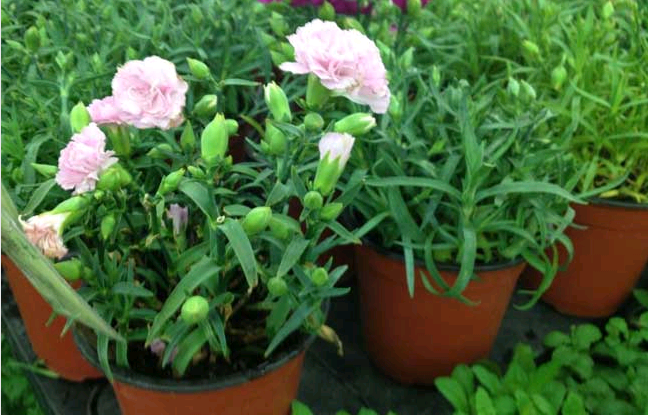
Carnation propagation methods generally include seed sowing, layering propagation, tissue culture and cutting propagation. The following introduces them separately, hoping to help flower lovers who grow carnations and enable them to propagate carnations better.
How do carnations propagate? 1. Carnation seed sowing propagationThe germination temperature for carnation seeds is best at around 20°C. They should be sown indoors in early spring or sown in the open field in September-October, and protected over winter in winter; the temperature must not be higher than 15°C, nor lower than 0°C, and they can be potted in early spring.
2. Carnation layering propagationCarnation layering is carried out in August-September. Select a long branch, cut open the bark on the part touching the ground with a knife, press soil over it, and after 5 to 6 weeks it can root and survive.
3. Carnation tissue cultureCarnation tissue culture propagation is an important means of producing virus-free seedlings and is widely used in cut flower production. Generally, shoot tips are used for virus elimination culture, and then mass propagation is carried out.
Carnation cutting propagation method tutorial 1. Selection of slipsSelect plants that are free of pests and diseases, grow vigorously and have closely spaced nodes, and that have 3-4 pairs of expanded leaves and 1 pair of unexpanded leaves, with the flower bud rate of the group of slips being less than 10%.
2. Taking of slipsThe taking of slips is generally carried out at the same time as bud thinning of carnations. Slips should be taken according to standards; when taking slips, break off the shoots by hand rather than cutting with scissors, so as to avoid cross-infection by viruses. The base should carry a little cortex from the main stem, but without damaging the mother branch, and keep 4-5 leaves at the top of the slip while removing all the rest. After arranging them into bundles, soak them in clean water for 30 minutes so that the slips absorb enough water. The cut surface should be close to the node, and treat with growth regulators to increase the survival rate and the rate of plants ready for sale.
3. Storage of slipsStoring slips can provide great convenience for year-round seedling raising and year-round balanced flower supply, and can also carry out batch operations at one time, saving manpower and material resources. The storage temperature is 1-2°C, and the smaller the fluctuation range the better, preferably within ±1°C. Before storage, give them a slight dehydration treatment, and the slips should be packed in ultra-thin plastic film.
4. Cutting timeGenerally, the hot summer months of July-August should be avoided. The slips are required to be of good quality, larger-particle perlite is used as the cutting medium, the water quality is good, and the cutting bed is a raised bench.
5. Cutting methodWhen inserting, it is suitable to insert into the medium by 1 cm; in summer, insert deeper, generally 1.5-2 cm. After cutting is completed, spray enough water, and afterward control it so that it is not too wet, so as to avoid root rot.
6. Cutting managementThe cutting bed should have intermittent misting facilities, and the amount of mist should be controlled so that the leaves are just moist. If there is no misting measure, cover with plastic film, and after 1 week switch to reed curtains, but do not shade too much, to prevent leggy growth. When the roots of the cutting seedlings are 1 cm long, carry out transplanting, taking care to damage the roots as little as possible.
How do carnations propagate? Introduction to carnation propagation methods
Carnation propagation is divided into two types: asexual propagation and sexual propagation. Sexual propagation often has a low seed-setting rate, the offspring from seeds vary greatly in traits, and the seedlings grow slowly, so it is rarely used in production. In production, asexual propagation is widely used, mainly cutting propagation, which has the advantages of abundant slips, stable traits and quick results. Let us take a look together below!
Carnation seed propagation
The germination temperature for carnation seeds is best at around 20°C. They should be sown indoors in early spring or sown in the open field in September-October, and protected over winter in winter; the temperature must not be higher than 15°C, nor lower than 0°C, and they can be potted in early spring.
Carnation layering propagation
Carnation layering is carried out in August-September. Select a long branch, cut open the bark on the part touching the ground with a knife, press soil over it, and after 5 to 6 weeks it can root and survive.
Carnation tissue culture
Carnation tissue culture propagation is an important means of producing virus-free seedlings and is widely used in cut flower production. Generally, shoot tips are used for virus elimination culture, and then mass propagation is carried out.
Carnation cutting propagation
1. Selection of slips: Select plants that are free of pests and diseases, grow vigorously and have closely spaced nodes, and that have 3-4 pairs of expanded leaves and 1 pair of unexpanded leaves, with the flower bud rate of the group of slips being less than 10%.
2. Taking of slips: The taking of slips is generally carried out at the same time as bud thinning of carnations. Slips should be taken according to standards; when taking slips, break off the shoots by hand rather than cutting with scissors, so as to avoid cross-infection by viruses. The base should carry a little cortex from the main stem, but without damaging the mother branch, and keep 4-5 leaves at the top of the slip while removing all the rest. After arranging them into bundles, soak them in clean water for 30 minutes so that the slips absorb enough water. The cut surface should be close to the node, and treat with growth regulators to increase the survival rate and the rate of plants ready for sale.
3. Storage of slips: Storing slips can provide great convenience for year-round seedling raising and year-round balanced flower supply, and can also carry out batch operations at one time, saving manpower and material resources. The storage temperature is 1-2°C, and the smaller the fluctuation range the better, preferably within ±1°C. Before storage, give them a slight dehydration treatment, and the slips should be packed in ultra-thin plastic film.
4. Cutting time: Generally, the hot summer months of July-August should be avoided. The slips are required to be of good quality, larger-particle perlite is used as the cutting medium, the water quality is good, and the cutting bed is a raised bench.
5. Cutting method: When inserting, it is suitable to insert into the medium by 1 cm; in summer, insert deeper, generally 1.5-2 cm. After cutting is completed, spray enough water, and afterward control it so that it is not too wet, so as to avoid root rot.
6. Cutting management: The cutting bed should have intermittent misting facilities, and the amount of mist should be controlled so that the leaves are just moist. If there is no misting measure, cover with plastic film, and after 1 week switch to reed curtains, but do not shade too much, to prevent leggy growth. When the roots of the cutting seedlings are 1 cm long, carry out transplanting, taking care to damage the roots as little as possible.