How can carnations be propagated by cuttings so they root easily?
Carnations are mainly propagated by cuttings. Since cutting material is plentiful, growth is fast and the survival rate is high, this helps speed up propagation. Cuttings can be taken in any season except the hot summer. In production, indoor cuttings from January to March are preferable, so that the plants can bloom in winter and spring. Especially when cuttings are taken from late January to early February, the survival rate is high and growth performance is good.
Select cuttings from mother plants that are vigorous, show the typical characteristics of the variety and are free from pests and diseases. It is best to choose side shoots that have already sprouted at the first to sixth nodes from the base and are 7 to 10 cm long. When taking the shoots, it is better to snap them off by hand than to use scissors. Make sure the base of the cutting has a node scar, as this makes rooting easier. The cutting medium consists of a mix of 2 parts garden soil and 1 part rice-hull ash. Insert immediately after collection to prevent wilting, or rinse the cuttings with water before inserting. Insert about 1 cm deep, with a spacing of about 2 cm.
Water immediately after inserting, and cover with shade. Keep the room temperature at 10 to 13 degC. Roots generally begin to form in about 20 days, and transplanting can be done after 40 to 50 days, with a spacing of 5 to 7 cm.
Propagating carnations by cuttings
Carnation, also known as clove pink, is an annual or perennial clump-forming herbaceous flower of the genus Dianthus in the family Caryophyllaceae. It can be propagated by sowing, cuttings, layering and tissue culture, but cuttings are generally the most common method, carried out in winter and spring.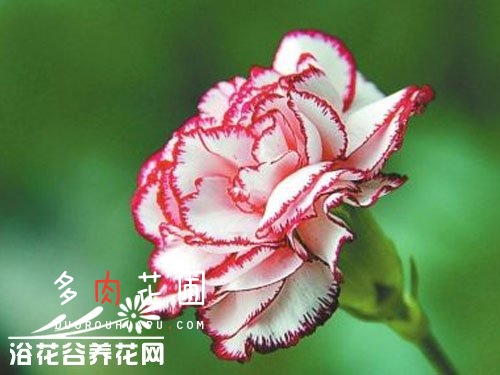
Generally speaking, carnation cuttings can be taken from December to April of the following year, with January to February being especially suitable, when the side buds used as cuttings grow vigorously and are of the best quality; at the same time, cuttings taken during this period can control the plants to bloom at New Year's Day and Spring Festival the following year. Cuttings taken in March also have a relatively high survival rate, but subsequent growth is not as good as that of cuttings taken in January to February, so they can be taken at this time when replanting is needed. To take carnation cuttings, first prepare the growing medium, generally mixing 30% to 40% rice-hull ash or sandy soil into garden soil, then place the mixture in a cutting pot or wooden box after mixing evenly.
Cuttings need to be taken in a greenhouse, selecting cuttings from mother plants that are vigorous, bloom uniformly and have thick, short-noded branches. Choose short, thick side buds from the middle of vigorous branches, in sections 3 to 4 cm long. When taking cuttings, use the "snap-off method" with both hands at the same time, that is, hold the main branch with one hand and the bud selected as the cutting with the other, peeling the old leaf and bud outward together so that the base is intact and bears a node scar. Dip the cutting in water or spray water on the peeled area so it absorbs enough water, and set it aside for insertion.
The insertion depth should be 1/3 to 1/2 of the length of the cutting. Water thoroughly after inserting and maintain a temperature of 10 degC to 15 degC. Care of the seedbed must be meticulous. Water again the next day after inserting. If the leaves appear wilted, spray the leaf surface several times; the soil should be slightly moist, but not too wet. At the initial stage after inserting, shade from strong light is generally needed during clear daytime, usually for about 2 weeks. The cuttings will root in about 30 to 45 days, and transplanting can generally be done 1 month after the seedlings have taken root.
If cuttings are taken after March, the selected cuttings can be slightly longer. As the temperature gradually rises at this time, with large day-night temperature differences and high humidity, it is necessary to set up a shading frame for about 3 weeks and pay attention to ventilation to prevent the seedlings from being attacked by pests and diseases.
How to propagate carnations by cuttings
[Common questions] How to propagate carnations by cuttings
Image: Carnation
[Expert answer]
1. Establishment of the cutting mother plant garden.Practice has shown that the mother plants for taking cuttings must meet the following conditions: the plants are relatively young in age, have good flowering traits, have a disease index of zero, and the part from which cuttings are taken must be strictly controlled above the 6th node. Therefore, establishing a dedicated cutting mother plant garden is very necessary and crucial, and it is also an indispensable step in the modern carnation seedling production process. It is both a prerequisite for producing high-quality seedlings and the foundation for large-scale seedling raising throughout the year.
The mother plants in the cutting mother plant garden must be tissue-cultured seedlings. The key to cultivation and management of the mother plant garden is: strengthening soil disinfection, advocating crop rotation, ensuring sufficient base fertilizer, having rain and shade protection measures, advocating drip irrigation, and doing a good job of pest and disease control.
2. Cutting technique
(1) Selection of cuttings. Choose plants that are free from pests and diseases, grow vigorously and have tight internodes, with 3-4 pairs of expanded leaves and 1 pair of unexpanded leaves, and with less than 10% of the cuttings in the batch bearing flower buds.
(2) Cutting time. Generally, the hot summer months of July-August should be avoided. The cuttings are required to be of good quality, larger-grained perlite is used as the cutting medium, the water quality is good, and the cutting bed is raised.
(3) Taking and inserting the cuttings. The taking of cuttings is generally carried out at the same time as the disbudding of carnations. Cuttings should be taken according to standards; when taking cuttings, snap off the buds by hand rather than cutting with scissors, to avoid cross-infection by viruses. The base should carry a little cortex from the main stem, but without damaging the mother branch. Keep 4-5 leaves at the top of the cutting and remove all the rest. After arranging them into bundles, soak them in clean water for 30 minutes so the cuttings absorb enough water. The cut surface should be close to the internode and treated with growth regulators to increase the survival rate and the rate of usable seedlings. When inserting, it is best to insert 1 cm into the medium. In summer, insert deeper, generally 1.5-2 cm. After inserting, spray thoroughly with water, and afterward keep it from becoming too wet to avoid root rot.
(4) Storage of cuttings. Storing cuttings can provide great convenience for raising seedlings throughout the year and supplying flowers evenly all year round, and it allows batch work to be done in one go, saving manpower and material resources. Storage requirements: temperature 1-2 degC, with as small a fluctuation as possible, preferably within ±1 degC; a slight dehydration treatment before storage; cuttings should be wrapped in ultra-thin plastic film.
(5) Cutting management. The cutting bed should have intermittent misting facilities, with the misting amount controlled so that the leaves are just moist. If no misting is available, cover with plastic film, and change to reed curtains after 1 week, but do not shade too much, to prevent leggy growth. When the roots of the cuttings reach 1 cm long, transplant them, taking care to damage the roots as little as possible.
[Editor's summary]
Carnation propagation methods are divided into sexual propagation and asexual propagation, but in the cultivation process, the common method is cutting propagation. The First Farm Economics editor has introduced the carnation cutting propagation method to you in this article, and hopes it will be helpful to you.