What to Do When a Dracaena fragrans Gets Anthracnose? Detailed Prevention and Control Methods
[Symptoms]It mainly affects the leaves. In the early stage, the spots on the leaves are nearly round to oval, then expand and lengthen, becoming white, greyish-white to reddish-brown, with distinct but irregular edges; in the later stage, small black dots appear on the spots, namely the pathogen's acervuli.
[Occurrence pattern]It overwinters as mycelium and acervuli in diseased parts or in the soil along with diseased plant debris. In May to June of the following year, it produces large numbers of conidia, which spread by wind and rain, causing primary infection and repeated secondary infections, continuously expanding and spreading until winter. Temperatures of 25-30°C and relative humidity above 80% make the disease likely to occur. Warm, humid weather, or heavy fog and dew, favor the disease; excessive application of nitrogen fertilizer or a densely planted site with poor ventilation and light penetration will make the disease worse.
[Prevention and control methods]① Dracaena fragrans likes warmth and well-drained soil rich in humus. For a home potted growing medium, garden soil, leaf mold, and wood chips or sawdust can be mixed at 2:1:1; from April to August it enters the peak growing season, so apply fertilizer once every 20-30 days. ② In the early stage of the disease, spray 50% thiophanate-methyl sulfur suspension concentrate at 800 times dilution, or 25% tanteling wettable powder at 1000 times dilution, 50% shibaogong or shibaike wettable powder at 1000 times dilution, 30% copper hydroxide suspension concentrate at 600 times dilution, 10% shigao water-dispersible granules at 3000 times dilution, 70% thiophanate-methyl wettable powder at 1000 times dilution, 75% chlorothalonil wettable powder at 1000 times dilution, 50% compound thiophanate wettable powder at 1000 times dilution, 40% duoliu suspension concentrate at 500 times dilution, or 50% benomyl wettable powder at 1000 times dilution. ③ For home potted Dracaena fragrans, applying medical dakening ointment to the spots is effective.
Prevention and Control Methods for Dracaena fragrans Anthracnose
Some flower lovers have a Dracaena fragrans at home that has developed anthracnose. Here is a brief introduction to the symptoms, patterns, and prevention and control methods of Dracaena fragrans anthracnose:
I. Symptoms:
1. The disease causes large leaf spots, and in severe cases an entire clump of leaves dries up and rots, losing its commercial value.
2. The disease affects many kinds of Dracaena fragrans. The spots mainly occur at the leaf tips and leaf margins. In the early stage, small yellow spots appear on the leaves; after expanding, they become irregular large spots that are reddish-brown; in the later stage, the center of the spot becomes brown to greyish-white, with many small black dots arranged in a ring on it, the spot margin is dark brown, and there is a yellow halo outside it.
II. Occurrence pattern:
1. The pathogen overwinters in diseased leaves, diseased plants, and diseased plant debris; it spreads by wind and rain and by splashing water droplets.
2. High temperature (25°C-30°C), frequent rain, poor ventilation with high humidity, excessive application of nitrogen fertilizer, and poor plant growth all favor the disease.
3. Outdoors, the disease occurs from May to October, and is severe in the rainy season; indoors, it occurs year-round.
III. Prevention and control methods:
Preventive methods: Drain promptly after rain; keep the greenhouse well ventilated and well lit, and reduce humidity and temperature; from April to August, during the peak growing season, apply dilute organic fertilizer, or a special fertilizer sold on the market, about once a month, and appropriately increase the application of phosphorus and potassium fertilizer; the growing medium should be loose, permeable, and fertile.
Treatment methods: In the early stage of the disease, spray 50% shibaike or shibaogong wettable powder at 1000 times dilution, or 10% shigao water-dispersible granules at 3000 times dilution, or 25% yingde suspension concentrate at 1000 times dilution, or 25% tanteling wettable powder at 500 times dilution, etc. Once every 7-10 days.
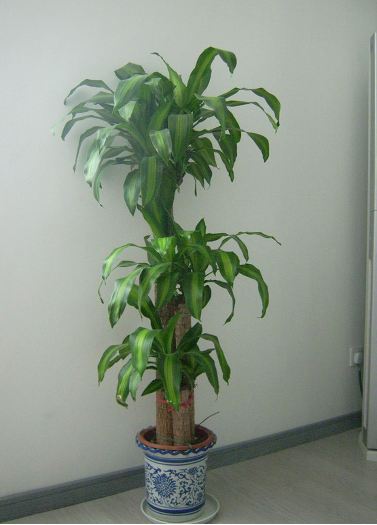
Prevention and Control Methods for Dracaena fragrans Anthracnose
Some flower lovers have a Dracaena fragrans at home that has developed anthracnose. Here is a brief introduction to the symptoms, patterns, and prevention and control methods of Dracaena fragrans anthracnose:I. Symptoms:
1. The disease causes large leaf spots, and in severe cases an entire clump of leaves dries up and rots, losing its commercial value.
2. The disease affects many kinds of Dracaena fragrans. The spots mainly occur at the leaf tips and leaf margins. In the early stage, small yellow spots appear on the leaves; after expanding, they become irregular large spots that are reddish-brown; in the later stage, the center of the spot becomes brown to greyish-white, with many small black dots arranged in a ring on it, the spot margin is dark brown, and there is a yellow halo outside it.
II. Occurrence pattern:
1. The pathogen overwinters in diseased leaves, diseased plants, and diseased plant debris; it spreads by wind and rain and by splashing water droplets.
2. High temperature (25°C-30°C), frequent rain, poor ventilation with high humidity, excessive application of nitrogen fertilizer, and poor plant growth all favor the disease.
3. Outdoors, the disease occurs from May to October, and is severe in the rainy season; indoors, it occurs year-round.
III. Prevention and control methods:
Preventive methods: Drain promptly after rain; keep the greenhouse well ventilated and well lit, and reduce humidity and temperature; from April to August, during the peak growing season, apply dilute organic fertilizer, or a special fertilizer sold on the market, about once a month, and appropriately increase the application of phosphorus and potassium fertilizer; the growing medium should be loose, permeable, and fertile.
Treatment methods: In the early stage of the disease, spray 50% shibaike or shibaogong wettable powder at 1000 times dilution, or 10% shigao water-dispersible granules at 3000 times dilution, or 25% yingde suspension concentrate at 1000 times dilution, or 25% tanteling wettable powder at 500 times dilution, etc. Once every 7-10 days.