How to Propagate Asparagus Fern? A Detailed Guide to the Common Propagation Methods
Asparagus fern can be propagated by two methods: seed sowing and division, but plants grown from division often develop an irregular shape, so division is not used much; seed sowing is mostly used. Getting asparagus fern to set seed is not as easy as it is with ordinary herbaceous plants.
Potted asparagus fern generally blooms after 4 to 5 years. If care is poor, it may bloom but still not bear fruit. To make asparagus fern bear fruit, you must both strengthen fertilizer and water management and prevent flower drop. During the flowering period, do not move the pot; if you must move it indoors to shelter it from rain and wind, pay attention to its orientation when you move it, so that the side facing south still faces south. If the light direction is disturbed, the flowers will drop.
In some areas, potted plants often fail to produce seeds, so 3- to 4-year-old asparagus ferns are often used as mother plants for seed collection and grown in the ground in a greenhouse. Build a frame with thin bamboo poles, galvanized wire or coir rope, and train the stems to grow upward. It generally produces small yellowish-white flowers in August to September, and in February to March of the following year most of the fruits turn from green to purplish-brown, after which they are harvested as they ripen. Alternatively, wash the harvested seeds clean with clear water, dry them in a cool, ventilated place, and then store them for later use.
The time of seed harvest and the handling after harvest have a direct effect on the germination rate after sowing. If seeds are collected too early, before they are fully mature, the germination rate will be low. After harvesting, mature seeds should be dried in a cool, ventilated place; if they are dried in the sun, the seed embryos will be killed by the sun and the seeds will lose their ability to germinate. In addition, seeds must not be exposed to smoke or damp.
The sowing time is April in spring. You can sow in a pot or in an indoor seedbed. Just make sure the growing medium is loose; mix 50% leaf mold, 30% vegetable garden soil and 20% rice husk ash. When sowing, first water the pot soil thoroughly, then scatter the seeds. Asparagus fern seeds are larger than those of ordinary herbaceous flowers (about 25 seeds per gram), so you can sow them in individual spots. Cover with only a thin layer of soil, just enough to cover the seeds. After sowing, water thoroughly and generously, using a fine sprayer. Cover with glass and place in a warm spot indoors. Before the seeds germinate, keep the soil constantly moist. Covering with too much soil or letting the soil dry out will both affect the germination rate. After sowing, the seeds generally germinate one after another in 20 to 30 days. After germination, besides receiving less intense sunlight in the morning or evening, strong sunlight around midday must be shaded, or the seedling pots should be moved indoors. About 10 days after germination, you can apply liquid fertilizer at a concentration of 10%. After about another 30 days, when the seedlings have grown to 60 cm tall and have 5 to 6 leaves, they can be moved into pots with a diameter of 10 to 13 cm for care.
Division propagation of asparagus fern is carried out in April to May in spring, using vigorous 3- to 4-year-old plants. First tip the plant out of the pot and gently remove the growing medium (be careful not to damage too many roots). Use sharp scissors to cut it apart at the root crown where it separates easily, dividing it into several clumps according to the size of the plant, with about 3 to 4 roots per clump, then plant them in small pots, place them in a cool place and water thoroughly. After that, strengthen care and management.
How to Propagate Asparagus Fern: Propagation Methods for Asparagus Fern
Although asparagus fern is not actually bamboo, its stems are jointed like bamboo and its form is very beautiful. How do you propagate asparagus fern? Below we will tell you the propagation methods for asparagus fern.
Asparagus fern is mainly propagated by two methods: seed sowing and division.
1. Sowing
Sowing is the main method of propagating asparagus fern. When the fruit skin of the asparagus fern seed turns black and soft, it is ripe; at this point it should be picked gradually according to its degree of ripeness, the flesh rubbed off, rinsed clean with clear water, dried until half-dry and then stored for later use. Sow in early April, and by autumn of the same year they can become marketable seedlings or indoor displays. The sowing medium is generally fine sand, and the container is a clay pot or wooden box. Place the seeds on the pot soil at a spacing of 2-3 cm, with 2-3 seeds per spot. After sowing, cover with fine sand 5 mm thick, and cover with glass or plastic film, keeping the temperature at 20-25°C and spraying water frequently to keep the pot soil moist. About 30 days after sowing, germination and emergence begin. When the seedlings are 4-5 cm tall, transplant them for growing on, and when they are 8-10 cm tall, they can be planted into pots.
2. Division
Home pot growing can also use division propagation. Asparagus fern has a strong clumping habit; plants 4-5 years old will continuously send up root-sucker shoots from the root zone, making the clump grow larger and larger. In spring, when repotting, you can divide the potted plant into several clumps and plant them separately in pots to obtain new plants.
Points to note when propagating asparagus fern:
Asparagus fern is mainly propagated by sowing and division. Sowing is done in March to April; before sowing, soak the seeds for 24 hours, then sow them in individual spots in a pot 10 cm deep, cover with glass or plastic film to prevent water evaporation, keep the temperature at 20-25°C and the pot soil moist; they can germinate in 20-30 days, and when the seedlings are 5 cm tall they can be put into small pots. For plants grown in large pots, division propagation should be carried out in spring. Division is best done with large plants that have grown for 2-3 years; according to the size of the plant, divide one pot into two or three pots. The division operation is very simple: pull the asparagus fern roots apart by hand, and as long as not too many roots are damaged, plant the divided plants in flower pots and water thoroughly once and they will survive. When dividing, apply 3-4 pieces of horse hoof slices or sesame paste residue and other organic fertilizer in the pot as a base fertilizer.
When indoor conditions are not ventilated, scale insects are likely to occur; spray 2000-fold dichlorvos emulsion for control. In summer, red spiders are likely to occur; you can spray special miticides such as dicofol. Diseases include gray mold and leaf blight, which damage the leaves; spray with 50% thiophanate-methyl wettable powder at 1000-fold dilution.
Asparagus fern likes a clean environment with circulating air. If it is irritated by harmful gases such as smoke, dust, coal gas or pesticides, the leaves will turn yellow, curl and even die. On warm sunny days, open the windows for ventilation from 10 a.m. to 3 p.m. to keep the indoor air fresh and well ventilated.
When the leaves and branches of asparagus fern grow too long, give it a trellis, or cut it shorter, to help ventilation and light penetration.
Because the branches and leaves of asparagus fern spread out horizontally, they easily collect dust, which not only affects growth but also makes the branches and leaves turn yellow easily, so they need to be sprayed and washed with clear water to remove dust. Before spraying, it is best to shake off part of the surface dust from the stems and leaves by hand, then wash with a fine-nozzle watering can, and gently shake off the water droplets clinging to them.
How to Propagate Asparagus Fern? Propagation Methods for Asparagus Fern
[Common Question] How to Propagate Asparagus Fern? Propagation Methods for Asparagus Fern
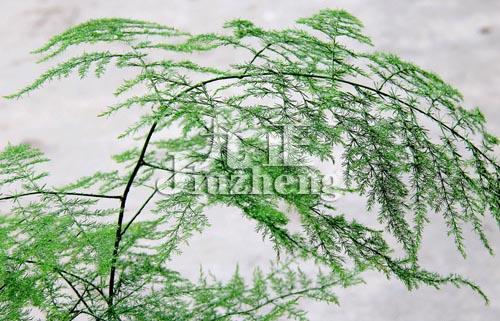
Image: Asparagus fern
[Expert Answer]
● Division propagation.Asparagus fern cannot be propagated by pinching off a section of stem the way pothos can; it must be propagated by division. This comes down to the characteristics of asparagus fern: it has a very strong clumping habit, and after 4 years it will send up new sucker shoots from the root zone, making the plant grow larger and larger. The best season for division propagation is spring. Take the asparagus fern out of the flower pot, separate the new plants, and plant them separately in pots to obtain new plants.
● Sowing propagation.This is the main method of propagating asparagus fern. When the fruit skin of the asparagus fern seed turns black and soft, it is ripe; rub off the fruit skin, rinse clean, and dry it before sowing. When sowing, do not cover with soil too deep; generally about 2 cm is enough. Then pay attention to keeping it moist (you can cover with film or use a seedling box), place it in a spot with plenty of sunlight, and keep the temperature above 18°C. Be patient about the germination time; it takes 2-4 weeks to germinate. After germination, when the seedlings grow to 3-4 cm tall, they can be separated and transplanted.
[Editor's Summary]
Asparagus fern likes a warm, semi-shaded and ventilated environment and dislikes direct sunlight. It is a commonly seen plant suitable for growing in offices. Asparagus fern generally blooms in September to October, and after blooming it bears fruit; the seeds can of course be used for propagation, and there is also the division propagation method. The above is the article "How to Propagate Asparagus Fern?" compiled for you by the First Agricultural Economics editor; we hope it is helpful to you.