How to propagate camellias? A detailed guide to common propagation methods
Camellias are mostly propagated by cuttings, but layering and grafting can also be used.
(1) Cutting method: April to July is the most suitable period. Choose current-year, thick, pest- and disease-free young shoots as cuttings, about 10 cm long, keeping 1 terminal bud, 1 lateral bud and 2-3 leaves at the top, and removing all the lower leaves. First soak the cuttings in a solution of naphthaleneacetic acid or indolebutyric acid (concentration 200 ppm-500 ppm) for 8-12 hours, then rinse them clean with water and insert them into a seedbed or pot prepared with fine sand or vermiculite, protecting them from direct sunlight. Water promptly after inserting, and spray water 2-3 times on sunny days to keep the soil moist. On cloudy and rainy days, no shading is needed; with careful management, new roots emerge in 60-70 days.
(2) Layering method: Generally in April, choose current-year young shoots, wound the part to be buried with a knife or perform ring barking, then press the cut into the soil, keeping the soil moist often; after rooting, cut it away from the mother plant.
(3) Cleft grafting method: In February to March, use robust single-petaled camellias or seedlings grown from camellia oleifera seeds as rootstock, and use new shoots of excellent current-year varieties as scions, with the scion bearing 1-2 leaves and its base cut into a 1 cm wedge shape. Cut off the rootstock 3-5 cm from the root collar, then make a vertical cut 2 cm deep and insert the scion into the rootstock's cut so that the cambium layers of rootstock and scion align, tie it tightly with hemp, and place it in a cool place. In June to July, use the approach grafting method for grafting.
How do camellias propagate? An introduction to camellia propagation methods
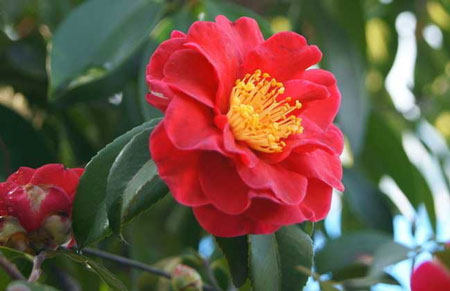
Camellias are mainly distributed in China and Japan, and are widely cultivated outdoors in the central and southern provinces of China, with a cultivation history of 1400 years. There are many propagation methods, and both sexual and asexual propagation can be used, among which cuttings and approach grafting are the most commonly used. Let's take a look at these camellia propagation methods below!
Cutting propagation of camellias
This method is the simplest. September is the most suitable time for cuttings, and spring also works. Choose well-growing, semi-lignified branches, remove the lower leaves, keep the upper 3 leaves, cut diagonally with a sharp knife, immediately soak the cut end in 200-500 ppm indolebutyric acid for 5-15 minutes, dry it in the sun, then insert it into a sand pot or vermiculite pot. After inserting, water it; the wound heals in about 40 days and roots form in about 60 days. Cuttings treated with hormones root 2-3 months earlier than those without hormones. Using vermiculite as the cutting bed also roots much faster than a sand bed.
Approach grafting propagation of camellias
Choose a suitable variety such as Chazhong camellia or camellia oleifera as the rootstock, and approach-graft a precious camellia onto it. The approach grafting time is generally between Qingming Festival and Mid-Autumn Festival. First plant the rootstock in a flower pot, use a knife to shave off about half at the parts to be joined respectively, with smooth cuts, then make the two cut surfaces fit tightly together, wrap with plastic film, and water the rootstock twice a day; after 60 days it will have healed, at which point it can be cut off and planted, and placed under tree shade, avoiding direct sunlight. In February of the following year, use a knife to cut off the tail of the rootstock, then plant it out.
Leaf-cutting propagation of camellias
Camellias are generally propagated by stem cuttings, but some precious varieties, due to limited sources of branches or because taking material would affect their tree shape, also use the leaf-cutting method. Use mountain soil as the cutting medium, and mix in 1/3 river sand to facilitate aeration and drainage. Put the medium in a clay pot, then carry out pot cutting. Leaf cuttings are best done during the rainy season. Take one-year-old leaves as leaf-cutting material; leaves that are too old root with difficulty, and those too tender rot easily. Insert about 2 cm into the soil, press the soil firm after inserting, water thoroughly, then place in a cool, ventilated place. Generally, roots develop in 3 months, and in the spring of the following year they can sprout and grow shoots.
High-level cutting propagation of camellias
The greatest feature of the high-altitude cutting method is that it can give new life to all the weak and small branches on the camellia that would otherwise be pruned off. Moreover, this method has a high survival rate, quick rejuvenation, and early flowering. Take the thin, weak branches that need to be pruned off and perform ring barking at an appropriate position (generally leaving 15-25 cm of branch at the upper part); the ring-barking length can be between 5-8 mm, tie on a suitably sized plastic film, and add sterilized and disinfected peat soil or leaf mold inside the film. After 7-10 days, perform another ring bark of 5-8 mm on the lower part of the plastic film; this is called the double ring-barking high-cutting method.
Tree grafting propagation of camellias
Camellias are plants that are relatively difficult to keep alive. There are many and varied propagation methods for camellias, among which grafting is the most commonly used. Graft-propagating camellias has many advantages: it can maintain the excellent traits of the variety, accelerate plant growth so it takes shape quickly, allow large-scale production, and save scion wood, which is especially important for rare varieties with few sources of scion wood. The technique of grafting camellias onto camellia oleifera trees: the grafting time is preferably between June and July, when the leaves of the new shoots of the camellia scion have already unfolded and the temperature is relatively high, so the graft wound heals quickly and the survival rate is high. The grafting method uses the cut-grafting method among the branch grafting methods; because the grafting position is relatively high, it is often called "high grafting to change the head".
How do camellias (camellia) propagate
There are many propagation methods for camellias, and both sexual and asexual propagation can be used. Around Guangzhou, asexual propagation is usually used, among which the air-layering method (air layering) and the cutting method are the most common. The various propagation methods are introduced below.1. Seed propagation: Harvest the seeds after the fruit matures in December, sow immediately after harvesting, or store the seeds in sand and sow in February to March of the following spring. After sowing, shade them; they germinate after two months. Be careful to strengthen management, weed promptly, loosen the soil and fertilize. Transplant once in the autumn of that year or in February to March of the following year, with appropriate cultivation. They begin to flower in the third or fourth year, and at this time the plants can also be used as rootstock for grafting.
2. Cutting propagation: Varieties suitable for cutting propagation include Guanfen camellia, Dahong, and others. Generally in September, choose young shoots from well-growing plants, remove the leaves below the growing point, keep the upper 8 leaves, and perform ring barking to remove the bark layer at the place where roots will grow; after the callus has grown, cut them off before "Great Cold" (late January), wrap the callus part with mud, and then insert them into sand. Such cuttings have a relatively high survival rate and root relatively quickly.
3. Air-layering propagation: Varieties suitable for air layering (air layering) propagation include Chazhong camellia, Fujian camellia, Wubao camellia, Dahong camellia, Guanfen camellia, and others. The air-layering method is: in early March, choose disease-free branches, about 15-20 cm long, ring bark off a 1 cm length of bark, scrape the cambium clean, then wrap a mud ball at the ring-barked opening, and water daily to keep it moist. After 100-120 days, cut them off with scissors, plant them in groups of 10 in a seven-jin pot, and place them in a relatively shaded place for management; transplant in February to March of the following year, two plants per pot, and by October plant them individually in five-jin or seven-jin pots.