Solutions for yellowing and dropping of lower leaves on the rubber plant
The rubber plant (Ficus elastica) is a perennial evergreen woody plant in the mulberry family (Moraceae), with thick, glossy leaves that stay green all year round; in some cultivars the leaves and young tips are purplish red, and the plant has a full, graceful shape. Its common cultivated cultivars include:
(1) Black-leaved rubber plant: leaf surface dark red, veins on the leaf underside red, young buds bright red.
(2) Variegated rubber plant: leaf margins and veins have yellow and white markings, leaves are long ovate.
(3) Beautiful-leaved rubber plant: leaves slightly rounded, leaf margins and veins have yellow and white markings, young leaves tinged with red, stipules red. During the growing season apply a top dressing once a month, and repot once every 1 to 2 years. The overwintering temperature must be above 10°C.
The rubber plant likes a warm, humid environment and plenty of light; it tolerates shade and drought but not cold, and its optimum growing temperature is 22 to 32°C. High temperature and drought in summer, low temperatures in winter, prolonged exposure to weak light, long periods without fertilizer, fertilizer applied too strong, or the use of unmatured fertilizer can all cause the lower leaves of the rubber plant to turn yellow and drop; older, taller plants also often have bare, leafless lower sections, which spoils the ornamental effect.
The plant can be renewed by the following method: in spring, when the temperature reaches 20 to 30°C, cut off the upper branches and leaves 10 to 15 cm above the soil surface of the pot, and smear plant ash on the wounds to prevent rot. Given suitable temperature, light, and fertilizer and water conditions, new buds will sprout below the cut within 2 to 3 weeks; keep three strong buds facing different directions and remove all the rest. After a period of careful care, it will grow into a sturdy plant with full branches and leaves. At the same time, cut the removed branches into 20 cm-long stem sections according to their length, insert the stem sections into an inorganic substrate such as vermiculite or river sand, and provide appropriate shading and moisture retention; they will root after 30 days, and once rooted they can be planted into flower pots of an appropriate size for normal care and management.
Air layering can also be used: in the suitable growing season of June to August, peel off a 1 cm-wide strip of bark (the cortex) at the layering site and let the white sap flow out, then treat it by the usual method; it will root in about a month. Once rooted, cut off the branch and plant it separately.
What should you do if the rubber plant develops yellow leaves and drops leaves?
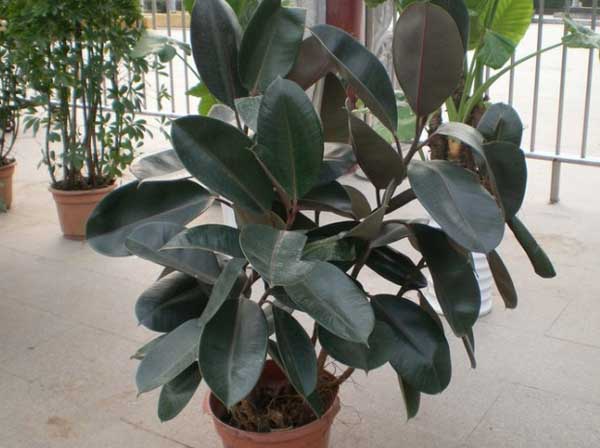
The rubber plant is an evergreen woody foliage plant with fairly large, thick leathery, glossy leaves, round to long elliptical, dark green on the upper surface and pale green underneath. It is a very lively plant to place in the home, but sometimes small problems arise, such as the rubber plant's leaves turning yellow or even dropping. Today we will introduce the causes of yellowing and dropping leaves in the rubber plant and the solutions:
Soil compaction caused by not repotting for a long time
[Cause] In its early growth stage the rubber plant needs repotting once a year, with the pot diameter increasing year by year; after 6 to 8 years of growth it can be repotted once every three years. If it is not repotted for a long time, the potting soil becomes severely compacted and the soil aeration is poor, causing the rubber plant's fibrous roots to suffocate and die, so they cannot absorb water and nutrients, which makes the leaves turn yellow and drop.
[Solution] When the temperature reaches above 15°C, repot it: cut away the dead roots and shake off most of the old soil. Remove the yellowed leaves and shorten the stem appropriately, replace the original compacted potting soil with fresh, fertile culture soil, and keep the soil consistently moist; this can prompt it to send out new roots, recover to a healthy state, and grow into a plant with many branches. In future care, keep the potting soil well aerated; while keeping the potting soil moderately moist, loosen the potting soil once every 15 to 20 days to prevent repeated watering from compacting the potting soil and causing root rot or root shrinkage.
Not fertilizing for a long time
[Cause] The rubber plant likes heavy feeding and abundant water; not fertilizing for a long time causes malnutrition and makes the leaves turn yellow.
[Solution] Add an appropriate amount of base fertilizer when repotting, remove the yellow leaves, and thereafter apply liquid fertilizer once every half month, mainly phosphorus and potassium fertilizer.
Overwintering temperature too low
[Cause] The rubber plant's minimum tolerable temperature is above 6 to 8°C; if the indoor temperature in winter falls below 5°C, the leaves will turn yellow and drop.
[Solution] Raise the indoor temperature for overwintering and be sure to keep it above 6 to 8°C.
Overwatering or overfertilizing
[Cause] Although the rubber plant likes water and fertilizer, if it is watered or fertilized too much, especially during August to September when the weather is still rather muggy, excessive watering creates standing water in the pot; or if it is watered too much during overwintering, when the plant is in its dormant period and transpiration is reduced, the water in the pot cannot drain away in time; or if raw fertilizer, heavy fertilizer, or strong fertilizer is applied by mistake, all of these can cause root rot through water damage or fertilizer damage, making the leaves turn yellow. If the root rot is caused by fertilizer damage, the roots will be accompanied by an unpleasant odor.
[Solution] First cut away the rotted roots until the cut surface is fresh and white milky sap oozes out. Let them air for a while until the sap at the wounds dries, or smear sulfur powder on the wounds to disinfect them, or wipe clean plant ash or charcoal crumbs on the wounds; at the same time cut away part of the branches to reduce transpiration water loss, then repot. When replanting, it is best to use clean, slightly damp fine sand to first surround the root wounds, and plant the outer part in fresh, loose sandy loam; strengthen shading and misting management, and do not water again until the potting soil is dry. As long as the root system is not too severely damaged, new fine fibrous roots will grow from the root wounds after a month. In future care, just keep the potting soil slightly moist; do not water excessively, and mist the leaves more in the morning and evening.
Lack of water
[Cause] Because the indoor air is too dry, the water in the potting soil is not enough to supply transpiration for all the leaves, causing some leaves, especially the lower old leaves, to turn yellow and even drop.
[Solution] Check the moisture level of the potting soil from time to time and replenish water in time; mist the leaves every morning and evening, and if that is still not enough, mist the leaves again around noon. Note: the water temperature for watering and misting should be basically the same as the soil temperature and room temperature; if the water temperature for watering and misting differs greatly from the soil temperature and air temperature, it can easily cause adverse physiological reactions.
Poor indoor ventilation
[Cause] If the room is not ventilated for a long time, some harmful gases accumulate, such as an excessively high concentration of carbon dioxide, and yellow leaves can also occur.
[Solution] Open the windows in time for ventilation and keep the indoor air fresh and circulating, and it will improve. In winter, open the doors and windows at noon when the temperature is higher to change the indoor air.
Long-term shading
[Cause] The rubber plant is a tropical species that likes plenty of sunlight and does not tolerate shade; if it cannot get sunlight indoors for a long time, yellow leaves will also occur.
[Solution] Place the plant in a spot with sunlight.
It may be infected with gray mold
[Cause] Gray mold is a fungal disease common in open-field and protected cultivation and relatively difficult to control; it is a low-temperature, high-humidity disease, with the pathogen growing at 20 to 30°C, and the high-incidence period for the disease is when the temperature is 20 to 25°C and humidity stays above 90%.
[Solution] Remove diseased leaves promptly and burn them. Increase indoor light and raise the room temperature. Or alternately spray 50% vinclozolin (Ronilan) wettable powder at 1200 times dilution, or 40% chlorothalonil wettable powder at 600 times dilution, once every 7 to 10 days, spraying 2 to 3 times in succession, which can effectively control the spread of the disease.
How to cultivate and manage the rubber plant
The rubber plant is native to India, Myanmar and other places, and is most abundant in India, so it is also called the Indian rubber tree. Because its tree body contains white milky sap that contains rubber, before the development of Brazilian Hevea brasiliensis rubber it was once the main raw material tree species for extracting rubber; only later did it give way to Hevea brasiliensis and gradually become an ornamental tree species. Its leaves are thick, large and shiny. In the warm regions of South China and Southwest China it is mostly planted in courtyards for viewing, while in the Yangtze River basin and areas to the north it is mostly grown in pots indoors for appreciation.The rubber plant likes warmth and humidity, and can grow in sunny or semi-shaded places; it is not demanding about soil and is highly adaptable. It is mostly propagated by cuttings. In spring, take branches that grew the previous year, or in summer take new branches of the current year, cut them into sections 15-20 cm long, keep 1-2 leaves on the upper part of each section, cut the large leaves in half, and insert them into the soil; at a temperature above 20°C, they will root and grow into new seedlings in about 1-2 months. After rooting, the new seedlings can be potted; in the early stage, place them in a cool place to recover, and after about half a month they can be moved to a sunny spot. When growing in pots, pay attention to watering; during high temperatures transpiration is high, so ensure sufficient water, and in the rainy season watering can be reduced. For fertilizing, apply a thin fertilizer once every half month along with watering; do not apply too much nitrogen fertilizer, so as not to cause excessive growth and spoil the ornamental effect. It should also be moved regularly to a sunny place to receive light; do not leave it in a shaded place for too long, otherwise it easily causes the leaves to turn yellow or drop.
In winter, the overwintering temperature must not fall below 10°C. Because it grows fairly fast, it should be repotted at most once every two years; when repotting, use a sharp knife to cut away the curled roots, shorten and prune the branches, and renew the branches so they grow new shoots. When placed indoors it also needs regular ventilation to prevent sooty mold and scale insects. For small seedlings grown in small pots, move their position regularly to prevent them from growing leaning to one side because they compete for light, which lowers their ornamental value. For home cultivation of the rubber plant, smaller is better, since an oversized plant is inconvenient to place. Therefore, after two years of growth it should be renewed: along with repotting, keep 3-5 nodes from the base, cut off the upper part and use it for new cuttings, and the original plant will grow out again in about two months. After another two years it can be treated as a new plant. If the house is spacious, it can be grown into a large specimen in a wooden tub, but low branching should be maintained; do not let the branches grow too high, or the lower part will be bare and lose its ornamental value.