How to care for and shape lucky bamboo
The Chinese botanical name of lucky bamboo is Dracaena sanderiana, also known as the green-leaf bamboo banana; it belongs to the genus Dracaena in the family Agavaceae (Asparagaceae) and is an evergreen upright shrub. It grows about 1 m tall, with whorled leaves shaped like willow leaves. The main cultivated varieties include golden-edge lucky bamboo (with broad yellow stripes along the leaf margins) and silver-edge lucky bamboo (with broad white stripes on both sides of the leaves).
It originated in northern Myanmar and was introduced to Zhanjiang in the 1980s by the South Asia Tropical Crops Research Institute of the Chinese Academy of Tropical Agricultural Sciences. Lucky bamboo prefers loose, well-drained soil rich in humus and a warm, humid environment.
It is commonly propagated by cuttings. Cut current-year and older stems into 5-10 cm cuttings, insert them upright or flat into a moist sand bed, and keep the bed temperature at 25-30°C; it generally takes 1-2 months for new roots and shoots to grow. If leafy stem tips are used for cuttings, roots can form in 3-4 weeks. To promote rooting, treat the cuttings with low concentrations of indoleacetic acid (IAA), indolebutyric acid (IBA) or rooting powder. In addition, water propagation can also be used: immerse about the lower 1/3 of the cutting in water and it can also root.
Lucky bamboo can be grown as a single plant in a pot, or as a multi-plant layered combination planting. With the development of flower culture and increasingly refined aesthetics in recent years, combination potted art using different lengths, different numbers of stems and different layers has become increasingly popular. For example, the best-selling "lucky bamboo tower" on the market is made from three or more groups of lucky bamboo stems of different heights. The method is to cut the tips of lucky bamboo into cuttings of a certain length and pot them after they root. Because lucky bamboo roots and survives easily, water culture is currently common on the market. The key points of water culture are to always keep an appropriate amount of water in the pot or vase and to add water frequently so it does not dry out. Every month it should be placed on a windowsill to receive 1-2 days of sunlight. Every 2 months add a small amount of flower fertilizer to the water; in areas north of the Yellow River, add 10 drops of edible vinegar to the pot each month. The suitable growth temperature for lucky bamboo is above 5°C.
A lucky bamboo tower made from lucky bamboo has well-arranged, staggered layers, a noble and elegant shape, and rises section by section, symbolizing vigor and a striving, upward spirit. Placed on a desk or tea table, it adds a touch of spring, gives a fresh and natural feeling, and encourages integrity, self-discipline and continuous progress.
What are the shaping methods and precautions for lucky bamboo? How is lucky bamboo bonsai shaping done?
Lucky bamboo is a common ornamental plant used for bonsai making, and it carries the beautiful meaning of good fortune and wealth. Many flower lovers have also had experience growing lucky bamboo. How much do you know about making lucky bamboo bonsai? Today the editor will give you a detailed introduction to the precautions for controlling the top and side buds of lucky bamboo and the precautions for shaping lucky bamboo.
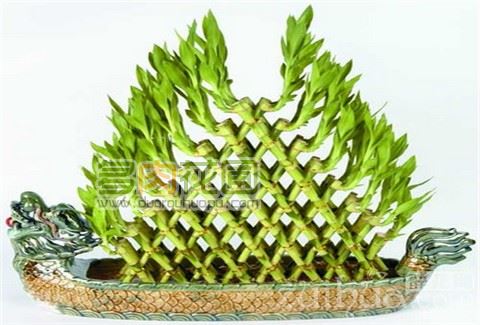
1. Precautions for controlling the top and side buds of lucky bamboo
The branches and leaves of lucky bamboo tend to grow wildly without limit; if not handled, this will affect the ornamental effect. Methods to inhibit excessive growth of branches and leaves include:
Control watering.
Keep it in a low-temperature environment below 18°C, and change the water frequently to prevent the roots from rotting.
Pinching.
When the top bud of each stem section grows to 1 cm, remove the tip: use your left hand to hold the bamboo tower steady, and with the thumb and index finger of your right hand carefully pinch the two small leaves at the tip and pull outward with force to remove the central leaf; be careful not to damage the other small leaves.
2. Precautions for shaping lucky bamboo
Lucky bamboo has an auspicious meaning; whether given as a gift or enjoyed yourself, it is an aesthetic pleasure, and it can also be shaped according to preference.
Pagoda shape.
Lucky bamboo grows robustly, has strong vitality and strong reproductive capacity, and is easy to manage. Based on these characteristics, large numbers of new bamboo are propagated and many stem sections of different lengths are cut to form a pagoda. The upper end of each stem section must have a shoot, and the bud eyes must be retained so that the top of each layer of the pagoda can sprout and grow branches and leaves, forming a new living pagoda.
Bottle-style bonsai.
Cut about 20 cm from the tail end of lucky bamboo stems and insert them into a vase or hanging bottle, then add water to a depth of 5 cm and change the water once every few days. Usually it can be placed on a cool, ventilated table indoors, and it can keep its leaves emerald green for a long time, with a distinctive charm.
Green pillar.
Place two pots of lucky bamboo on both sides of a hall screen. If they are not moved or pruned for a long time and are allowed to grow freely, they can rise straight up and grow taller than 1 m, forming green pillars..
Jungle-style bonsai.
After the new bamboo grows, old, weak and crowded bamboo can be cut away, and appropriate pruning and shaping can be done to create a jungle style; after the shape is set, peel off the dead lower stalks and old leaves of the bamboo stems, revealing the green, bright and glossy bamboo nodes, which set each other off with rocks and improve the ornamental effect.
That is all the content I have learned about lucky bamboo today. I hope flower lovers will find it helpful after reading this article. If you want to learn more about lucky bamboo, please continue to follow Duorou Huapu, and we will provide you with more related knowledge!
Shaping and care of lucky bamboo are extremely important
Today lucky bamboo has become a highly sought-after ornamental plant. Some people give it as a gift because it represents good fortune and wealth. Therefore, the shaping and care of lucky bamboo have become extremely important. Its shape design, top and side bud control and scientific care techniques are briefly described below.
I. Shaping.
(1) Pagoda type. Lucky bamboo grows robustly, has strong vitality and strong reproductive capacity, and is easy to manage. Based on these characteristics, large numbers of new bamboo are propagated and many stem sections of different lengths are cut to form a pagoda. The upper end of each stem section must have a shoot, and the bud eyes are retained so that the top of each layer of the pagoda can sprout and grow branches and leaves, forming a new living pagoda. For a four-layer pagoda, the first layer uses 36 stem sections, each with 3 nodes and 7 cm long; the second layer uses 23 sections, each with 4 nodes and 10 cm long; the third layer uses 18 sections, each with 5 nodes and 13 cm long; the fourth layer uses 11 sections, each with 6 nodes and 16 cm long. The nodes used to make the pagoda must be assembled immediately to avoid excessive water loss and failure to survive. When assembling, first take a 16 cm long stem section and a plastic cylinder 2.5 cm in diameter as the center of the pagoda, then arrange the 11 stem sections 16 cm long with their lower ends on the same plane in a circle along the outer edge of the plastic cylinder, and tie them tightly with plastic wire to form the fourth layer of the pagoda; then take 18 stem sections each 13 cm long, arrange them with their lower ends on the same plane along the outer edge of the fourth layer of the pagoda, forming the third layer of the pagoda; take 23 stem sections 10 cm long and arrange them around the outer edge of the third layer to form the second layer of the pagoda; for the bottom layer, use 36 stem sections 7 cm long arranged in a circle around the outer edge of the second layer to become the first layer of the pagoda. After the pagoda is made, in order to improve the ornamental effect, paste gold craft paper on the outside of the binding wire, or twist iron wire into gold bars with gold paper and wrap and tighten it 2-3 turns around the original binding wire to make the pagoda more spectacular; then a multi-layer stone-carved pagoda can be placed on top of the pagoda to form a pagoda on top of a pagoda, making it unusual and spectacular. Use a pink semi-shallow pot, about 6 cm high, with a diameter 2 cm larger than the base of the pagoda. Immerse the bottom of the pagoda in water, and after about 3 weeks each section can root and grow leaves. Green leaves and a red pot make it delightful to the eye.
(2) Green pillar. Place two pots of lucky bamboo on both sides of a hall screen. If not moved or pruned for a long time and allowed to grow freely, they can rise straight up and grow taller than 1 m, forming green pillars.
(3) Bottle-style bonsai. Cut about 20 cm from the tail end of lucky bamboo stems and insert them into a vase or hanging bottle, add water to a depth of 5 cm, and change the water once every few days. Usually place it on a cool, ventilated table indoors, and it can keep its leaves emerald green for a long time, with a distinctive charm.
(4) Jungle-style bonsai. After the new bamboo grows, cut away old, weak and crowded bamboo, and prune and shape appropriately to make a jungle style; after the shape is set, peel off the dried lower stalks and old leaves of the bamboo stems, and green, bright and glossy bamboo nodes can be seen, dotted with rocks to improve the ornamental effect.
II. Controlling the top and side buds.After lucky bamboo is made into a pagoda, the branches and leaves often grow wildly without limit, which is very troublesome. If not handled, the pagoda shape will be destroyed and the ornamental effect will be affected. To maintain elegant green leaves, excessive growth must be inhibited. The methods include:
(1) Control watering. Keep it in a low-temperature environment (below 18°C) and change the water frequently to prevent root rot;
(2) Pinching. When the top bud of each stem section grows to 1 cm, remove the tip: use your left hand to hold the bamboo tower steady, and with the thumb and index finger of your right hand carefully pinch the two small leaves at the tip and pull outward with force to remove the central leaf; do not damage the other small leaves;
(3) Chemical control. Water with 25% paclobutrazol at 1200 mg/L once every half month, or spray with 95% daminozide at 3000 mg/L once every half month, or spray with mepiquat chloride at 500-1000 mg/L once a month, or spray with chlormequat at 50-60 mg/L once a month; a growth inhibitor can also be dipped with a syringe needle tip and used to prick the top bud directly.
III. Scientific care.
(1) Fertilizing. Potted lucky bamboo can be planted in a mixture of equal parts leaf mold, vegetable garden soil and river sand, or coconut coir or rice bran and leaf mold plus a small amount of dried chicken manure and pig manure can be used as the growing medium; 3-6 plants per pot is suitable, and repot once every 2-3 years. When changing the soil, apply decomposed peanut bran fertilizer, chicken manure, pig manure or compound fertilizer to make it grow vigorously, and apply a nitrogen, phosphorus and potassium compound fertilizer once every 20-25 days.
(2) Water regulation. In summer, spray water once a day to wash dust off the leaf surface and increase humidity; it usually likes humidity, and during the growing season the soil should be kept moist, and water should often be sprayed on the leaves, but too much water will cause excessive growth and affect the appearance, so generally keep the soil moist.
(3) Light control. Lucky bamboo likes semi-shade and is suitable for growing in bright scattered light. Under strong light, the leaf tips turn yellow and the leaves can be scorched, especially from April to September, when strong direct sunlight, sun exposure or excessive drought should be avoided, otherwise the leaves will scorch and lose their luster. It usually likes appropriate sunlight, and it is generally better to place it on a balcony facing north at the back, with 3-4 hours of light per day, to keep the leaf color vivid.
(4) Heat preservation. Lucky bamboo likes high temperatures and has strong cold resistance. The suitable growth temperature is 20°C-30°C. In the hot and humid summer season, it is very favorable for its growth, and the overwintering temperature should be above 8°C.
After reading this, don't you think that shape design, top and side bud control and scientific care techniques are extremely important for growing lucky bamboo? Therefore, those who grow lucky bamboo themselves, or sell lucky bamboo, can refer to the above knowledge to shape and care for lucky bamboo. More agricultural technical knowledge is available at Huinong Xuetang, and everyone is welcome to follow every day to learn more agricultural technical knowledge.