What key points must be mastered for growing lucky bamboo in water?
Lucky bamboo, also known as wan shou zhu, has tall, slender, gracefully upright stems, fresh and green, with lance-shaped green leaves that spread out freely and an extremely elegant appearance. Its stems and leaves closely resemble emerald bamboo, staying green through winter and summer. If potted to decorate a hall or study, its green shadows sway, full of fresh vitality, bringing a feeling of wealth and good fortune. If grown in water in a transparent glass bottle (or box), with old and new roots alternating yellow and white in the clear water and green shadows rippling, it has a special charm as a water-grown plant and displays vigorous vitality, which is why it is so well loved.
Therefore, in recent years, more and more people have been growing it. Lucky bamboo likes a warm, humid and relatively shaded environment, prefers scattered light, and dislikes exposure to blazing sun; it is suited to loose, fertile soil. Lucky bamboo can be grown in pots or in bottles in water. To grow lucky bamboo in a bottle of water, the following key points must be mastered:
(1) Before placing in the bottle, cut off the leaves at the base of the cutting and cut the base into a slanted opening with a sharp knife; the cut should be smooth to help absorb water and nutrients. Change the clear water once every 3-4 days; do not move the position or change the direction within 1 day; after about 15 days, silvery-white fibrous roots will grow.
(2) After rooting, it is best not to change the water; when the water evaporates and decreases, simply add water in time. Frequent water changes easily cause yellow leaves and withered branches.
(3) After rooting, apply a small amount of compound fertilizer in time, and the stems will grow thick and strong and the leaves will be glossy green. If no fertilizer is applied for a long time, the plant will grow weak and thin and the leaves will turn yellow. But fertilizer must not be applied too much, to avoid burning the roots or causing leggy growth. In spring and autumn, apply compound fertilizer once a month. To prevent leggy growth in water-grown lucky bamboo, do not apply chemical fertilizer; it is best to add a few drops of brandy into the bottle about every 3 weeks, plus a small amount of nutrient solution, and the leaves will stay emerald green.
(4) Do not place lucky bamboo next to a television or in places where air conditioners or electric fans often blow, to avoid drying out the leaf tips and leaf edges.
What technical key points must be mastered for growing lucky bamboo in a bottle of water?
(1) Before placing in the bottle, cut off the leaves at the base of the cutting and cut the base into a slanted opening with a sharp knife; the cut should be smooth to help absorb water and nutrients. Change the clear water once every 3 days to 4 days; do not move the position or change the direction within 10 days; after about 15 days, silvery-white fibrous roots will grow.
(2) After rooting, it is best not to change the water; when the water decreases, simply add water in time. Frequent water changes easily cause yellow leaves and withered branches.
(3) After rooting, apply a small amount of compound fertilizer in time, and the stems will grow thick and strong and the leaves will be glossy green. If no fertilizer is applied for a long time, the plant will grow weak and thin, the leaves will turn yellow, and the ornamental effect will be affected. But fertilizer must not be applied too much, to avoid "burning the roots" or causing leggy growth. In spring and autumn, apply compound fertilizer once a month.
(4) Do not place lucky bamboo next to a television or in places where air conditioners or electric fans often blow, to avoid drying out the leaf tips or leaf edges.
Key points for growing lucky bamboo in water
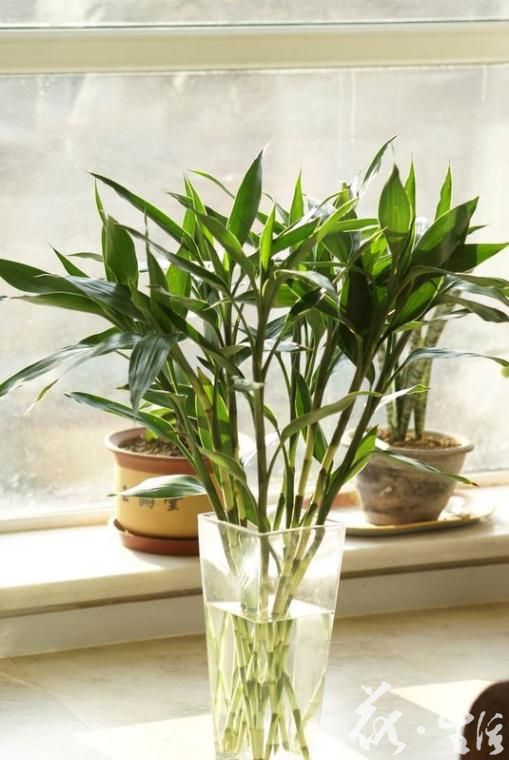
Lucky bamboo, also known as wan shou zhu, has tall, slender, gracefully upright stems, fresh and green, with lance-shaped green leaves that spread out freely and an extremely elegant appearance. Its stems and leaves closely resemble emerald bamboo, staying green through winter and summer. If potted to decorate a hall or study, its green shadows sway, fresh and harmonious, bringing a feeling of good fortune. If grown in water in a transparent glass bottle (or box), with old and new roots alternating yellow and white in the clear water and green shadows rippling, it displays vigorous vitality, which is why it is so well loved.
Therefore, in recent years, more and more people have been growing it. Lucky bamboo likes a warm, humid and relatively shaded environment, prefers scattered light, and dislikes exposure to blazing sun; it is suited to loose, fertile soil. Lucky bamboo can be grown in pots or in bottles in water. To grow lucky bamboo in a bottle of water, the following key points must be mastered:
1. Before placing in the bottle, cut off the leaves at the base of the cutting and cut the base into a slanted opening with a sharp knife; the cut should be smooth to help absorb water and nutrients. Every 3-4
days, change the clear water once; do not move the position or change the direction within 1 day; after about 15 days, silvery-white fibrous roots will grow.
2. After rooting, it is best not to change the water; when the water evaporates and decreases, simply add water in time. Frequent water changes easily cause yellow leaves and withered branches.
3. After rooting, apply a small amount of nutrient solution in time, and the stems will grow thick and strong and the leaves will be glossy green. If no fertilizer is applied for a long time, the plant will grow weak and thin and the leaves will
turn yellow. But fertilizer must not be applied too much, to avoid burning the roots or causing leggy growth. In spring and autumn, apply nutrient solution once a month. To grow lucky bamboo in water,
to prevent leggy growth, do not apply chemical fertilizer; it is best to add a few drops of brandy into the bottle about every 3 weeks, plus a small amount of nutrient solution, and the leaves will stay emerald green.
4. Do not place lucky bamboo next to a television or in places where air conditioners or electric fans often blow, to avoid drying out the leaf tips and leaf edges.
Latest information
Teach you how to make a pastoral flower basket
Steps for growing herbs at home
Fugui Taishan -- ornamental stone
Landscape bonsai -- mountain dwelling