What are the key steps for growing lucky bamboo in water?
If lucky bamboo is not managed well, it is prone to physiological problems such as faded leaves, loss of gloss and root rot. Lucky bamboo likes scattered light and fears direct strong light. If it is placed in the scorching sun during care, the leaves will at best fade, become dull and lack gloss, and at worst be scorched or turn withered and burnt. If it is grown indoors in too dark a place for a long time, the plant is likely to become leggy, and it will also lack gloss, the leaf color will fade, the markings will disappear, and the ornamental effect will be greatly reduced. Therefore, in everyday care it is best to place it near an east- or north-facing window with bright scattered light, so that the light is both bright and not direct, which is more favorable for its growth.
In water culture, besides controlling light and fertilization, mastering the temperature conditions well is also key to growing lucky bamboo successfully. Lucky bamboo likes warmth and fears cold. If it is exposed to cold wind in winter, its leaves will turn yellow from the cold. If, after cold damage, the stem is still green, it shows that there is still vitality, and when the temperature rises and turns warm again the following year, it can still sprout new leaves again. At this time, it is best to cut off the stem and insert it into a bottle again for water culture.
Lucky bamboo sometimes shows soft, drooping and shrunken leaves, and this phenomenon is mostly caused by transplanting. For example, the roots of lucky bamboo grown in water are delicate and slender; if it is transferred from water culture to soil culture and watering is not sufficient at this time, the above phenomenon will appear. Therefore, be careful to water thoroughly, especially in the early stage of planting, to promote good root development.
The most suitable time for growing lucky bamboo in a bottle of water is from April to September each year, that is, from late spring to late autumn, because the temperature is suitable during this period and it is easiest for it to root and survive. At other times, if the temperature is above 15°C, it can also root, but it takes longer.
How to grow lucky bamboo in water: what to do if the leaves of water-grown lucky bamboo turn yellow
Lucky bamboo is native to the Canary Islands and the tropical regions of Africa and Asia, and is now widely introduced and cultivated in China. It likes a high-temperature and high-humidity environment, has no strict requirements for light, and likes light but can also tolerate shade. It is suitable for growing in well-drained sandy loam. The optimum temperature for growth is 20-30°C, and the wintering temperature is 10°C. Lucky bamboo, originally called Pleomele, also known as bamboo lily and evergreen bamboo. It belongs to the family Ruscaceae, genus Dracaena. It is native to Cameroon in western Africa. It is a perennial evergreen herb, and the plant height can reach more than 1.5-2.5 m; if grown as a commercial ornamental, a cultivation height of 80-100 cm is appropriate. It is mostly cultivated in gardens, likes shade and moisture, and has thick stems and leaves. Its varieties include green leaf, green leaf with white edge (called silver edge), green leaf with yellow edge (called golden edge), and green leaf with silver center (called silver center). It is mainly used as a potted ornamental plant and has high ornamental value, and symbolizes "great good fortune and great prosperity". It was introduced into China in large quantities for ornamental use in the late 1970s, and is now a common ornamental plant in China and is also quite popular on the international market. The editor of Yiqiwang below will introduce it to everyone.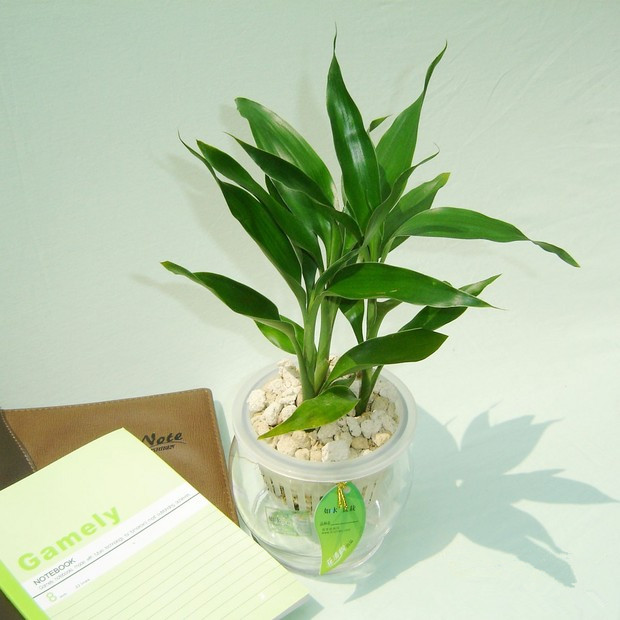
How to grow lucky bamboo in water: what to do if the leaves of water-grown lucky bamboo turn yellow
For growing lucky bamboo in a bottle of water, the following key points should be mastered:
1. Before placing it in, cut off the leaves at the base of the cutting, and cut the base into a slanted opening with a sharp knife; the cut should be smooth to facilitate the absorption of water and nutrients. Change the clean water once every 3-4 days, and do not move the position or change the direction within 10 days. After about 15 days, silvery-white fibrous roots can grow.
2. After rooting, it is not suitable to change the water; only after the water evaporates and decreases should water be added in time. Frequent water changes easily cause yellow leaves and withered branches.
3. After rooting, apply a small amount of compound fertilizer in time, and the leaves will be glossy green and the branches and stems sturdy. If no fertilizer is applied for a long time, the plant will grow thin and weak, and the leaf color will easily turn yellow. But do not fertilize too much, so as to avoid "burning the roots" or causing leggy growth. In spring and autumn, applying compound fertilizer once a month is enough. According to reference materials, to prevent leggy growth in water-grown lucky bamboo, do not apply chemical fertilizer; it is best to inject a few drops of brandy into the bottle about every 3 weeks and add a small amount of nutrient solution, which can keep the leaves emerald green.
4. Do not place lucky bamboo next to a television or in places often reached by air conditioners or electric fans, so as to avoid dry and withered leaf tips and leaf edges.
If leaf yellowing occurs, the cause can be sought from the following two aspects:
First, check the water quality, mainly to see whether the roots are fresh. If the roots rot due to water quality, then cooled boiled water should be used instead.
Second, check the light conditions of the placement site. If the light is too dark, stuffy, unventilated, or the air is dry, all of these can cause leaf yellowing; but if the light at the placement site is too strong, it can likewise cause leaf yellowing and loss of spirit.
What should be done about lucky bamboo whose leaves have turned yellow? If it is caused by light, first cut off the yellow leaves, and also cut off the rotten roots, then create for it a clean, suitably warm, cool, moist environment with fairly good scattered light. If root rot is caused by unclean water quality, first cut off the yellow leaves. When the symptoms are not serious, it is best to change the water frequently and place it in a ventilated position with fairly sufficient sunlight for restorative care; when the symptoms are serious, pesticides should be sprayed appropriately or a small amount of fungicide added to the water dish.
It is an evergreen woody plant. It likes a high-temperature and high-humidity environment, and is also shade-tolerant and waterlogging-tolerant, with a certain cold resistance. When the winter temperature is below 10°C, the leaves will turn yellow and fall off.
How to grow lucky bamboo in water?
Lucky bamboo likes moisture and is suitable for household water culture. Water-grown lucky bamboo is convenient and hygienic, simple and easy to do. First, choose a sturdy cutting free of pests and diseases; the cutting should be cut with a slanted opening to expand the water-absorbing area and also help the absorption of nutrients.
After insertion, it can root in about 7-10 days, and the new roots are white and beautiful and can be enjoyed as an ornamental feature. Second, do not change the water of water-grown lucky bamboo; changing the water will make the leaves turn yellow and the branches wilt. When the water decreases, add water frequently to replenish oxygen. Before water-grown lucky bamboo has rooted, the clean water can be changed once every 3 days, and after rooting it is no longer suitable to change the water.
Third, after lucky bamboo has rooted, it needs more nutrients, so nutrient solution should often be added to the water. In this way, the leaf color can be kept vivid and glossy, the branches and stems sturdy, and the ornamental effect enhanced. Finally, clean the leaf surface frequently to prevent dust accumulation and promote photosynthesis.