How to grow lucky bamboo? A detailed guide to cultivation methods and techniques
Lucky bamboo was originally grown as cut foliage, used as an accompaniment in flower arrangements. Nowadays it is becoming more and more popular as a potted plant and in water culture, and because its name is very auspicious, it sells well on the market. Lucky bamboo stays evergreen all year round, its stems and leaves closely resemble emerald bamboo, elegant and upright, refined and unworldly; as a small potted plant it is suitable for placing in a study, living room and other such places, adding a touch of elegance and vitality to the room, and it is very popular. In recent years a style has become popular on the market in which the trimmed stem nodes are combined to make a cone-shaped tower known as "fortune bamboo", available in many sizes and specifications and matched with high-end blue-and-white porcelain water basins; it can meet the needs of different environments and settings, is very popular, has greatly raised the utilization rate of lucky bamboo, has become an influential form of water culture, and is exported in large quantities to Europe.
Lucky bamboo is a bud-sport variety of golden-edged lucky bamboo; golden-edged lucky bamboo is named for the pale yellow golden edge bordering its leaf margins. In its place of origin in western Africa it grows up to 2 m tall, upright and unbranched. As a potted plant it is usually about 40 cm tall. It likes a warm, humid environment, enjoys light but also tolerates shade, fears scorching sun, and is not cold-hardy; its wintering temperature must be kept above 10°C, and it is not demanding about soil.
Lucky bamboo is mainly propagated by cuttings, and as long as the temperature is suitable it can be cuttings all year round. When taking cuttings, use 2 to 3 nodes, 10 to 15 cm long, as one section. Remove the lower leaves or all the leaves, insert into sand or vermiculite, and in summer it will root and sprout in about 7 days. Place the cuttings in a cup of water, add water to a depth of 5 cm, change the water 1 to 2 times a week, and it also roots very easily, with the new shoots that sprout showing vigorous vitality.
Lucky bamboo is not complicated to manage as a potted plant; plastic pots, purple clay pots and other containers are all fine, and small, finely made ones are preferable. For the potting soil, mix 2 parts garden soil with 3 parts sawdust or peat, or use whatever convenient substrate you have on hand, as long as it is loose and drains and breathes well. After the cuttings have taken, pot them up to settle them in (you can also insert the cuttings directly into the pot, 3 to 5 stems per pot, of differing lengths, so that the new shoots that sprout are staggered and more ornamental). Lucky bamboo adapts to a wide range of light and grows well both in direct outdoor sunlight and in bright indirect light indoors.
However, if golden-edged lucky bamboo gets no direct sunlight for a long time, the colour of the golden edge will fade. But in summer, long hours in the sun will, because the light is too strong, cause the leaves to lose their gloss, and in severe cases the leaf tips will scorch. Lucky bamboo is fairly drought-tolerant and also tolerant of wet conditions; especially when placed indoors, on a desk and other places without direct sunlight, its water consumption is not great, and even in summer it only needs watering about once a week. In other seasons, depending on the ambient temperature and ventilation conditions, as long as the soil is not extremely dry there will be no obvious adverse effects, and this is precisely its valuable trait. To keep the plant's shape fairly perfect and prevent overly vigorous growth, under normal circumstances no fertilizing is needed; if you want the plant to grow taller, apply a nitrogen fertilizer or well-rotted organic fertilizer 1 to 2 times a month. If the plant grows too large or crowded, you can prune and cut it back at any time as you wish, and after pruning it will quickly grow new shoots.
How to grow lucky bamboo: lucky bamboo cultivation methods
Lucky bamboo symbolizes prosperity in wealth and the good omen of rolling riches, so many people keep a pot of lucky bamboo at home or in the office. So how should lucky bamboo be grown? Come with the editor and take a look at the methods and techniques for growing lucky bamboo.
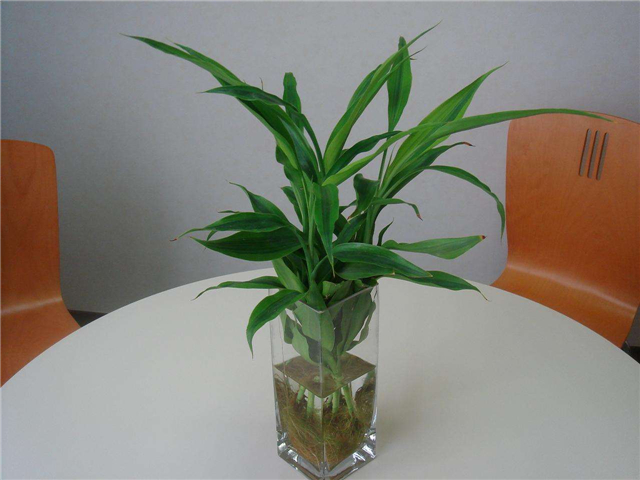
How to grow lucky bamboo - water-grown lucky bamboo
1. When growing in water, be careful to cut the base at an angle, and the cut must be smooth, to encourage rooting.
2. Add water until the bottle is one third full; if it is tap water, let it stand for a day before use, and place it in a bright, well-ventilated spot indoors.
3. Change the water about once every few days; you can put a few small pieces of charcoal into the bottle; do not turn the bottle within 10 days, and it will root in about half a month.
Once rooted, add water rather than changing it
Lucky bamboo that has just rooted is best not moved to fresh water; top up the water promptly, and if the water added is tap water let it stand for a day before use. To switch from soil culture to water culture, simply wash the roots clean and insert them in the bottle for normal care.
Add nutrient solution and change the water
1. Plain clear water alone will not grow lucky bamboo well; an appropriate amount of nutrient solution must be added. The dosage is roughly 5 to 10 drops of nutrient solution per 500 ml of water, about once a month.
2. After adding nutrient solution, change the water about every 10 days in winter, spring and autumn, and about every 5 days in summer, so that lucky bamboo can grow fast. Each time you change the water, wash the roots clean and cut off any rotted parts.
Do not expose it to blowing air
Do not place lucky bamboo where it can be hit by the air from an air conditioner or an electric fan, and do not place it on top of a television, to prevent the leaves from being blown yellow and dry.
How to grow lucky bamboo - soil-grown lucky bamboo
1. Order of suitability of pot choice: earthenware pot > purple clay pot > plastic pot
2. Potting soil: fertile, loose sandy soil is best; specifically, it can be mixed in a ratio of 1:4:5 of sand, vegetable garden soil and leaf mould, and it is even better to add a few crushed eggshells.
3. Changing soil and repotting: change once every year in spring; each time you change the soil you can put a layer of crushed foam pieces at the bottom, which increases the air permeability of the potting soil and also prevents root rot.
Potting up
1. Cut from the base into 20 cm lengths; the part that goes into the soil must have no leaves, so cut them all off, and apply plant ash or sulfur powder to the cut. Insert directly into the potting soil, place in a cool spot, and spray with water often.
2. Once new leaves grow, place it in a spot with indirect light.
Key points on light and temperature
1. Temperature: below 5°C in winter it must be brought indoors; the optimal growing temperature is 18°C-25°C.
2. Light: indirect light is enough; with insufficient light the leaves will lose their gloss.
Key points on water and fertilizer
1. The growing period is from April to October; water when the potting soil is dry, roughly once every 3-5 days, and water less in winter. Mist the leaves often.
2. Apply a small amount of nitrogen-phosphorus-potassium fertilizer every half a month to 20 days.
How to grow lucky bamboo in water: what to do when water-grown lucky bamboo leaves turn yellow
Lucky bamboo originates from the Canary Islands and the tropical regions of Africa and Asia, and is now widely introduced and cultivated in China. It likes high-temperature, high-humidity environments, is not strict about light, enjoys light and also tolerates shade. It is suited to well-drained sandy loam. The suitable growing temperature is 20-30°C, and the wintering temperature is 10°C. Lucky bamboo, originally called Sander's dracaena, is also known as bamboo dracaena and ten-thousand-year bamboo. It belongs to the family Ruscaceae, genus Dracaena. It originates from Cameroon in western Africa. It is a perennial evergreen herb whose plant height can reach 1.5-2.5 m or more; for commercial ornamental purposes, a cultivated height of 80-100 cm is appropriate, and it is mostly cultivated in garden nurseries. It likes shade and moisture, and its stems and leaves are thick and fleshy. Its varieties include green leaf, green leaf with white edge (called silver edge), green leaf with yellow edge (called golden edge), and green leaf with silver centre (called silver centre). It is mainly used as a potted ornamental plant, has high ornamental value, and symbolizes "great luck and great prosperity". It was introduced into China in large quantities as an ornamental in the late 1970s, and is now a common ornamental plant in China and also quite popular on the international market. Below, the editor of Yiqiwang introduces it to everyone.How to grow lucky bamboo in water: what to do when water-grown lucky bamboo leaves turn yellow
For growing lucky bamboo in a bottle of water, the following key points should be mastered:
1. Before placing it in, cut off the leaves at the base of the cutting and cut the base into a slanted opening with a sharp knife; the cut must be smooth, to facilitate the absorption of water and nutrients. Change the clear water once every 3-4 days, and do not move its position or change its direction within 10 days; in about 15 days silver-white fibrous roots will grow.
2. After rooting, it is best not to change the water; only top up the water promptly once it has evaporated and decreased. Frequent water changes easily cause yellow leaves and withered branches.
3. After rooting, promptly apply a small amount of compound chemical fertilizer, and the leaves will be glossy green and the stems stout. If no fertilizer is applied for a long time, the plant grows thin and weak and the leaf colour easily turns yellow. But fertilizer must not be applied in excess, lest it "burn the roots" or cause leggy growth. In spring and autumn, applying compound chemical fertilizer once a month is enough. According to reference materials, to prevent leggy growth in water-grown lucky bamboo, do not apply chemical fertilizer; it is best to inject a few drops of brandy into the bottle about every 3 weeks and add a small amount of nutrient solution, which will keep the leaves emerald green.
4. Do not place lucky bamboo beside a television or in places where an air conditioner or electric fan often blows, to avoid the leaf tips and leaf margins drying up.
If yellowing of the leaves occurs, the cause can be sought from the following two aspects:
First, check the water quality, mainly to see whether the roots are fresh; if the roots have rotted because of water quality, switch to cooled boiled water.
Second, check the lighting conditions of the placement site; if the light is too dim, the place is stuffy and unventilated, the air is dry, and so on, all can cause the leaves to turn yellow; but if the placement site has too strong light, this will likewise cause the leaves to turn yellow and lose their spirit.
So what should be done about lucky bamboo whose leaves have turned yellow? If it is caused by lighting, first cut off the yellow leaves and also cut off any rotted roots, then create for it a clean, suitably warm, cool, humid environment with fairly good indirect light. If the root rot is caused by unclean water, first cut off the yellow leaves; when the symptoms are not serious, it is best to change the water often and place it in a ventilated position with fairly abundant sunlight for restorative care; when the symptoms are serious, an appropriate pesticide should be sprayed or a small amount of fungicide added to the water dish.
It is an evergreen woody plant that likes high-temperature, high-humidity environments, and also tolerates shade and waterlogging; it has a certain cold resistance, and when the winter temperature is below 10°C, the leaves will turn yellow and drop.