Rubber Plant Cutting Propagation Methods and Steps
Rubber plants can only survive cutting propagation in a high-temperature environment, and the soil temperature should be kept constant and stable. The survival rate is highest when cuttings are taken from late May to mid-June. Young tender shoots tend to rot after cutting, while old branches are slow to form callus tissue and difficult to root. On the large side branches of perennial old plants, small shoots often sprout from dormant buds. They grow slowly, have short internodes and carry terminal buds, and their tissue is relatively firm. Cutting them off from the base where they cling tightly to the cortex of the mother branch and rooting them directly gives a high survival rate, and because they carry terminal buds, they also take shape relatively quickly.
When pruning a rubber plant, many long branches are cut off every year, and they can be used for cuttings. First cut off the tender tip at the end of the long branch, then cut it into sections of 3 nodes each, and immediately seal the cut with plant ash to prevent the milky sap from flowing out. At the same time, remove the lower leaves and keep one leaf at the tip, either rolling it into a tube and tying it with fine string, or cutting off 1/2 of it. Insert it 3-4 cm deep into the soil; too deep and it easily rots. Because it is inserted shallowly and the remaining leaf is rather heavy, the cutting tends to fall over, so it is best to insert a reed stem to tie and support it.
How to Take Rubber Plant Cuttings: Rubber Plant Cutting Propagation Tips
The low survival rate of rubber plant cutting propagation gives many friends a real headache, so how do you propagate a rubber plant? Next, Xiao Qi will talk about the propagation methods and cutting propagation tips for rubber plants, so everyone can improve their success rate with rubber plant cutting propagation.
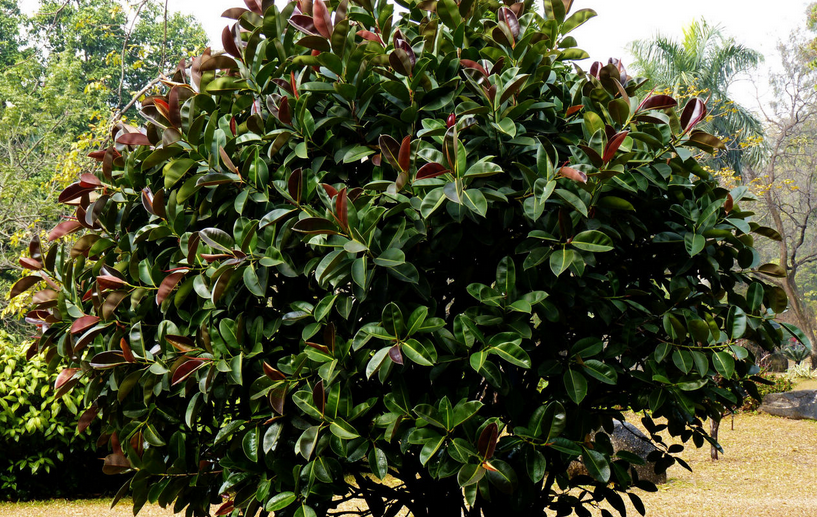
I. Propagation Methods for Rubber Plants
Rubber plants are generally propagated by cuttings and layering. For cuttings during the spring and summer growing season, it is best to choose healthy two-year-old branches from the middle and upper parts of the plant as cuttings. For autumn cuttings, choose woody branches of the current year as cuttings. As long as the bed temperature can be kept above 15°C during cutting, there is no restriction on when to take cuttings. In addition to cutting in a propagation bed, water cuttings can also be done. In April to May, take a 15 cm long branch of the current year, remove the lower leaves, wait for the cut to dry, then insert it into a glass bottle filled with water, place it in diffused light, change the water once a week, and roots can form after about 1 month.
II. Rubber Plant Cutting Propagation Tips
1. Cutting time:Choose summer for the cutting time, when the air humidity is also relatively high. Generally, late June to late July is suitable, and the cuttings root easily.
2. Selection of cuttings:The quality of the cuttings directly affects the survival rate of cutting propagation, so the cuttings to be used must be strictly selected. Generally, choose thick and strong branches from the previous year whose surface is not yet fully lignified as cuttings. This kind of branch has fairly sufficient nutrients, so it roots easily and also has strong disease resistance. Conversely, if you choose branches that are already lignified, they are not easy to root and very hard to keep alive, while choosing branches that are too tender makes them prone to rotting.
3. Preparatory work before cutting:One alcohol lamp (or a cup of boiling water), several sterilized canning jars (boiling them in water is enough), and one cutting bed, which can be replaced by a wooden box (the length of the wooden box depends on the number of cuttings, and a depth of 15 cm is enough). Evenly drill small holes in the bottom of the wooden box with a woodworking drill so water can drain through, spread a 5 cm thick layer of coarse river sand (just rinse it clean with water) evenly, then spread a 10 cm thick layer of fine river sand on top of the coarse sand (also rinse it clean with water), water it thoroughly with a watering can, and use plastic sheeting, wire or wood strips to make a cover whose height is 35-40 cm and whose length is just slightly larger than the wooden box used as the cutting bed.
4. How to perform the cutting:
a. Quickly cut the selected strong branches into 12-15 cm sections and quickly hold the cut ends over an alcohol lamp to singe them (or dip them in boiling water). Singeing (dipping) time: just until the white sap of the rubber plant no longer continues to flow out (Note: this is the key to whether the cuttings survive. The purpose of singeing or dipping the cut ends is twofold: first, after the cut ends are singed or dipped, the sap can no longer continue to flow out, thereby ensuring that the cuttings have sufficient nutrients and water inside to sustain them; second, it prevents bacteria in the sand of the cutting bed or in the air from infecting the wound and causing rot.)
b. Remove the excess leaves, keeping only two leaves. Put them into a canning jar, fill it with clean water (the water should have been left in the sun for 2-3 days in advance), and place it in a spot with plenty of sunlight. Spray clean water on the leaf surface 2-3 times a day to lower the temperature, and change the water in the jar once every 2-4 days. In weather with relatively high temperatures and plenty of sunlight, the cuttings can grow white roots in 8-10 days.
c. When the roots have grown to 3-5 mm long, they can be planted into a wooden box filled with river sand, planted at a depth of 7-9 cm, and inserted upright. After watering thoroughly, cover with a plastic cover and spray clean water once each morning and evening.
d. After 10-15 days, the cuttings can be transplanted into flower pots filled with plain soil and placed in a shady spot. After half a month they will have established roots; remove the excess axillary buds, keeping only two, and water with a little diluted fertilizer solution, gradually moving them from the shady spot into full light.
The above is an introduction to rubber plant propagation methods and cutting propagation tips. If you want to improverubber plant cuttingspropagation success rate, be sure to read carefully.
Rubber Plant Propagation: Rubber Plant Cutting (Stem Cutting) Methods
Cutting Time for Rubber Plants
Choose summer for rubber plant cuttings, when the air humidity is relatively high. Generally, late June to late July is suitable, and the cuttings root easily.
Selection of Rubber Plant Cuttings
The quality of the cuttings directly affects the survival rate of cutting propagation, so suitable cuttings must be chosen. Generally, choose thick and strong branches from the previous year whose surface is not yet fully lignified as cuttings. This kind of branch has sufficient nutrients, roots easily, and has relatively strong disease resistance. Conversely, if you choose branches that are already lignified, they are very hard to keep alive.
Preparatory Work Before Taking Rubber Plant Cuttings
You need to prepare one alcohol lamp, several sterilized canning jars (boiling them in water is enough), and pot soil, or a wooden box can be used instead (the length of the wooden box depends on the number of cuttings, and a depth of 15 cm is enough).
Before cutting, spread 5 cm of coarse river sand in the container, then spread a layer of 10 cm of fine river sand, and water thoroughly for later use.
Use plastic sheeting and wire to make a cover larger than the container, to keep in moisture after cutting.
Operating Steps for Rubber Plant Cuttings
Cut a healthy rubber plant branch into 12-15 cm pieces, then singe the cut ends over an alcohol lamp (or dip them in boiling water) until the rubber plant no longer exudes white sap.
Cut off the excess leaves on the branch, leaving only 2-3, so as to avoid consuming extra nutrients.
Insert the cutting into water and place it in a spot with plenty of sunlight. Spray water on the leaf surface 2-3 times a day, and change the water once every 2-4 days. In 8-10 days white roots will grow. (Rooting in water can increase the survival rate of cuttings.)
When the water-cultured roots have grown to 3-5 cm, insert the branch into the prepared pot soil at a depth of 7-9 cm, keeping the branch upright. After cutting, cover with a plastic cover to keep in moisture. Spray clean water once each morning and evening.
In about half a month, established roots will grow. Remove the excess buds, water with a little fertilizer solution, and gradually move it from the shady spot into full light. Slowly, new leaves will grow!