How to propagate the rubber plant? A detailed guide to air layering and cutting propagation methods
Air layering, also known as high-pressure layering or aerial layering, is a method of propagation by layering. Besides the rubber plant, flowers such as white michelia (Michelia alba), Aglaia odorata, Chinese rose, rhododendron, camellia, Schefflera octophylla, weeping fig, Cordyline fruticosa and croton can all be propagated by air layering. Although air layering is rather troublesome to carry out and has a low propagation rate, its success rate is high. Moreover, the propagated seedlings are relatively large. Some flower species that are difficult or slow to root from cuttings can also be propagated by air layering. Therefore, air layering is the most suitable flower propagation method for home gardening.
Air layering can be carried out throughout the entire growing season, but it is best done in late spring and early summer, in May to June. The temperature at this time is relatively suitable and the plants grow vigorously, so rooting is easy. Moreover, by late summer more roots can be produced, which benefits the growth and overwintering of the plant after cutting. If done too late, the plant will not yet have rooted, or will have just begun to root, and the temperature will already have dropped, which is unfavorable for the survival of the layer and the growth of the layered plant. For air layering, first select a robust branch that has been growing for more than two years on the mother plant, and make a ring-shaped bark cut below the part to be layered. The width of the ring cut depends on the thickness of the branch, generally 1 to 2 times the diameter of the branch. You can also use the notch method, wire girdling or twig twisting to damage the phloem at that part.
How to grow and propagate Ficus elastica
Ficus elastica
Ficus elastica is a tree of the genus Ficus in the mulberry family, reaching 20-30 m in height, with a trunk diameter at breast height of 25-40 cm; the bark is grayish white and smooth; when young it is epiphytic, and the branchlets are thick. The achene is ovoid, with small tubercles on the surface, a long persistent style, and an enlarged, nearly head-shaped stigma. The flowering period is winter. It is native to Bhutan, Sikkim, Nepal, northeastern India (Assam), Myanmar, Malaysia (northern), and Indonesia (Sumatra, Java). In China, it grows wild in Yunnan (Ruili, Yingjiang, Lianshan, Longchuan) at 800-1500 m.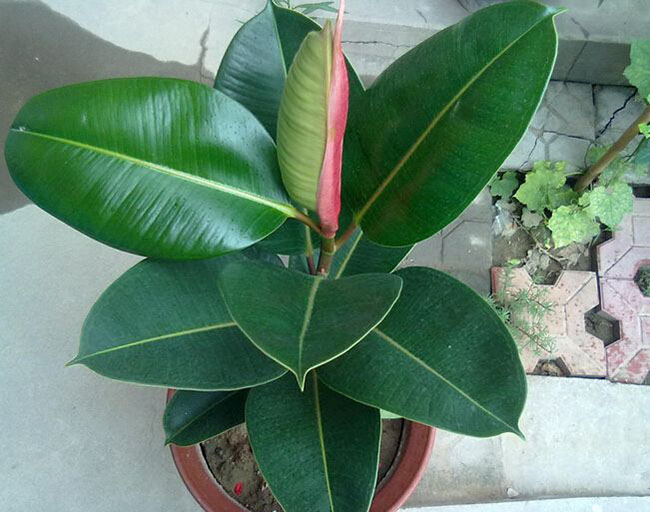
Morphological characteristics of Ficus elastica
Tree, up to 20-30 m tall, trunk diameter at breast height 25-40 cm; bark grayish white, smooth; epiphytic when young, branchlets thick. Leaves thickly leathery, oblong to elliptic, 8-30 cm long, 7-10 cm wide, apex acute, base broadly cuneate, entire, upper surface dark green, glossy, lower surface light green, lateral veins numerous, inconspicuous, parallel; petiole thick, 2-5 cm long; stipules membranous, dark red, up to 10 cm long, leaving obvious ring-shaped scars after falling. Figs borne in pairs in the leaf axils of defoliated branches, ovoid-oblong, 10 mm long, 5-8 mm in diameter, yellow-green, basal bracts hood-shaped, leaving a ring-shaped trace at the base after falling; male flowers, gall flowers and female flowers all borne on the inner wall of the fig; male flowers stalked, scattered on the inner wall, perianth segments 4, ovate, stamen 1, anther ovoid, without filament; gall flowers with perianth segments 4, ovary smooth, ovoid, style nearly terminal, curved; female flowers sessile. Achene ovoid, with small tubercles on the surface, style long, persistent, stigma enlarged, nearly head-shaped. Flowering period winter.
Distribution range of Ficus elastica
Native to Bhutan, Sikkim, Nepal, northeastern India (Assam), Myanmar, Malaysia (northern), and Indonesia (Sumatra, Java). In China, it grows wild in Yunnan (Ruili, Yingjiang, Lianshan, Longchuan) at 800-1500 m.
Growing environment of Ficus elastica
It likes a high-temperature, humid, sunny environment, and can tolerate shade but not cold. The suitable growing temperature is 20-25°C, and direct sunlight should be avoided. It can tolerate shade but not cold, and the safe overwintering temperature is 5°C. It tolerates dry air. It dislikes clayey soil and cannot tolerate barren or dry conditions; it likes loose, fertile, well-drained slightly acidic soil.
Propagation methods of Ficus elastica
The main propagation methods for Ficus elastica are cuttings and layering. Cuttings are relatively simple, and the rubber plant's survival rate and growth rate are also relatively high. Generally speaking, rubber plant cuttings are mainly taken in late spring and early summer together with pruning. Choose a robust branch from the middle of the rubber plant as the cutting, keep three buds on the cutting, and let the latex at the cut coagulate, or you can use some charcoal ash and rice-hull ash to absorb it dry, then insert it into a cutting bed with river sand or vermiculite as the substrate, keeping the cutting's growing environment between 18-25°C. After about 30 days, the cutting will root. When the rooted rubber plant cutting has grown 2 leaves, it can be transplanted into a pot.
The survival rate of rubber plant air layering is very high. When layering, it is best to choose a branch that grew in the second year. First make a ring cut 0.5-1 cm wide on the rubber plant branch, then wrap it with moist moss or plastic film and peat soil. While keeping it moist, wait for the rubber plant to root, then cut off the rooted branch and plant it in soil, and it will grow into a new rubber plant.
Choice of growing medium for Ficus elastica
For potting, use peat soil and leaf mold plus 1/4 river sand and a small amount of base fertilizer to make a growing medium; fine sandy soil can also be used. The rubber plant grows quickly and likes fertilizer; apply fertilizer once a week. Usually, repot or change the soil before new shoots grow in spring. When the seedlings are 80 cm to 100 cm tall, pinch them as needed to promote side branches. Generally keep 3 main branches and remove the other excess ones. If cultivated well, in about 3 years it can grow into a large plant 2 m tall.
The rubber plant likes strong sunlight; from spring to autumn, during the entire growing season, it should be grown in full sunlight, and in winter it should also be placed in the brightest spot indoors. If placed indoors for ornamental display, generally change its position about every 2 weeks, and it should not stay too long. The rubber plant grows very fast in high-humidity, moist environments, producing one leaf every 5-7 days. During this period, sufficient fertilizer and water must be ensured. In autumn, gradually reduce fertilizing and watering to encourage the branches to grow firm.
Because the rubber plant has strong resistance to dry environments, cultivation in North China is also relatively easy. It should be placed in a room above 10°C to overwinter; prolonged low temperature and wet potting soil easily cause root rot. From late April to early October each year, move it outdoors for cultivation.
How to grow Ficus elastica
1. Temperature
It likes warmth, and the most suitable growing temperature is 20-25°. It tolerates high temperatures and can grow well even above 30°. It is not cold-tolerant; the safe overwintering temperature is 5°. Variegated varieties are slightly less cold-tolerant, and the overwintering temperature should preferably be maintained above 8°. When the temperature is low, it will shed a large number of leaves.
2. Light
It likes bright indirect light and has a certain ability to tolerate shade. It cannot tolerate intense direct sunlight; when the light is too strong, it will scorch the leaves, causing yellowing and burnt leaf edges. It should also not be placed in too dark a place, otherwise it will cause a large number of leaves to fall and make the beautiful markings of variegated varieties fade. From May to September, shading should be provided, or the plant should be placed in a spot with ample indirect light. At other times, it should be given sufficient sunlight.
3. Watering
It likes a moist soil environment, and during the growing period water should be supplied adequately to keep the potting soil moist. In winter, watering needs to be controlled; when the temperature is low and the potting soil is too wet, root rot is easily caused.
4. Environmental humidity
It likes a humid environment. During the growing season, when the weather is clear and the air is dry, frequently spray water on the branches, leaves and the surrounding environment to increase the relative air humidity.
5. Fertilizing
Because it grows rapidly, nutrients should be supplied in time so that the plant can grow vigorously. Apply a nitrogen-based fertilizer 2-3 times a month as a top dressing. Varieties with colorful markings grow relatively slowly, so the number of fertilizations can be reduced, while increasing the application of phosphorus and potassium fertilizer to make the markings on the leaves bright and colorful. If too much nitrogen fertilizer is applied, or only nitrogen fertilizer is used, the color of the markings will fade or even disappear. In September, nitrogen fertilizer should be stopped, and only phosphorus and potassium fertilizer should be applied to improve the plant's cold resistance. In winter the plant goes dormant, so fertilizing should be stopped.
6. Pruning
In spring, prune together with moving the plant out of the shed, removing forked branches, inward-growing branches, dead branches and thin weak branches inside the crown, and shortening the rampant branches that protrude beyond the crown, so that the interior of the plant has good ventilation and light and the tree shape remains rounded. If the crown is too large, the outer branches can be shortened as a whole. During the growing period, remove overly dense branches at any time and shorten long branches.
7. Repotting
Usually repot once every 2 years. It likes fertile, loose, well-drained sandy loam; the growing medium can be made from garden soil, leaf mold and plain sand, mixed with farmyard manure as a base fertilizer.
8. Pest and disease control
It is harmed by pests and diseases such as leaf spot disease, red spider mites, fig thrips and scale insects.
How to propagate potted rubber plants? An introduction to rubber plant propagation methods
The rubber plant has high ornamental value and is a famous potted foliage plant, extremely suitable for indoor beautification and arrangement. Small and medium-sized plants are often used to beautify living rooms and studies; medium and large plants are suitable for placing on both sides of the entrance halls of large buildings and in the center of lobbies, appearing majestic and spectacular and able to display a tropical flavor. Rubber plants are commonly propagated by two methods: cuttings and air layering.
Propagation by cuttings is relatively simple, extremely easy to root and fast-growing. It is generally done in late spring and early summer together with pruning. Choose a lignified branch from the middle that is one year old as the cutting, keeping three buds on the cutting, cut off the lower leaf, bring the upper two leaves together and tie them with plastic, or cut off half of the upper leaf to reduce water evaporation; to prevent excessive loss of latex from the cut and its effect on survival, promptly smear the wound with plant ash; insert the treated cutting into a cutting bed with river sand or vermiculite as the substrate; after insertion, keep the cutting bed at fairly high humidity and frequently sprinkle water on the ground (but do not let water accumulate) to increase air humidity. At a temperature of 18-25°C and under semi-shaded conditions, it will root in about 2-3 weeks.
Using air layering at home is also fairly convenient, and the success rate is high. When air layering, choose a two-year-old branch, first make a ring cut 1-1.5 cm wide on the branch; then wrap moist moss or peat soil around the wound, finally wrap it tightly with plastic film and tie both the upper and lower ends; after 1-2 months, the rooted branch can be cut off and potted.