How to propagate snake plants? Introduction to several common methods
For propagating snake plants in small quantities, division can be used. Its underground rhizomes are thick and branch strongly, and after the terminal bud on each branch sprouts, it can send up new leaves. When dividing, first take the plant out of the pot, shake off the soil, find the rhizome beneath each cluster of leaves, cut it off with pruning shears, and plant it separately; all will survive. After surviving, the adventitious buds at the rhizome nodes quickly sprout and send up new underground rhizomes, causing the clump to keep expanding, and after 1 year the new leaf clusters can again cover the pot surface.
For golden-edged snake plants (Sansevieria trifasciata 'Laurentii'), only division can ensure that the offspring plants' leaves also have the golden edge characteristic; if leaf cuttings are used, the golden edge of the leaves will disappear. For mass propagation of snake plants, leaf cuttings can be used.
Leaf cuttings are done in spring and summer, with May to June being best. Choose plump, thick leaves as cutting material, cut them into sections 5-6 cm long, and leave them indoors to dry for 2 days. After the cut ends are dry, insert them upright into moist plain sand, burying them 2-3 cm deep, and keep them in a bright indoor spot, maintaining a room temperature above 25°C. After 30 days, new roots first grow from the pith at the cut end, then very short underground rhizomes are sent up along with new leaves. At this time the old leaf section used for the cutting does not wither; after the new leaf cluster has fully grown, cut off the old leaf.
How to propagate snake plants
For propagating snake plants in small quantities, division can be used. Its underground rhizomes are thick and branch strongly, and after the terminal bud on each branch sprouts, it can send up new leaves. When dividing, first take the plant out of the pot, shake off the soil, find the rhizome beneath each cluster of leaves, cut it off with pruning shears, and plant it separately; all will survive. After surviving, the adventitious buds at the rhizome nodes quickly sprout and send up new underground rhizomes, causing the clump to keep expanding, and after 1 year the new leaf clusters can again cover the pot surface. For golden-edged snake plants (Sansevieria trifasciata 'Laurentii'), only division can ensure that the offspring plants' leaves also have the golden edge characteristic; if leaf cuttings are used, the golden edge of the leaves will disappear.
For mass propagation of snake plants, leaf cuttings can be used. Leaf cuttings are done in spring and summer, with May-June being best. Choose plump, thick leaves as cutting material, cut them into sections 5-6 cm long, and leave them indoors to dry for 2 days. After the cut ends are dry, insert them upright into moist plain sand, burying them 2-3 cm deep, and keep them in a bright indoor spot, maintaining a room temperature above 25°C. After 30 days, new roots first grow from the pith at the cut end, then very short underground rhizomes are sent up along with new leaves. At this time the old leaf section used for the cutting does not wither; after the new leaf cluster has fully grown, cut off the old leaf.
How to propagate snake plants, snake plant propagation methods / division has the widest applicability
Snake plants are known for their emerald-green leaves with tiger stripes. Their care and management are mainly low-maintenance, and they are relatively easy to grow, which involves the issue of propagation. When a snake plant has been grown for a certain time, it needs to be propagated anew, so how do you propagate a snake plant? Let's look at the propagation methods for snake plants.
How to propagate snake plants
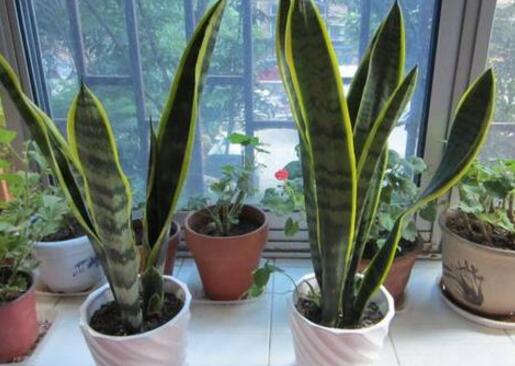
Usually, snake plants have three relatively common propagation methods, namely division, cuttings, and sowing. For most hobbyists growing them in pots, division and cuttings are the most practical, while sowing is actually also very simple. Below we introduce these methods in detail.
I. Snake plant cutting propagation
1. Applicable varieties
Because there are many varieties of snake plants, and many of them have golden-yellow edges or silver veins, with yellow and white markings on them, these varieties are not suitable for cuttings. Although cuttings are the most commonly used of the snake plant propagation methods, because they cause these markings to disappear, they are only suitable for ordinary varieties of snake plants.
2. Cutting method
(1) Select leaves from a healthy plant, cut them into small sections 5-6 cm long, and place them in a cool place to wait for the cut ends to dry naturally.
(2) Put sand and vermiculite as the substrate into a flower pot, insert the dried leaves straight or at an angle into the substrate, with a depth generally of one-half or one-third of the cut section, then water thoroughly.
(3) Keep the soil moist, with the temperature between 15-20°C. Generally, roots will form in one month. It will send out roots from the base and grow into a rhizome, then slowly grow into a new plant, and after it has 2-3 new leaves it can be transplanted.
II. How to divide snake plants
1. Applicable varieties
Because division involves splitting the mother plant and planting the parts separately, it is the snake plant propagation method that has the least impact on plant growth and can be applied to any variety of snake plant. The most suitable propagation time is spring and summer, and it can be done together with repotting in spring.
2. Division method
(1) When using division, how do you propagate a snake plant? First take the mother plant out of the flower pot, use a knife to divide the mother plant into several clusters of offspring plants. During the separation process, try to avoid damaging the roots, and each offspring plant needs to retain more roots.
(2) Apply plant ash to the cut surfaces and then let them dry, after which they can be planted separately in new potting soil. After planting, place them in a cool place and water as little as possible to prevent the cut surfaces of the roots from rotting. Keep the environment moist and wait for new leaves to grow, which indicates that the division was successful.
III. How to sow snake plants
Buy superior snake plant seeds from a professional flower market, then evenly scatter them in fertile soil, water thoroughly, and then keep the temperature at 20-25°C. After waiting for a period of time, young shoots will sprout, and after leaves grow, carry out normal care according to snake plant cultivation methods.