What are the spring propagation methods for snake plants?
Snake plants are mostly propagated by division and by leaf cuttings.
(1) Division: For home growers, division is best done in early spring when repotting. The underground part of a snake plant is a creeping rhizome, and every spring multiple small buds sprout from the nodes of the rhizome, making the plant grow fuller and fuller. For overcrowded plants, take them out of the pot and carefully pull the rhizomes apart, then plant each clump with about 3 to 4 leaves. The potting soil should not be too wet, otherwise the wounds on the rhizomes are prone to infection and rot.
(2) Leaf cuttings: The above-ground part of a snake plant has no obvious stem, so cuttings are mainly leaf cuttings, and the snake plant is a classic subject with a high survival rate from leaf cuttings. Cuttings are best taken in May to June; select healthy leaves from the outer part of the plant, cut them into 5 cm long leaf sections, then let the cuttings dry in indirect light for about 1 hour so the cut ends shrink and heal properly, preventing rot after being inserted into the medium. Finally, insert the cuttings obliquely into a sand bed, taking care that the upper end faces up and the lower end faces down; to avoid confusion, the different cut ends can be used to tell them apart. After inserting, provide appropriate shade and keep moist; roots form after 4 weeks, with a fairly high survival rate. After another 2 to 3 weeks, adventitious buds will grow from the lower cut end, and once the new shoots push 10 cm above the sand surface, they can be planted into small pots.
The golden-edged varieties of the snake plant are not suitable for propagation by leaf cuttings; otherwise the golden edges will disappear and their ornamental value will be reduced. When transplanting seedlings, do not water too much, as high temperature and excessive moisture easily cause rhizome rot. With a little shading in summer, the leaves will be fresh, green and tender, and the plant can become a full potted specimen within the same year.
How to propagate snake plants, snake plant propagation methods / division has the widest applicability
Snake plants are known for their emerald green leaves with tiger-like stripes. Their care and management are mainly low-maintenance, making them relatively easy to grow, and this involves the question of propagation. When a snake plant has been grown for a certain time, it needs to be propagated again, so how do you propagate a snake plant? Let us look at snake plant propagation methods.
How to propagate snake plants
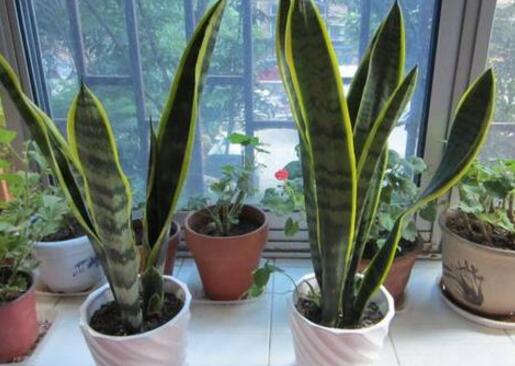
Generally, snake plants have three relatively common propagation methods: division, cuttings and sowing. For most hobbyists growing them in pots, division and cuttings are the most practical, while sowing is actually very simple too. Below we introduce these methods in detail.
I. Snake plant propagation by cuttings
1. Applicable varieties
Because there are many varieties of snake plants, and many of them have golden yellow edges or silvery veins, with yellow or white markings on them, these varieties are not suitable for cuttings. Although cuttings are the most commonly used of the snake plant propagation methods, since they cause these markings to disappear, they are only suitable for ordinary varieties of snake plants.
2. Cutting method
(1) Select leaves from a healthy plant, cut them into small sections 5-6 cm long, and place them in a cool place to wait for the cut ends to dry naturally.
(2) Put sand or vermiculite as the medium into a flower pot, insert the dried leaf sections vertically or obliquely into the medium, generally to a depth of one-half or one-third of the section, and then water thoroughly.
(3) Keep the soil moist, with the temperature between 15-20 degrees; roots usually form in about one month. Roots grow from the base and develop into a rhizome, then slowly grow into a new plant; after 2-3 new leaves appear, it can be transplanted.
II. How to divide snake plants
1. Applicable varieties
Since division means dividing the mother plant and planting the parts separately, it is the snake plant propagation method that has the least impact on plant growth and can be applied to any variety of snake plant. The most suitable propagation time is spring and summer, and it can be done together with repotting in spring.
2. Division method
(1) How do you propagate a snake plant by division? First take the mother plant out of the pot, use a knife to divide the mother plant into several clumps of daughter plants, try to avoid damaging the roots during separation, and each daughter plant needs to retain a relatively large root system.
(2) Apply plant ash to the cut surfaces and then let them dry, after which they can be planted separately in new potting soil. After planting, place them in a cool place and water as little as possible to prevent the cut surfaces of the roots from rotting. Keep the environment moist and wait for new leaves to grow, which indicates that division has succeeded.
III. How to sow snake plants
Buy superior snake plant seeds from a professional flower market, then sow them evenly in fertile soil, water thoroughly, and keep the temperature at 20-25 degrees. After a period of waiting, young shoots will emerge, and once leaves have grown, carry out normal care according to snake plant growing methods.
How to propagate the broad-leaved snake plant
Propagation: Division and cuttings are commonly used. For division, do it in spring, in March-April, when repotting. Pull off the crowded clumps that have grown over the pot edge together with their rhizomes, and after the wounds on the dried stems have dried slightly, pot them directly. For cuttings, usually done in May-June, choose healthy leaves of moderate size as cuttings. Cut them into 7-8 cm lengths and insert them into a sand bed; after insertion, roots form in about 1 month, and when the roots are 2-3 cm long they can be potted.
Cultivation: It likes a warm, dry environment and plenty of sunlight. It is not cold-tolerant, is relatively shade-tolerant but afraid of waterlogging. A fertile, loose, well-drained sandy loam soil is best. In winter the temperature should not be lower than 10 degrees Celsius.
For newly potted seedlings, do not water too much; slightly dry is better. Only after new leaves emerge above the soil surface can the soil be kept slightly moist. During the growing period, fertilize once a month. In summer, during high temperatures and strong light, shade can be provided and more water sprayed on the leaves. In July-August, during the flowering period, watering can be increased somewhat. In winter, move them indoors for care. The broad-leaved snake plant has a relatively large stature and its rhizomes grow irregularly, so each year when potting, prune and adjust the plant shape or renew it in time.
Pests and diseases: Common hazards include gray blight and brown spot, which can be sprayed with 70% thiophanate-methyl wettable powder at 1000 times dilution. Among insect pests, there is damage by weevils, which can be sprayed with 20% fenvalerate at 2500 times dilution.