Methods for controlling stem rot and southern blight in the ZZ plant
How do you care for a ZZ plant? Here's a book for you, "868 Top Flower-Growing Tips," and you'll never worry about failing to grow a ZZ plant again! How to get this book?
lixiayuanyi
↑↑↑↑↑↑ Long-press to copy → open WeChat → tap the "+" in the top right corner → tap Add Contacts → paste and search → when "User does not exist" appears, tap "Search" below → tap the first result and follow → reply "ZZ plant" and you'll get it.
Southern blight
It mostly infects the roots and stems; the diseased parts often appear water-soaked and sometimes exude a yellow liquid. White silky threads grow on the affected parts, sometimes in a radial pattern. Sclerotia the size of rapeseeds form on the hyphae, initially white, later brown, ultimately causing the plant to topple and die. During the rainy season, prevent the substrate from becoming too wet and ensure good ventilation. The substrate should be sterilized before use; sclerotia can be killed at a temperature of 100°C, and the hyphae die very easily when exposed to scorching sun.
When a diseased plant is found, isolate it immediately; if severe, destroy it at once, and clean up diseased plants, diseased leaves, growing substrate and so on to block the source of infection. At the same time, spray the surrounding plants with a fungicide for control; you can use validamycin at 500-700 times dilution and spray the diseased plants directly 2-3 times to clear it completely. Validamycin is currently one of the most effective agents for controlling southern blight. You can also use 15% triadimefon wettable powder mixed with 100-200 parts fine dry soil and spread it around the root and stem of the diseased plant.
Stem rot
It harms the base of the stem; in the early stage the stem base turns brown, the leaves lose their green color, the leaf rachis bends downward, the interior of the stem rots in a spongy manner, and finally the whole plant dies. When a diseased plant is found, burn it immediately, and for other plants, spray 27% copper hydroxide suspension at 600 times dilution or 50% thiophanate-methyl + sulfur suspension at 800 times dilution for control.
What to do when the ZZ plant gets bugs, and pest and disease control for the ZZ plant / 4 diseases, 1 pest
As an excellent foliage plant, the ZZ plant not only has a beautiful appearance but also a unique and auspicious meaning, making it deeply loved by flower enthusiasts. However, if you don't follow the proper ZZ plant care methods, it can also get bugs or diseases, seriously affecting its ornamental value. So what do you do when the ZZ plant gets bugs? Below is a selection of pest and disease control tips for the ZZ plant from the editor; read on!
1. When the ZZ plant gets bugs, spray with pesticide
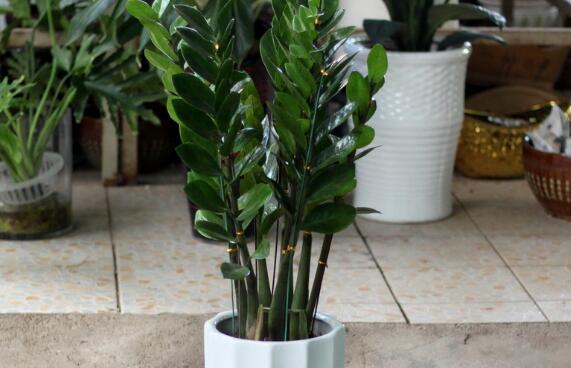
Growing a ZZ plant at home doesn't have to be outdoors; with careful care, it is rarely troubled by pests and diseases. However, in a high-humidity environment, the ZZ plant can also get bugs and diseases. So what do you do then? It's actually very simple: we just need to determine which pest or disease it is, and then spray the appropriate pesticide. The specifics are all in the pest and disease control for the ZZ plant; let's continue reading.
2. Pest and disease control for the ZZ plant, 1 pest and 4 diseases
1. Mealybugs
One of the main pests of the ZZ plant, occurring year-round in greenhouses. It pierces the leaves with its mouthparts and sucks the sap from the ZZ plant's leaves. Symptoms of infestation: the ZZ plant's leaves turn yellow, and in severe cases the plant dies.
Control method: when there are few mealybugs, gently and repeatedly wipe the diseased plant with alcohol to remove them; when there are many pests and you see mealybugs crawling out from under the mother, spray immediately with dichlorvos at 1000-15000 times dilution or 50% malathion emulsion at 1000 times dilution for control.
2. Southern blight
This disease is also called sclerotial root rot and, as the name suggests, harms the root and stem parts of ZZ plant seedlings and young plants. Symptoms: the cortex of the infected root and stem gradually turns brown and necrotic, and in severe cases the cortex rots.
Control method: promptly remove diseased plants; in the early stage of the disease, you can use 25% carboxin wettable powder 50g, add 50kg water, and pour it onto the roots of the diseased plant.
3. Brown spot disease
Another pest and disease problem of the ZZ plant, it mainly harms the leaves. Symptoms: the lower leaves begin to show symptoms, gradually spreading upward; in the early stage they are round or oval and purplish-brown, later turning black; in severe cases the spots can join together, causing the leaves to wither and drop and affecting flowering.
Control method: after finding the above symptoms, immediately spray 50% carbendazim wettable powder at 500 times dilution, or 25% chlorothalonil at 500 times dilution, once every 7-10 days; 2-3 times should be effective.
4. Stem rot
As the name suggests, it is a disease that harms the stem of the ZZ plant. It generally spreads through splashing water, and long periods of retained moisture make it more likely to occur. Symptoms: the stem or stem base of the ZZ plant rots, causing the whole plant to wither and die quickly.
Control method: for controlling ZZ plant stem rot, in the early stage of the disease, spray 27% copper hydroxide suspension at 600 times dilution; when the disease is severe, when drenching the roots or spraying, you can also add some chemical agents, such as 50ml Qingkulike + 15g hymexazol.
5. Late blight
One of the main diseases of the ZZ plant, it mostly occurs in July and August. Symptoms: the leaf tips of the lower part of the ZZ plant begin to show symptoms, initially as dark green water-soaked irregular spots, which turn brown after expanding. Under high humidity, white mold grows at the junction of diseased and healthy tissue on the back of the leaf.
Control method: remove the first diseased leaves early and burn them in a centralized manner to reduce the pathogen. This disease is mainly controlled through prevention; before it occurs, promptly spray 27% copper hydroxide suspension at 600 times dilution; at the peak of the disease, spray 72.2% propamocarb aqueous solution at 600-700 times dilution for control.
How to grow and care for the ZZ plant and points to note
How do you care for a ZZ plant? Here's a book for you, "868 Top Flower-Growing Tips," and you'll never worry about failing to grow a ZZ plant again! How to get this book?
lixiayuanyi
↑↑↑↑↑↑ Long-press to copy → open WeChat → tap the "+" in the top right corner → tap Add Contacts → paste and search → when "User does not exist" appears, tap "Search" below → tap the first result and follow → reply "ZZ plant" and you'll get it.
The ZZ plant is a relatively shade-tolerant foliage plant of the Araceae family, introduced from the Netherlands, and has become a rather popular indoor ornamental plant in recent years. Its leaves are short and round, arranged in strings, resembling strings of coins, hence the name ZZ plant. It has underground tubers, and the plant grows from dormant buds on the tubers; the leaf stalks at the base of the plant swell and thicken.
The ZZ plant gets its name because its thick, fleshy leaves are arranged very neatly, much like copper coins. The ZZ plant is generally 50-80 cm tall, with very large underground tubers 5-8 cm in diameter; the above-ground part has no main stem, and pinnate compound leaves emerge from the top of the tuber. Each leaf rachis has 6-10 pairs of opposite or nearly opposite leaflets; the leaves are ovate, thickly leathery, dark green, with a metallic luster. Below is a detailed introduction to how to grow the ZZ plant:
The ZZ plant's leaves have turned yellow and you don't know what to do? Click here: What to do when the ZZ plant's leaves turn yellow?
1. Soil selection for growing the ZZ plant
6. Pest and disease control for growing the ZZ plant
(1) Scorched leaf tips: common in production, mainly occurring on new leaves; the tips of the leaflets turn yellow first, then scorched yellow, and leaf yellowing may also occur.
(2) Stem rot: you can spray 50% thiophanate-methyl + sulfur suspension at 800 times dilution or 50% chlorothalonil + sulfur suspension at 600 times dilution, once a week for 3-4 consecutive times, for a relatively good control effect.
(3) Brown spot disease: in the early stage of the disease, use 50% carbendazim wettable powder at 500 times dilution, or 0.5%-1.0% Bordeaux mixture, or 40% chlorothalonil at 500 times dilution, spraying once a week for 3-4 consecutive times, for a relatively good control effect.
(4) Southern blight: during the disease season, you can use 50% compound sclerotium-killing wettable powder at 1000 times dilution or 50% chlorothalonil at 500 times dilution.
7. Points to note when growing the ZZ plant
(1) The ZZ plant likes warmth, with a suitable growing temperature of 15-25°C; it is not tolerant of low temperatures, growing slowly below 10°C and stopping growth below 5°C, and may suffer cold damage. The ZZ plant is relatively shade-tolerant and can also grow in darker places, with its leaves giving off a glossy sheen. Generally, in cultivation and production, the ZZ plant requires 90% shading; too much light will cause the leaves to turn yellow. When planting the ZZ plant, too much water easily causes the tuber to rot.
(2) The ZZ plant is 25-50 cm tall and has underground tubers. Pinnate compound leaves emerge from underground; the leaflets are opposite, ovate, with acute tips, entire margins, thickly leathery and glossy. The plant is robust, shade-tolerant and drought-tolerant, suitable for beautifying shaded garden spots or for potting.
(3) The ZZ plant is not very demanding about light and can be kept indoors for a long time for viewing. In summer it should be placed where there is no direct light, otherwise the young tender leaves are very easily scorched.
(4) In winter, the ZZ plant should be moved to a brighter spot indoors; water less, do not fertilize, and maintain the room temperature at around 10°C. In winter, water about once every half a month; in spring and autumn, once a week; in summer, spray once every 3 days.
8. Propagation methods for growing the ZZ plant
The propagation methods for the ZZ plant include division propagation and cutting propagation.
Cutting propagation can be used in spring, summer and autumn. The cutting material can be a single mature, thick leaflet, a single section of leaf rachis, or a section of leaf rachis with 2 leaves; the rachis should be inserted to a depth of 1/3 to 1/2 of its total length. After inserting into the growing medium, water thoroughly. Place in a shaded spot, maintain an ambient temperature of 25-27°C, and according to how dry or moist the medium is, mist the leaf surface 1-2 times a day, keeping the substrate slightly moist.
The ZZ plant's tubers bear dormant buds. When doing division propagation, the tubers can be cut into small pieces each with 2-3 dormant buds. The ZZ plant can also be propagated by leaf cuttings. Insert the leaves into a seedbed; after 10-14 days a very small bulb-like stem can form at the base of the leaf, after which the bulb-like stem continues to swell and dormant buds grow on the tuber; after 2-3 months of culture, small plants can grow. ZZ plant cutting propagation grows relatively slowly and has a low propagation coefficient. For large-scale production, tissue culture can be used for propagation.